The Thyssen Art Macabre
Tuesday, January 16th, 2024
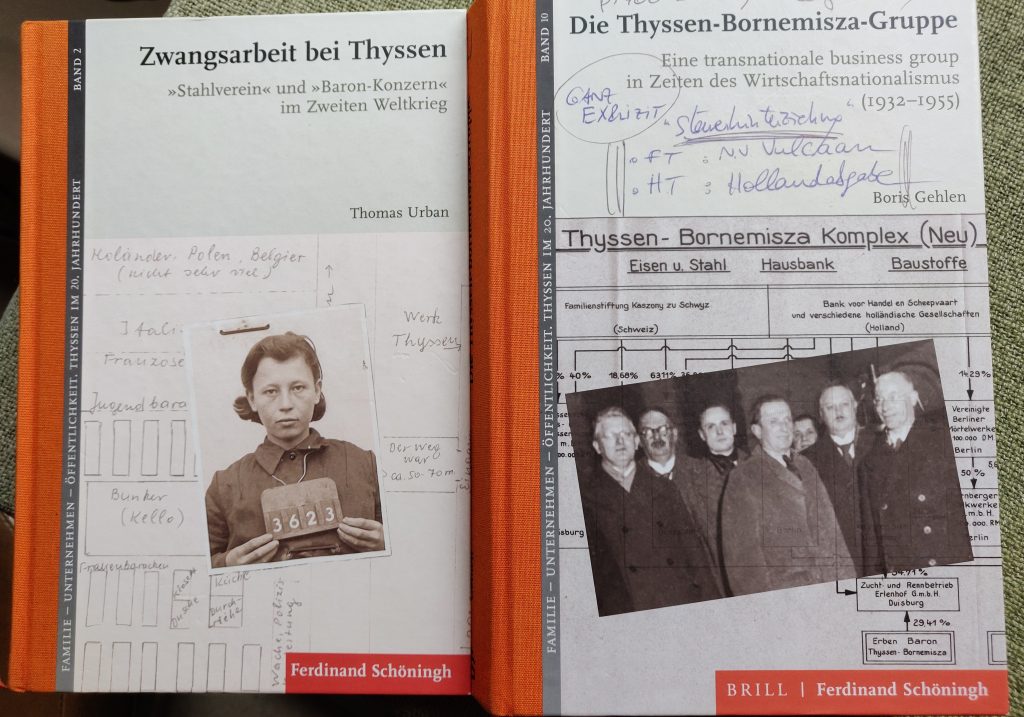
In 2021, Professor Boris Gehlen – as a Fritz Thyssen Foundation funded academic – bravely described our 2007 Thyssen biography (available in English, Spanish, German and Italian) thus:
“Researched thoroughly”… “A particular usefulness is derived from the fact that Litchfield was able to conduct interviews with Hans Heinrich Thyssen-Bornemisza, which are not accessible anywhere else”…“He describes the Thyssen dynasty as people denying their own past and therefore their responsibility”.
And Gehlen acknowledged in his own book, available in German only, and part of an otherwise somewhat uncritical 10-book series:
“The Erlenhof transaction [stud farm ‘aryanisation’ from Moritz James Oppenheimer], together with the transnational tax evasion via the ‘Dutch Levy’, and the use of forced labour [under the Nazi regime] belong without a doubt to the flaws on the moral balance sheet of the Thyssen Bornemisza Group”.
It is the closest anyone from the Thyssens and their entourage has ever come to acknowledging the gravity of the unsavoury parts of the Thyssen dynasty’s history.
Tags: aryanisation, Boris Gehlen, Dutch Levy, Erlenhof, Forced Labour, Fritz Thyssen Foundation, Hans Heinrich Thyssen-Bornemisza, history, Moral balance sheet, Moritz James Oppenheimer, Nazi regime, stud farm, tax evasion, Thyssen Bornemisza Group, Thyssen Dynasty
Posted in The Thyssen Art Macabre, Thyssen Corporate, Thyssen Family Comments Off on The “Flaws on the Moral Balance Sheet” of the Thyssen Bornemisza Group
Wednesday, January 30th, 2019
Following the publication of our book ‘The Thyssen Art Macabre’ (Quartet Books, London, 2007), the Fritz Thyssen Foundation finally commissioned its own Aufarbeitung, namely a series of ten academic books under the title ‘Thyssen in the 20th Century. Family – Enterprises – Public’, publication of which began in 2014.
We have so far reviewed five of these works (click on title to see review):
1) Alexander Donges: The United Steelworks under National Socialism. Concern Politics between Market Economy and State Economy
2) Thomas Urban: Forced Labour at Thyssen. United Steelworks and Baron-Concern during World War Two
3) Johannes Gramlich: The Thyssens as Art Collectors. Investment and Symbolic Capital (1900-1970)
4a) Simone Derix: The Thyssens. Family and Fortune
(and specifically about the Rechnitz Massacre):
4b) Simone Derix Shrouds Thyssen Guilt
5a) Felix de Taillez: Two Burghers Lives in the Public Eye. The Brothers Fritz Thyssen and Heinrich Thyssen-Bornemisza
(with the following two additions):
5b) Fritz Thyssen and the Forced Sterilisation of 400,000 Germans
5c) The Fritz Thyssen Foundation Admits its Role in Banishing the Shadows of the Family’s Nazi Past
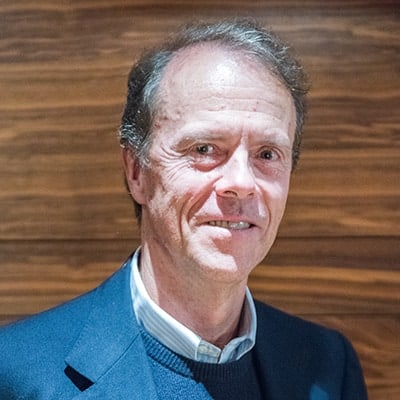 Georg Heinrich Thyssen-Bornemisza (‘Heini Junior’) (19.03.1950 – 30.09.2022) I liked ‘Heini Junior’, because he trusted us to write his father’s history. As did his father! May they both Rest In Peace. (photo copyright Nomis Foundation Zürich)
Tags: Alexander Donges, Art Collectors, Aufarbeitung, Baron Concern, Family, Felix de Taillez, Forced Labour, forced sterilisation, fortune, Fritz Thyssen, Fritz Thyssen Foundation, guilt, Heinrich Thyssen-Bornemisza, Investment, Johannes Gramlich, London, national socialism, Quartet Books, Rechnitz Massacre, Simone Derix, The Thyssen Art Macabre, the Thyssens, Thomas Urban, Thyssen in the 20th century, United Steelworks, World War Two
Posted in The Thyssen Art Macabre, Thyssen Art, Thyssen Corporate, Thyssen Family Comments Off on Our Book Reviews So Far of the Official Thyssen-Aufarbeitung ‘Thyssen in the 20th Century. Family – Enterprises – Public’, Fritz Thyssen Foundation, Ferdinand Schoeningh Verlag Paderborn (scroll down for german version)
Wednesday, January 30th, 2019
Tags: Alexander Donges, Asso Verlag, Aufarbeitung, Baron Konzern, Die Thyssen-Dynastie, Die Thyssens, Familie, Felix de Taillez, Fritz Thyssen, Fritz Thyssen Stiftung, Heinrich Thyssen-Bornemisza, Investition, Johannes Gramlich, Kunstsammler, Nationalsozialismus, NS-Vergangenheit, Oberhausen, Öffentlichkeit, Rechnitz-Massaker, Schuld, Simone Derix, Thomas Urban, Thyssen im 20. Jahrhundert, Vereinigte Stahlwerke AG, Vermögen, Weltkrieg, Zwangsarbeit, Zwangssterilisation
Posted in The Thyssen Art Macabre, Thyssen Art, Thyssen Corporate, Thyssen Family, Uncategorized Comments Off on Unsere bisherigen Buchbesprechungen der Offiziellen Thyssen-Aufarbeitung “Thyssen im 20. Jahrhundert. Familie – Unternehmen – Öffentlichkeit”, Fritz Thyssen Stiftung, Ferdinand Schöningh Verlag Paderborn
Thursday, December 6th, 2018
While I do not deny my role as a polemicist, as a rule I am not motivated by revenge. It is difficult, however, not to appreciate the hand of Nemesis in the inexorable slide of that supremely hubristic organisation that is ThyssenKrupp, towards the edge of the abyss.
When we first started researching ‘The Thyssen Art Macabre’ in the 1990s, Manfred Rasch, then Thyssen AG’s corporate archivist, accused me of forging our letter of introduction from Heini Thyssen and refused to co-operate with us.
But we were in the privileged position of being granted access to private family archives not yet under his control, and thus retrieved all the information we needed.
The corporate arm of the Thyssen family, initially in the form of Thyssen AG and subsequently ThyssenKrupp, not only continued to refuse to co-operate with either myself or Caroline Schmitz, but once our research had been completed, our book written, translated and published, this policy was replaced with public accusations against us of ineptitude, lack of professional qualification, ‘sex and crime’ journalistic practices and sensationalism.
This did not prevent ThyssenKrupp commissioned and thus potentially prejudiced academics from using the results of our research extensively, with little or no credit or reference to us in their claimed, independent series of history books.
In her role as researcher and translator of documentary evidence, Caroline, who is German, understandably found their behaviour unacceptable. As an Englishman, I appreciated the irony in the fact that while they used every opportunity to discredit us, during the same period the Thyssen organisation’s management has been almost constantly subject to charges of dishonesty and corruption, resulting in convictions and payments of many hundreds of millions of Euros in fines and lost business.
But while we gained some degree of satisfaction from revealing the details of the Konzern’s dishonesty, we would both have preferred to have received corporate and familial recognition of the legitimacy of our work.
To this end, a few years ago, I wrote a conciliatory letter to Heinrich Hiesinger, CEO of ThyssenKrupp from 2011 to July 2018. But Mr Hiesinger, who had promised to tackle Thyssen’s corrupt corporate culture prior to his resignation and the inheritance of his positions by one Guido Kerkhoff, did not honour me with a personal reply. Instead he authorised a member of his public relations team to dismiss us and refer us arrogantly to their ‘independent’ historiographers; the same academics whose books we are in the process of reviewing on this website and who continue to cast dispersions on our work.
Meanwhile, ThyssenKrupp has continued to suffer, not only as a result of its business inefficiency, but also from the apparent continuation of its corporate dishonesty, to the point where it now seems quite possible the organisation might shortly cease to exist in any form even vaguely resembling that German industrial icon it once was. It is a situation which sadly will have a devastating effect on the corporation’s loyal workforce, who have also been betrayed by their management.
‘The Thyssen Art Macabre’, meanwhile, will probably continue to be bought and read globally and accepted, without corporate hindrance, as a legitimate history of the Thyssen family and their industrial and socio-political past.
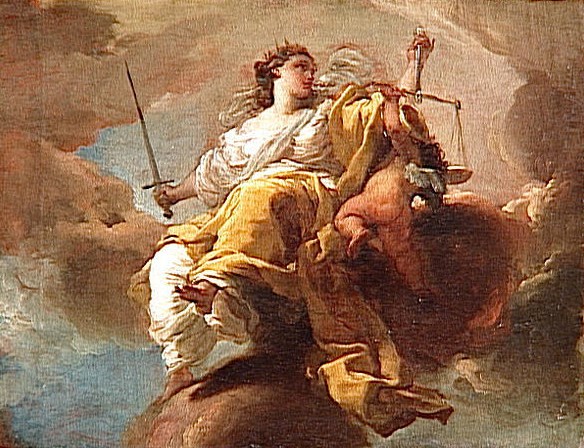 The goddess Nemesis (photo copyright NadezhdaGazuriCherniak.com) Meine Rolle als Polemiker will ich nicht abstreiten, doch im Regelfall ist Rache nicht meine eigentliche Motivation. Recht schwierig ist es allerdings, im stetigen Abrutschen der äußerst anmaßenden Firma ThyssenKrupp, nicht etwas die Hand der Nemesis zu goutieren.
Als wir in den 1990er Jahren anfingen, ‘Die Thyssen-Dynastie’ zu recherchieren, warf mir Manfred Rasch, damals Unternehmensarchivar der Thyssen AG, vor, unser Empfehlungsschreiben von Heini Thyssen gefälscht zu haben und weigerte sich, mit uns zu kooperieren.
Doch wir hatten das Privileg, private Familienarchive einsehen zu dürfen, die noch nicht unter seiner Kontrolle waren und konnten so alle Informationen abrufen, die wir benötigten.
Der Unternehmensbereich der Thyssen-Familie – zunächst die Thyssen AG, später ThyssenKrupp – weigerte sich nicht nur, mit mir oder Caroline Schmitz zusammen zu arbeiten. Sobald unsere Recherche vervollständigt war und unser Buch geschrieben, übersetzt und veröffentlicht, ging er zu der Strategie über, uns öffentlich Unfähigkeit, einen Mangel an professioneller Qualifikation, ‘sex and crime’ Journalismus und Sensationalismus vorzuwerfen.
Dies hielt die von ThyssenKrupp beauftragten und daher möglicherweise befangenen Akademiker nicht davon ab, die Resultate unserer Recherche in einer angeblich unabhängigen Serie von geschichtlichen Büchern ausgiebig zu verwenden, mit wenig oder keiner Nennung oder Referenz zu unserer Arbeit.
In ihrer Rolle als Researcher und Übersetzer schriftlicher Belege fand Caroline, die Deutsche ist, dieses Verhalten natürlich inakzeptabel. Als Engländer stach für mich die Ironie der Tatsache hervor, dass das Management der Thyssen Organisation, während es uns ständig zu diskreditieren versuchte, selbst fast permanent mit Vorwürfen der Unredlichkeit und Korruption konfrontiert war, welche in Verurteilungen und Zahlungen von vielen Hundert Millionen Euros in Strafen und entgangenen Geschäften resultierten.
Doch während wir eine gewisse Satisfaktion darin fanden, die Unredlichkeit des Konzerns bloß zu stellen, so wäre es uns doch lieber gewesen, vom Unternehmen und der Familie eine Anerkennung der Legitimität unserer Arbeit erhalten zu haben.
Daher schrieb ich vor einigen Jahren einen konzilianten Brief an Heinrich Hiesinger, Firmenboss bei ThyssenKrupp von 2011 bis Juli 2018, der bis zu seiner Abdankung und Ablösung durch Guido Kerkhoff daran festhielt, die korrupte Unternehmenskultur bei Thyssen in den Griff bekommen zu wollen. Eine persönliche Antwort erhielt ich von ihm nicht. Vielmehr beauftragte er ein Mitglied des Public Relations Teams uns abzutun und in arroganter Manier an die ‘unabhängigen’ Geschichtsschreiber zu verweisen; die gleichen, deren Bücher wir seit 2015 auf dieser Webseite rezensieren, und die unsere Arbeit weiterhin diskreditieren.
Währenddessen ist ThyssenKrupp auf stetigem Krisenkurs, nicht nur als Folge wirtschaftlicher Ineffizienz, sondern auch, wie es scheint, wegen einer trotz allem fortgeführten unternehmerischen Unredlichkeit, die es nunmehr wahrscheinlich erscheinen lässt, dass die Organisation bald nicht mehr in irgendeiner Form existieren wird, die auch nur annähernd an die deutsche Industrie-Ikone erinnert, die sie einmal war. Es ist eine Situation, die leider auch eine verheerende Auswirkung auf die treue Belegschaft der Firma hat, die ebenfalls von ihrer Geschäftsleitung verraten worden ist.
Unterdessen wird ‘Die Thyssen-Dynastie’ vermutlich weiterhin weltweit gekauft und gelesen werden, und ohne Hemmnisse von unternehmerischer Seite als legitime Geschichte der Thyssen Familie und ihrer industriellen und sozio-politischen Vergangenheit akzeptiert sein.
Tags: academics, business inefficiency, Caroline Schmitz, convictions, corporate dishonesty, corrupt corporate culture, corruption, deutsche Industrie-Ikone, Die Thyssen-Dynastie, dishonesty, fines, German industrial icon, Geschäftsleitung, Guido Kerkhoff, Heinrich Hiesinger, historiographers, Hubris, korrupte Unternehmenskultur, Management, Manfred Rasch, Nemesis, private family archives, resignation, sensationalism, sex and crime, Strafen, The Thyssen Art Macabre, Thyssen AG, Thyssen Familie, Thyssen Family, ThyssenKrupp, Verurteilungen
Posted in The Thyssen Art Macabre, Thyssen Corporate, Thyssen Family Comments Off on ThyssenKrupp – Hubris Begets Nemesis
Sunday, October 28th, 2018
|
The Thyssen-Bornemisza Art Collection in Madrid continues to qualify ever more as a misguided cultural and financial ‘investment’ for the State of Spain.
Every day that passes, the art becomes more of a tourist attraction and less of a cultural statement, with a corresponding reduction in quality and authenticity.
Meanwhile treasury budgets have sored, fundraising activities become ever more ambitious and competitive, while the original owners, on the other hand, continue to exploit tax advantages inherent in the business of art collecting.
The Thyssen-Bornemisza collection has always been at the forefront of such mirages, ever since, in 1993, the Thyssen family sold half of Heini Thyssen’s highly questionable collection to the Spanish state for what the gullible Spanish public were convinced was a bargain price of some $600 million.
By now they must have begun to realise that the purchase price and cost of housing the museum was only the tip of the iceberg. For then you have to constantly invest more money in such necessities as staff, insurance, the cost of mounting one-off exhibitions, whose purpose is to encourage the public to revisit and, finally, the black art of restoration.
The latter being, of course, a contradiction in terms, for the more paint that is added to the surface, the less of the original work can legitimately be attributed to the artist in question. This is particularly relevant in the case of the Thyssen-Bornemisza Collection, which has often been accused of already suffering from over-restoration.
But as the restorers are the same people as those who advise on how much restoration is needed, it rapidly becomes an ever increasing financial burden, to the point where the Thyssen-Bornemisza National Museum has even had to resort to crowd funding and sponsorship to raise the finance needed to undertake such activities!
The latest example of this artistic vandalism is Saint Catherine of Alexandria by Caravaggio, originally commissioned by Cardinal Francesco Maria del Monte, which, according to the Thyssen-Bornemiza Museum’s restoration ‘team’, had already suffered from ‘aggressive’ restoration at some unspecified earlier point in time.
Ironically, considering the rumours surrounding Heini’s widow Tita Thyssen-Bornemisza’s colourful past history, the model for the picture was anything but saintly and was in fact Fillide Melandroni, a leading courtesan of the time.
Originally attributed to Orazio Gentileschi, the painting was ‘re-attributed’ to Caravaggio when scholars began to realise that they could make more money from confirming rather than denying the authenticity of art.
For this claim to be accepted by other ‘scholars’, it was also necessary to re-establish the status of a remarkably similar work, owned by the Prado and deposited in the church Iglesia de los Jeronimos, as being a mere ‘copy’.
There can now be little doubt that like many similar national institutions, the Thyssen-Bornemisza National Museum has become, as I warned them it would, more of a financial tread-mill than a cultural asset.
Fortunately, due to the fact that the Spanish agreed to sign a contract that prevents them from ever selling or disposing of any of the works that make up the Thyssen-Bornemisza Collection, the value of the works is somewhat academic.
Thus they might be best advised to get rid of their costly restoration team and follow the example of my late mother, who used to add sparkle to our artistic family treasures by giving them an annual wipe with a diluted mixture of toilet cleaner!
see this article by Natividad Pulido in the Spanish ABC newspaper of 21.10.2018:
https://www.abc.es/cultura/arte/abci-retrato-cortesana-como-santa-paso-manos-cardenales-201810210128_noticia.html |
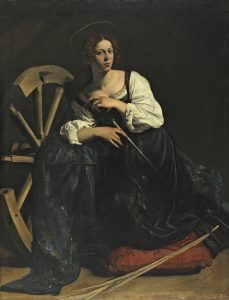 CARAVAGGIO (Michelangelo Merisi) Saint Catherine of Alexandria, ca. 1598 (photo copyright Museo Nacional Thyssen-Bornemisza, Madrid) 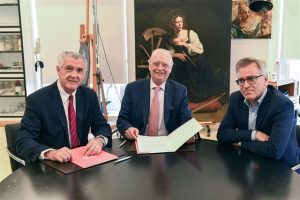 A representative of the ASISA charity funding the restoration (middle), with two representatives of the Thyssen Museum Madrid (photo copyright: Guillermo Navarro, ABC newspaper, Spain) 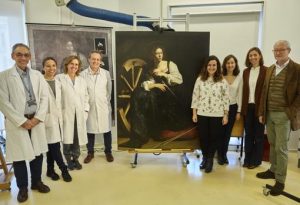 The ‘restoration’ team at the Thyssen-Bornemisza National Museum in Madrid, Spain (photo copyright: Giullermo Navarro, ABC newspaper, Spain) |
|
Tags: aggressive restoration, artistic vandalism, Caravaggio, collecting art, crowd funding, Heini Thyssen, Iglesia de los Jeronimos, Madrid, Natividad Pulido, Orazio Gentileschi, over-restoration, Prado, restoration, Saint Catherine of Alexandria, Spain, sponsorship, tax advantages, Thyssen-Bornemisza Collection, Thyssen-Bornemisza National Museum, Tita Thyssen-Bornemisza
Posted in The Thyssen Art Macabre, Thyssen Art, Thyssen Family Comments Off on Thyssen-Bornemisza Collection Revisited or Caravaggio Tart Art
Sunday, August 19th, 2018
|
Die offizielle Geschichte zum Zweiten Weltkrieg, die in der Vergangenheit vom Thyssen Komplex herausgegeben wurde, war dass Fritz Thyssen die Nazis eine Zeit lang unterstützt hatte, er aber gegen den Krieg gewesen sei und daher aus Deutschland floh, festgenommen wurde und in ein Konzentrationslager kam. Von seinem Bruder Heinrich wurde gesagt, er sei ein Ungar gewesen und in der Schweiz wohnhaft, sodass überhaupt keine Verbindung zu Deutschland oder gar zum Nationalsozialismus bestanden hätte. Nachdem wir in unserem Buch „Die Thyssen-Dynastie“ (2008) aufgezeigt hatten, dass dies nicht der Wahrheit entspricht, lancierte die Fritz Thyssen Stiftung als Antwort eine akademische Reihe, in die sich dieser Band eingliedert. Er befasst sich vor allem mit Berichterstattungen über die Thyssens in verschiedenen Zeitungen und ist der längste der Serie, mit 546 Seiten, weshalb sich diese Besprechung auf 20 Seiten erstreckt. Das Buch setzt die allgemeine Tonlage der Reihe fort, nachdem die einzelnen Autoren zwar Informationen veröffentlichen, die den alten Thyssen Mythen klar widersprechen, diese Mythen jedoch nichtsdestrotrotz weiter aufrecht erhalten werden.
Wie wir sehen werden würde Felix de Taillez diese Haltung als „vollkommen verständlich“ qualifizieren, da die Thyssens und die Thyssen Unternehmen „einen guten Ruf zu verteidigen“ haben. (1997 fusionierte die Thyssen AG mit der Krupp AG zur Einheit thyssenkrupp, welche sich gegenwärtig in wirtschaftlichen Schwierigkeiten befindet). Das bevorzugte Mittel von de Taillez, um berechtigte Kritikpunkte zu vermeiden ist es, etwas als „bemerkenswert“ zu bezeichnen. Er verwendet diesen Ausdruck ausgesprochen oft, was ein äusserst gestelltes Bild ergibt. „Bemerkenswert“ ist ein vager Ausdruck, den man in einer akademischen Arbeit nicht in dieser hohen Frequenz erwartet. Es scheint, als würde de Taillez so eine Atmosphäre von „Spin“ erschaffen, welche Menschen ohne Vorkenntnis des Themas umgarnt. Dies birgt die Gefahr seine ansonsten exzellente historische Arbeit in ein Werk der Public Relations zu verwandeln.
Für die Allgemeinheit sieht es so aus, als würde Felix de Taillez diese beiden Gesichter der Medaille äußerst gut zuwege bringen und es erstaunt nicht, dass er es zu einer verantwortungsvollen Position als Referent der Präsidentin der Universität der Bundeswehr in München gebracht hat, die für die Ausbildung des deutschen Offizier-Korps zuständig ist. Aber es gibt Unstimmigkeiten in seiner Buchpräsentation und da seine Thesen jetzt mit der deutschen Staatsräson in Einklang stehen sollten, gibt dies Anlass zur Sorge. So verspricht seine Online Präsenz an der Ludwig-Maximillians-Universität:
„(Dieses Projekt) wird die Brüder Fritz und Heinrich Thyssen als EINHEIT GERADEZU KOMPLEMENTÄRER GEGENFIGUREN interpretieren, DENN DER SCHEINBAR UNPOLITISCHE HEINRICH AGIERTE, WENN AUCH VERDECKT, MINDESTENS SO NACHHALTIG POLITISCH wie Fritz. Mediale Sichtbarkeit bzw. Unsichtbarkeit erscheinen in dieser Perpektive als ABGESTIMMTE STRATEGIE POLITISCHEN HANDELNS“.
Diese Aussage scheint eine willkommene, neuartige Ehrlichkeit zu versprechen und doch erstaunt sie gleichzeitig, denn sie erscheint nicht im Buch selbst und ist tatsächlich gar nicht repräsentativ für dessen Ausarbeitungen. Im Band selbst wird Heinrich Thyssen-Bornemisza’s Medienabstinenz tenorartig weiterhin damit erklärt, dass er im Zusammenhang mit einem Gerichtsverfahren in jungen Jahren in London schlechte Erfahrungen mit der Presse gemacht und sich danach mit seiner Heirat 1906 als unpolitischer, ungarischer Adeliger aus dem öffentlichen (v.a. dem deutschen!) Leben komplett zurückgezogen habe.
Dies ist die Version, welche auch die Familienmitglieder seit jeher propagiert haben. Erst kürzlich wieder ließ sich Francesca Habsburg née Thyssen-Bornemisza im Financial Times Weekend Magazine als österreichische Thronanwärterin und Enkelin eines „ungarischen Barons“ feiern. Was sicherlich angenehmer ist, als Heinrich Thyssen-Bornemisza korrekterweise als bürgerlichen, deutschen Waffenhersteller und Nazi Banker preisgeben zu müssen; besonders, wenn man sich, wie Habsburg-Thyssen, im schönen Schein der teuren Kunst sonnt, die die Familie, zumindest teilweise, mit den Profiten dieser verwerflichen Aktivitäten erstand.
Selbst der von Felix de Taillez für seine Arbeit gewählte Titel ist auffallend irreführend, suggeriert er doch, dass beide Brüder, und zwar als bürgerliche Mitglieder der Gesellschaft, gleichwertig und gewollt in der Öffentlichkeit verankert gewesen seien. Dabei sahen sich die ja gerade diese Thyssen Brüder gar nicht als Teil des Bürgertums. Auch befasst sich nur ein knappes Viertel des Werks mit Heinrich Thyssen-Bornemisza, und nur mit seiner ausdrücklich zugelassenen Sichtbarkeit in den exklusiven Teilöffentlichkeiten der Kunstsammlerei (welche von Johannes Gramlich bereits ausführlich erarbeitet wurde) und des Pferderennsports (welche wir in einem separaten Artikel nach dieser Rezension besprechen werden).
Wir nahmen an, de Taillez würde aufzeigen, wie es Heinrich Thyssen ansonsten gelang, sich aus Medienberichten konsequent herauszuhalten und was er dabei der öffentlichen Einsichtnahme zu entziehen suchte. Immerhin verfügt das neu gegründete Archiv der Stiftung zur Industriegeschichte Thyssen in Duisburg über erstaunliche 840 laufende Meter bis zu dieser Serie (ausser von uns) unerschlossenen Materials zum Thema Thyssen-Bornemisza. Doch anstatt gründlich den Wind der Aufarbeitung durch die Bestände des Archivs der ThyssenKrupp AG und der neu hinzugekommenen Akten wehen zu lassen, wird die Öffentlichkeit wieder einmal mit Krümeln abgespeist.
In diesem Band wie in der ganzen Serie bleiben die polit-ökonomischen Handlungen v.a. des Heinrich Thyssen-Bornemisza weitgehend verschleiert, diesmal dem Thema entsprechend hinter der Aussage, die Brüder seien Opfer unausgewogener Berichterstattungen und Medienmechanismen wehrlos ausgesetzt gewesen. Felix de Taillez erwähnt Heinrich’s Beteiligung am Private Banking nicht, welches von Natur aus unter größter Diskretion abgewickelt wird. Er verschweigt seine Freunschaft mit Hermann Göring (ein Kunde der August-Thyssen-Bank) und erwähnt auch nicht die Benutzung der Bank durch die deutsche Spionageabwehr. Dadurch vermeidet er es, Informationen darüber zu geben, wie die Thyssens ihrerseits, und v.a. Heinrich, die Medien manipuliert und ihre Aktivitäten aus deren Spotlight herausgehalten haben.
* * *
Zu den aufschlussreichen Beschreibungen in Felix de Taillez’s Buch gehört die Aussage, dass Heinrich im Ruhrkampf 1923 sich „politisch auf die Seite von Fritz“ schlug, er „in gewisser Weise (…) sogar radikaler als sein Bruder (Fritz war), da er Verhandlungen mit der Besatzungsmacht grundsätzlich ablehnte“. „Hinter den Kulissen“, so heisst es, traf Heinrich „zusammen mit Weggefährten“, – die de Taillez unbenannt lässt – „die sich alle einer ‘vaterländischen Bewegung der Ruhr’ angeschlossen hatten, führende Militärs und Politiker in Berlin (…).“ Als „Finanzverwalter“ der „Ruhrschutz-Gemeinschaft“ habe Heinrich Thyssen-Bornemisza „Propaganda im deutschen Sinn in allen besetzten Gebieten“, (sowie in) „Holland, (der) Schweiz, Elsass-Lothringen und Italien“ mit organisiert, so de Taillez weiter.
Man würde gerne Frau Habsburg fragen, warum ein Mann, der angeblich ein ungarischer Baron war, so etwas getan haben soll. Und wieso hat es ein Jahrhundert gedauert, bis diese Einstellungen und Handlungen des Heinrich Thyssen-Bornemisza ans Licht der Öffentlichkeit kamen? Weil hier über die Jahre hinweg eine ganz bewusste Strategie am Werk war. Weil der Thyssen-Komplex die Thyssen Brüder bisher immer so porträtiert hat, als sei Fritz der deutsche Nationalheld und Heinrich der von allem deutschen Übel Befreite gewesen. So schlägt man zwei Fliegen mit einer Klappe und spielt gleichzeitig bei Fragen von Macht und Schuld Verwirrspiele mit der Öffentlichkeit.
Aber so vorteilhaft diese Art von Dienlichkeitslegenden auch sein mag, es ist sehr aufwändig, sie aufrecht zu erhalten; denn die Welt ist ja, glaubt man Felix de Taillez, voller „schonungsloser“ linker Schreiberlinge, die aus unerfindlichem Grund darauf bestehen, Dinge zu hinterfragen. So kam es z.B. auch, wie der Autor darlegt, dass ausgerechnet „das SPD-Blatt ‘Vorwärts’“ 1932 von einem holländischen Insider die Information bekam und diese auch druckte, dass die Thyssen-Firma „Vulcaan beim Erzfrachtverkehr der (Vereinigten Stahlwerke AG) bevorzugt (wurde), indem sie als einzige Reederei in den Genuss von sehr langfristigen Verträgen mit dem Düsseldorfer Stahlriesen gekommen sei. Überdies zahle die (VSt) dafür Raten, die weit über den üblichen Marktpreisen lägen“.
Man würde annehmen, es sei als verwerflich einzustufen, dass ein Teil des von Christopher Neumaier so treffend als „exorbitant“ beschriebenen Thyssen Vermögens also auf unlauteren Geschäftspraktiken zu beruhen scheint. Aber de Taillez erlaubt sich statt dessen den folgenden Kommentar: „Auf diese Weise wurden Geschäftsverbindungen enthüllt, die die Thyssens unter erheblichem Aufwand zu verschleiern versucht hatten“. Als sei die wirtschaftskriminelle Tat eine Leistung und das wahre Übel deren wahrheitssuchende Aufdeckung.
Und de Taillez setzt auf diese verdrehte Betrachtungsweise sogar noch einen drauf. Fritz Thyssen bezeichnete den Mangel an Kapital als das größte wirtschafliche Problem der Weimarer Republik. Die Frage nach seiner eigenen Kapitalflucht aus Deutschland heraus verwies er jedoch ins Reich der Legende, z.B. in einem Interiew mit Ferdinand de Brinon 1924. Absolut verständlich, nach Auffassung von de Taillez, schließlich hatte er ja einen Ruf als „pflichtbewusster deutscher Unternehmer“ aufrecht zu erhalten. Wodurch die Künstlichkeit der Thyssenschen Reputation im Handumdrehen ein akademisches und, wegen der Position des Autors, sogar ein quasi staatstragendes (!) Legitimitätssiegel erhält.
* * *
Das Leben der Thyssen Brüder Heinrich und Fritz strotzte nur so von künstlichen Konstrukten. Da war ihr Militarismus, welchen de Taillez als verinnerlichte Verbindung zu ‘Heer, Tradition, Glaube und militärischen Praktiken’ darstellt. Beide hatten sich in Hohenzollernschen Elite-Regimentern militärisch ausbilden lassen und doch verweigerte sich Heinrich dem Kriegsdienst und Fritz entwich ihm frühzeitig, indem er sich „auf eigenen Vorschlag mit einem offiziellen Auftrag des Auswärtigen Amts betrauen (ließ), um die Rohstofflage für das Reich im Orient (Osmanisches Reich) zu klären“. Stephan Wegener’s Behauptung, die Thyssens hätten im ersten Weltkrieg hohe materielle Verluste erlitten ist nichts weiter als Familienfolklore, die unliebige Fakten zu verschleiern sucht. Wegener, vom Familienzweig des Josef Thyssen, blendet bequemerweise aus, dass die Familie nicht nur vom deutschen Staat entschädigt wurde, sondern auch noch enorme, komplett auditierte Gewinne durch Lieferung von Stahl, Waffen und U-Booten (unter Verwendung von Zwangsarbeitern) machte. Es schwer auszuhalten, dass Felix de Taillez und andere in der Serie die Familienlegende der hohen Kriegsverluste unhinterfragt wiedergeben, als sei sie Fakt.
Zu welchen charakterlichen Verrenkungen ihre Selbstinszenierungs-Konstrukte führten wird für Heinrich Thyssen-Bornemisza am besten am Beispiel seiner adoptierten Nationalität deutlich. Da er sich im Gegensatz zu Fritz als „Ungar“ aufstellen musste, bestand er unerbittlich darauf, sein Schloss im Burgenland mit der ungarischen Bezeichnung „Rohoncz“ zu benennen. Die deutsche Version war ihm zu „sozialistisch“ (aus einem Brief an seine Frau, siehe „Die Thyssen-Dynastie“, Seite 123 – er implizierte fälschlicherweise, der deutsche Begriff sei 1919 mit Ausrufung der Republik neu entstanden). Hierbei legte Heinrich sich laut de Taillez sogar mit der burgenländischen Landesregierung, dem österreichischen Bundesdenkmalamt, dem Bayerischen Staatsministerium für Unterricht und Kultur und dem Auswärtigen Amt in Berlin an. Ironischerweise saß die Schlossverwaltung ganz woanders, nämlich beim Rotterdamsch Trustees Kantoor in Rotterdam. Doppelt und dreifach tarnte sich “der Baron“; ortsgebundene Amtshengste hatten solchen extravaganten Strategien nichts entgegen zu setzen.
Auch Fritz stand der Abschaffung der Monarchie in Deutschland und Österreich, sowie der aufsteigenden Sozialdemokratie feindselig gegenüber. Laut de Taillez sah er Deutschland als bedrängten Mittelpunkt eines engen Kreises aus England, Frankreich, Italien und Russland und meinte, der „große Druck von außen lasse die deutsche nationale Einigung auf demokratischem Wege nicht zu“. Sozialdemokraten fand er als „gemäßigte Revolutionäre“ „genauso gefährlich“ wie radikalere Umstürzler. Thyssen wollte, so de Taillez, dass der „spirit of the worker“ einfach nur „deutsch“ sei, und sonst gar nichts. Während die Gewerkschaften verstärkte Rationalisierungen, Arbeitszeitverkürzungen und Lohnerhöhungen forderten, wollte er ein durch die Heraufsetzung des Arbeitstags von 8 auf 10 Stunden (!) wiedererstarktes Volk und das Ende der betrieblichen Mitbestimmunng. Doch wie konnte dies den Kriegsheimkehrern schmackhaft gemacht werden, die sich zunehmend pazifistischen und demokratischen Organisationen zuwandten?
Laut Niels Löffelbein, erklärt George Mosse den Aufstieg des Faschismus durch eine „Brutalisierung“ der politischen Kultur der Nachkriegszeit durch die Masse der Soldaten, die zu einer „Entgrenzung und Radikalisierung der politischen Gewalt“ geführt habe. Angel Alcalde hält dem entgegen, die Weltkriegsteilnehmer seien in der „mythomotorischen Inkubationszeit“ der 1920er Jahre durch die extreme Rechte und Veteranenorganisationen zunehmends als anti-bolschewistische Kämpfer „instrumentalisiert“ worden. Im Kult um die gefallenen (wie die noch kampfbereiten) Helden zelebrierten sie die Verbindung von Radikalnationalismus und Krieg. Laut de Taillez richtete Fritz Thyssen noch im Oktober 1917 eine Beitrittserklärung an die rechtsnationale Deutsche Vaterlandspartei (DVLP). 1927 gab er während einer Abendveranstaltung des „Stahlhelm Bund der Frontsoldaten“, des „gewaltbereiten Kampftrupps“ der Deutschnationalen Volkspartei (DNVP) in seiner Heimatstadt Mülheim eine Rede. Auch dem „Bündnis der antidemokratischen rechtsextremen Harzburger Front“, in dem der „Bund der Frontsoldaten“ vertreten war, soll er „sehr nahe“ gestanden haben.
Wie Felix de Taillez schreibt, unterstützte Thyssen auch die Austro-faschistische Heimwehrmiliz: „Über Anton Apold, (…) dem Generaldirektor der Österreichisch-Alpinen Montangesellschaft (…) (die) mehrheitlich der Vereinigte Stahlwerke AG gehörte, (…) gab es eine Verbindung Thyssens zu den rechtsradikalen Heimwehren in Österreich.“ „Dem deutschen Großindustriellen wurden von der Düsseldorfer Volkszeitung unterstellt, auf ‘begrenztem Kampffeld in Österreich’ testen zu wollen, wie der Einfluss der Gewerkschaften gebrochen werden könnte.“
All dies wird eindeutig auch Heinrich im Geiste unterstützt haben, aber als angeblicher Ungar hielt er sich aus der deutschsprachigen Berichterstattung zum Thema heraus und wurde so nicht als rechtsextremer Unterstützer wahrgenommen. Indem er versäumt, dies klar zu sellen, trägt de Taillez zu dem Bild bei, das in dieser Reihe weiterhin von Heinrich gezeichnet wird, eines Mannes nämlich, der in keinster Weise ein Sympathisant der extremen Rechten gewesen sei. Das ist eine Behauptung, die ausschließlich auf der Abwesenheit öffentlicher Quellen beruht, die als solche bewusst von Heinrich und seinen Partnern sicher gestellt wurde. Mangel an Beweisen ist nicht mit Beweis eines Nichtbestehens gleich zu setzn. Dies hätte von de Taillez klar gestellt werden müssen. Doch tut er dies nicht, denn wenn man Heinrich’s rechtsextreme Sympathien enthüllt, zerstört man zugleich den mythologischen Ruf der Thyssens.
* * *
Für die Thyssens gab es stets Interessenkonflikte zwischen ihrer nationalen Zugehörigkeit und ihren wirtschaftlichen Eigeninteressen. Nachdem sie bereits vor dem ersten Weltkrieg die Besitzstrukturen ihrer Werk in die neutralen Niederlande verlegt hatten, beteiligten sich Fritz und sein Vater August kurz nach Ende des Krieges in Düsseldorf an Gesprächen über die Gründung einer Rheinischen Republik. Laut de Taillez lautete der Vorwurf des Mülheimer Arbeiter- und Soldatenrats, der sie verhaftete, dass sie „die Abtrennung Rheinland-Westfalens und die Besetzung des Ruhrgebiet durch die Alliierten gefordert hätten“. Ein Kellner hatte das Treffen gemeldet und die Thyssens sahen sich bald als „profitgierige Heuchler“ und „Geldsackpatrioten“ bezeichnet; andere sagten, dies sei eine Verleumdung absolut treu-deutscher Industrieller. Das Verfahren gegen sie wurde eingestellt, offiziell, weil ihnen kein Hochverrat an Deutschland nachgewiesen werden konnte. Felix de Taillez schreibt der Kellner hätte gestanden, gelogen zu haben. Dass er dies eventuell tun musste, um seinen, oder überhaupt einen, Job zu behalten, scheint dem Autor nicht in den Sinn zu kommen. Fritz Thyssen, der laut de Taillez „für die deutsche Politik einen viel höheren Stellenwert als ein normaler Bürger“ hatte, wurde bald darauf vom Auswärtigen Amt in Berlin an den vertraulichen Nachverhandlungen einzelner Artikel des Vertragswerks des Versailler Friedensvertrags beteiligt.
Bereits kurz nach dem Krieg fing Fritz Thyssen auch an, sich in Argentinien einen Ausweichwohnsitz einzurichten, in dem er zunächst die Estancia Don Roberto Lavaisse in der Provinz San Luis erstand. Auch die Verbindung der Familie mit Südamerika reichte bereits in die Zeit vor dem ersten Weltkrieg zurück, als August Thyssen in Buenos Aires eine Zweigniederlassung der Firma Deutsch-Überseeische Handelsgesellschaft der Thyssen’schen Werke (Hamborn) gegründet hatte. Seit 1921 hieß die Tochterfirma dann Compania Industrial & Mercantil Thyssen Limitada. 1927 übernahm sie die Firma Lametal und „firmierte fortan unter Thyssen-Lametal S.A.“. Heinrich Thyssen-Bornemisza verkaufte sie laut de Taillez 1927 für 4,8 Millionen Gulden an die Vereinigte Stahlwerke AG. Auch in Brasilien hatte die Familie seit Jahren Besitz und warb für den wirtschaftlichen Handel dort.
Während des Ruhrkampfs 1923, den Fritz Thyssen angeblich als „legitime Abwehrmaßnahme gegen die ausländischen Neider“ interpretierte, ließ er sich vor dem alliierten Gericht durch Friedrich Grimm verteidigen, einem erklärten Antisemiten und späteren NS-Juristen, der laut de Taillez nach 1945 NS-Täter verteidigte und NS-Verbrechen verharmloste. In den Augen des Autors wurde Thyssen aber nur künstlich zur „Projektionsfläche“ einer „neuen deutschen Nationalidentität“ bzw. eines „freien Deutschtums“ „hochstilisiert“ , und zwar vor allem durch die New York Times und die Times of London. Dabei bildete der Ruhrkampf die erste Möglichkeit für Fritz, öffentlich aus dem Schatten seines bis dato allbestimmenden Vaters herauszutreten, der nun ernsthaft kränkelte. Dieses Selbstbefreiungsmotiv ist aus unserer Sicht im Zusammenhang mit Fritz Thyssen’s öffentlich zelebrierten Rechtsrucks ein nicht zu unterschätzender Faktor.
Wenn es nach de Taillez geht, muss konkret „offen bleiben“, „ob Fritz Thyssen von der Welt eines mitunter extremen Nationalismus, der sich in Deutschland im ersten Weltkrieg gebildet hatte, erfasst wurde“. Schade nur, dass seine Ehefrau Amelie Thyssen in dieser akademischen Reihe so wenig Beachtung findet, ausser als Co-Stifterin der Fritz-Thyssen-Stiftung. Laut Heini Thyssen’s persönlicher Aussage uns gegenüber war Amelie Thyssen jedenfalls alles andere als „hochstilisiert“, sondern tatsächlich während dieser „Inkubationszeit“ der 1920er Jahre in ihrem starken Deutschnationalismus nationalsozialistisch. Obwohl de Taillez immer wieder beschreibt, wie sehr Fritz von der Meinung seiner Frau abhing, lässt er die Möglichkeit der politischen Beeinflussung innerhalb dieser Paarbeziehung gänzlich unerwähnt. Da Amelie die treibende Kraft hinter der Wiedererlangung des Thyssen-Imperiums nach dem zweiten Weltkrieg war, würde auch jedes schlechte Licht auf sie, den mythologischen Ruf der Thyssens gefährden.
Grimm’s Argumentation vor Gericht war von der Aussage geprägt, dass „Privatbesitz wie die Ruhrkohle (…) rechtlich ohne Entschädigung der Eigentümer nicht einfach beschlagnahmt werden (könne), um staatliche Schulden zu tilgen. De Taillez behauptet, der Ruhrkampf habe in Fritz Thyssen ein „politisches Sendungsbewusstsein“ ausgelöst, „das weit über die Aktivitäten im Interesse des Geschäfts hinausging“. Er gesteht ein, dass Thyssen durch seine Aussagen, die deutsche Wirtschaft könne „nur durch größere Arbeitsleistung“ gesunden, SCHULD auf sich geladen habe. Er habe nämlich „durch solche öffentliche Äußerungen (…) auch zum Scheitern der Sozialpartnerschaft in den 1920er Jahren (beigetragen), was die demokratische Staatsform in Deutschland erheblich gefärdete“.
Später ließ Adolf Hitler Fritz Thyssen in dem Glauben, er dürfe für sein Konzept des korporativen Staats eine Forschungs- und Entwicklungsgesellschaft führen. Diese nicht erwiderte Tätigkeit ermutigte Fritz zu beträchtlicher politischer Aktivität. Fritz war enttäuscht, als sein Projekt nicht umgesetzt wurde, aber, als er dies bei Hitler bemängelte, erwiderte dieser: „Es gibt nichts, wofür ich Ihnen dankbar sein müsste. Was Sie für unsere Bewegung getan haben, haben Sie zu Ihrem eigenen Nutzen getan und es als Versicherungsprämie abgeschrieben“. (Zitat bei Henry Ashby Turner Jr., siehe „Die Thyssen-Dynastie“, S. 138).
Laut de Taillez verfolgte Fritz Thyssen vorrangig seine eigenen Geschäftsinteressen, außer dann wenn für ihn nicht ganz klar war, „welcher Weg (diesen) am zuträglichsten sein würde“. In der Europäischen Verständigungspolitik beschreibt er ihn als „zweideutig“. Thyssen kritisierte die Weimarer Republik sowohl in der französischen Presse als auch in der amerikanischen Öffentlichkeit, bezeichnete die deutsche Regierung als „schwach und nicht vertrauenswürdig“ und fiel damit „der deutschen Außenpolitik in einer schwierigen Situation in den Rücken“. Andererseits kritisierte er die „kurzsichtige und engherzige egoistische Wirtschaftspolitik der Nordamerikaner“. Thyssen „wollte bilaterale Austauschverträge für den Rohstoffverkehr, die der internationalen Finanzspekulation das Handwerk legen und Unabhängigkeit vom Wechselkurs erreichen sollte“. Wenn Fritz aber „gegen die Finanztechnik (wetterte), die die wirkliche Wirtschaft störe“, so blendete er dabei praktischerweise aus, dass die Thyssen-Familie drei internationale Banken zu 100% kontrollierte und damit selbst ein Global Player in Sachen Finanztechnik war (was allerdings von de Taillez unbegreiflicherweise nicht erwähnt wird).
* * *
Obwohl seine Nachwuchsgruppenleiterin Simone Derix es in ihrem Band bereits ausgiebig widerlegt hat, behauptet Felix de Taillez wiederum dass Heinrich seinen Erbteil des Familienkonzerns vollkommen unabhängig vom Erbteil des Fritz Thyssen führte. Auch dass die beiden Brüder ein schlechtes Verhältnis gehabt hätten betont er häufig. Nun mag es ja sein, dass sie sich nicht über alles liebten. Es ist ganz normal, dass es zwischen Geschwistern gewisse Neidhaftigkeiten gibt. Heini Thyssen erzählte uns, wie sein Vater eines Tages die Zürcher Bahnhofstrasse entlang gelaufen und demonstrativ auf die andere Straßenseite gewechselt sei, als er seinen Bruder Fritz sah. Doch das hatte tatsächlich mehr mit Image als mit Realitäten zu tun. Auch Heini wollte ein Bild des Zwists bestärken, da sich seine, die Thyssen-Bornemisza Seite der Familie bis dahin erfolgreich aus jedweder Diskussion um den Nationalsozialismus herausgehalten hatte. Aber schon ein kurzer Blick auf ein Bild der drei Thyssen-Brüder im Jahr 1938 in unserem Buch und hier zeigt, dass es im Verständnis zwischen Heinrich und Fritz überhaupt kein Problem gab. Statt objektiv zu sein, plappert de Taillez althergebrachte, zu Dogmen erhobene Thyssen-interne Mythen nach. Was „bemerkenswert“ ist, da er doch eigentlich beide Männer als „eine Einheit geradezu komplementärer Gegenfiguren interpretieren“ will, deren „Sichtbarkeit bzw. Unsichtbarket“ (in dieser Perspektive) als „abgestimmte Strategie politischen Handelns (erscheint)“.
Nachdem Heinrich 1926 seine „exorbitante“ Erbschaft gemacht hatte, investierte er über wenige Jahre hinweg massiv in Gemälde und Kunstgegenstände, dem Vorbild seines Freunds Eduard von der Heydt folgend, der im gleichen Jahr in die Schweiz gezogen war. Obwohl seine Sammlung nie dort ansässig war nannte er sie „Sammlung Schloss Rohoncz“, um ihr den Anschein zu geben, als sei sie seit längerem organisch gewachsen und von noblem Format. Als solche ließ er sie 1930 in der Neuen Pinakothek in München ausstellen. Doch Friedrich Winkler von den Staatlichen Museen in Berlin rückte „Thyssen-Bornemiszas Methoden (…) in die Nähe von Napoleons Kunstraub“ und beschrieb ihn als „unbedarft, unwissend, beschränkt und abhängig von Händler- und Expertenurteilen“. Rudolf Buttmann, Abgeordneter der NSDAP im Bayerischen Landtag, nannte die Sammlung gar ein „von Händlern zusammengestelltes Ganzes“. Viele Zuschreibungsfehler und Fälschungen wurden angeprangert, was sich zum regelrechten „Medienskandal“ auswuchs. Die Münchner Pinakotheken zeigten sich, laut de Taillez, nur bei 60 der 428 Bilder nach Ende der Ausstellung bereit, sie vorübergehend in ihren eigenen Beständen zu zeigen.
Doch dies waren hochspekulative Zeiten mit einer „zunehmenden Kommerzialisierung des Kunstmarkts“. Allem Aufschrei zum Trotz ging Heinrich Thyssens „Kalkül“ auf, „öffentlich den Wert seiner Sammlung bestimmen zu lassen“ (50 Millionen RM – es ist allerdings nicht ersichtlich wie de Taillez von solch einem „Kalkül“ wissen will). Auch wurde sein Unterfangen als „nationale Tat“ beschrieben „an der ganz Deutschland interessiert sei“. Er sei ein „Retter deutschen Kulturguts“ und mit einem „bürgerlichen Bildungsauftrag“ ausgestattet. Während dessen war auffallend, dass Heinrich nirgendwo als Sohn des bekannten Ruhrindustriellen und Erschaffers des Familienvermögens, August Thyssen, vorgestellt wurde. Stattdessen wurde er als „großer Unbekannter“ gehandelt, als eine Person von ominösem Flair, von der niemand so richtig zu wissen schien, woher sie kam. Es musste gerade genug „Deutschtum“ angeheftet bleiben, um die konservativen Kreise Münchens zufrieden zu stellen, während man die Illusion von Heinrich’s adoptierten Magyarentum aufrecht erhielt. Was bedrückt, ist dass de Taillez dies nicht klar als die offensichtliche Thyssensche Manipulation öffentlicher Wahrnehmung outed, die es war.
Die Stadt Düsseldorf und ihr Kunstmuseum, die in den Weimarer Jahren „unter deutschen Großstädten führend“ waren im Hinblick auf ein „hoch entwickelte IInstrumentarium kommunaler Öffentlichkeitsarbeit“ nutzte Heinrich Thyssen über Jahre hinweg aus. Laut de Taillez hielt er sich „für eine so wichtige Persönlichkeit (…), um der lokalen Politik Forderungen zu stellen“. Aber de Taillez behauptet unsinnigerweise, die nationale Verortung Heinrichs in Deutschland wäre einzig und allein aufgrund der Pressearbeit seines Kunstberaters Rudolf Heinemann und des Düsseldorfer Oberbürgermeister Robert Lehr entstanden, und nicht in Heinrichs eigenem Sinn gewesen. Dabei gibt er im gleichen Werk an (siehe oben), dass Heinrich im Ausland „Propaganda im deutschen Sinn“ organisierte. Also verstand er sich sehr wohl als Deutscher, behielt ja auch seinen deutschen Pass (siehe „Die Thyssen-Dynastie“ S. 76 – von Simone Derix bestätigt) und kassierte deutsche Entschädigungszahlungen für Kriegsschäden an seine Firmen (siehe „Die Thyssen-Dynastie“, S. 256 – von Harald Wixforth bestätigt). Es ist unverständlich, warum de Taillez solch widersprüchliche Aussagen macht; es sei denn, die Kritik an dieser Reihe, sie sei durch die Quelle des Sponsoring – die Fritz Thyssen Stiftung – beeinflusst, könnte berechtigt sein.
Felix de Taillez geht weiter als er sollte, in dem er nicht nur existierende Thyssensche Manipulationen verschleiert, sondern sogar neue ins Leben ruft. Er schreibt: „Heinrich (reagierte) insofern auf das Ausstellungsdebakel, als er seine Kollektion danach zu großen Teilen umbaute, dabei die umstrittenen Bilder veräußerte, und somit erst den eigentlichen Durchbruch zu der heute weltbekannte Sammlung schaffte“. Dabei verweist er auf Johannes Gramlich’s Band „Die Thyssens als Kunstsammler“, Seiten 263-273. Dort allerdings wird nur von 32 Bildern gesprochen, die zwischen 1930 und 1937 verkauft worden sein sollen. Thyssen-interne Listen, die uns vorliegen zeigen, dass 405 Gemälde, die Heinrich bis einschließlich 1930 gekauft hatte 1948 von seinen vier Kindern geerbt wurden. Demnach wären theoretisch also nur 23 Bilder zwischen 1930 und 1948 verkauft worden.
Es kann demnach absolut keine Rede davon sein, Heinrich habe „seine Kollektion (nach dem Ausstellungsdebakel) ZU GROßEN TEILEN (umgebaut)“ und dabei „DIE umstrittenen Bilder (veräußert)“, was sich so anhört, als habe er ALLE umstrittenen Bilder der 1930er Ausstellung danach verkauft.
Das Thyssen-Bornemisza Museum in Madrid enthält noch heute mindestens 120 Bilder aus der Münchner Ausstellung von 1930. Wenn ein „Umbau“ stattfand, dann wurde dieser nicht von Heinrich Thyssen-Bornemisza aktiv durchgeführt, sondern fand passiv nach seinem Tod statt und zwar v.a. durch Erbteilung (1948, sowie 1992 nach dem Verkauf nur einer Hälfte der Thyssen-Bornemisza Sammlung an Spanien – die andere Hälfte ging an die Frau und vier Kinder von Heinrichs Sohn, Hans Heinrich).
Auch gab es einen Verkauf deutscher Bilder durch Hans Heinrich Thyssen-Bornemisza in den 1950er Jahren, der sich nach der Nazi-Era noch stärker als sein Vater von Deutschland absetzen wollte (siehe „Die Thyssen-Dynastie“, S. 269). Ausserdem wurde Heini Thyssen natürlich ein Kunstsammler auf einer ganz anderen Ebene als sein Vater und kaufte tatsächlich einige sehr gute, v.a. moderne Gemälde.
Viele der fragwürdigen, 1930 ausgestellten Bilder sind jedoch in Thyssen-Besitz geblieben. De Taillez’s gegenteilige Behauptung ist irreführend.
Man muss auch daran erinnern, dass Heini Thyssen die meisten in der Erbteilung von 1948 verteilten Bilder von seinen Geschwistern zurück gekauft hat, sodass die meisten der fragwürdigen 1930er Bilder in seinem Besitz endeten. Die Einstellung der Thyssens war es immer, dass Bilder, sobald sie einmal in ihrem Besitz waren, nicht mehr hinterfragt werden durften. Darin versuchten sie, das Prestige, welches die Rothschilds besaßen, nachzuahmen. Die Öffentlichkeit und die Medien – die möglicherweise einem VIP-Äquivalent des königlichen Turnus’s unterworfen sind (wonach Journalisten vom Zugang zu Mitgliedern des Königshauses ausgeschlossen werden, wenn sie negative Stories publizieren) – schienen diese Version der Realität meist zu akzeptieren.
* * *
Was an diesem Buch und an der Serie auffällt ist, dass sie nicht ein einziges Originalstatement eines lebenden Mitglieds der Thyssen Familie enthällt. Tausende Seiten neuer Geschichte werden zu ihrem Thema geschrieben, und man frägt sich, wie die Thyssens sich wohl fühlen, jetzt da einige der Teller, die über so einen langen Zeitraum hinweg und in so kostspieliger Weise in der Luft jongliert wurden, plötzlich mit einigem Getöse auf den Boden zu fallen drohen.
Doch Felix de Taillez wäre nicht Felix de Taillez wenn er uns nicht noch mit einer weiteren schönfärberischen Einschätzung aus dem Reich der Thyssen-Kunst entlassen würde. Verschiedene Kunstberater, Museumsdirektoren und der Baron selbst hatten widersprüchliche Aussagen gemacht, wann genau die Gemälde erstanden worden waren. Waren sie je im Rechnitzer Schloss gewesen, wie es der Name der Sammlung suggerierte? Manchmal hieß es ja, manchmal nein. Die uns vorliegenden Thyssen-internen Listen zeigen, dass das erste Bild von ihm 1928 erstanden wurde und alle Werke bis zur Ausstellung im Jahr 1930 in verschiedenen Depots verwahrt wurden (das Vorwort des Ausstellungskatalogs macht die sehr deutlich – siehe hier). Was allerdings den Baron nicht davon abhielt, manchmal 1906 für seinen ersten Kauf anzugeben, das Jahr seiner Verheiratung nach Ungarn.
Und Ähnliches tat sein Rechtsanwalt auch in den 1930er Jahren mit den Schweizer Behörden: „Im Zusammenhang mit Heinrich Thyssen-Bornemiszas Umzug in die Schweiz ist weiterhin bemerkenswert, dass ihm die erste Ausstellung seiner Sammlung in München in finanzieller Hinsicht von Nutzen war. Anlässlich der Einfuhr seiner Gemälde und anderer Kunstgegenstände in die Schweiz diente ihm bei den eidgenössischen Behörden der Hinweis auf die Ausstellung mit besagtem Katalog als Beweis dafür, dass sich rund 250 wertvolle Gemälde schon länger in seinem Besitz befänden. Durch diesen Schachzug gelang es ihm, die Kunstgegenstände ‘zum persönlichen Gebrauch’ zollfrei nach Lugano schaffen zu lassen“.
(Der Name von Heinrich Thyssen-Bornemisza’s Tessiner Anwalt war Roberto van Aken, und es war nicht das einzige mal, dass er es für seinen Kunden mit der Wahrheit nicht so genau nahm).
Rekapitulatierend: Heinrich Thyssen trickst über seinen geschmeidigen Anwalt die Schweizer Zollbehörden aus, Felix de Taillez applaudiert dies, gibt anscheinend als Grund dafür, dass angeblich nicht 428, sondern 250 Gemälde in die Schweiz geschafft wurden an, der Baron habe die fragwürdigen verkauft und lässt uns gleichzeitig ebenso wie Johannes Gramlich im Dunkeln, wann und wie genau der Transfer der Güter aus Deutschland heraus stattgefunden hat. Da die Sammlung bei der Erbteilung 1948 insgesamt 542 Bilder enthielt lässt de Taillez auch offen, woher die anderen knapp 300 Bilder stammten und wann sie in die Schweiz gekommen sein sollen.
Dass die Thyssens selbst sich so intransparent gaben, leuchtet ein. Dass allerdings Akademiker, die 80 Jahre nach den Geschehnissen beauftragt wurden, den Sachverhalt angeblich „unabhängig“ aufzuarbeiten genauso vorgehen, ist nicht hinnehmbar. Zumal kein Mitglied der Familie befragt wurde.
* * *
Alles in allem ist Felix de Taillez erstaunlich stur dabei, die Heinrich Thyssen-Bornemisza umgebenden Mythen zu verlängern, während er bei der Presentation von Fritz viel direkter ist. Wir unterstellen nicht, dass die Fritz Thyssen Stiftung oder die Stiftung zur Industriegeschichte Thyssen die Ergebnisse dieser akademischen Untersuchungen gesteuert haben. Aber die Tatsache, dass Zugang zu Quellen und finanzieller Unterstützung durch diese Einheiten gewährt wurde (in deren Vorständen nur EIN Mitglied der Thyssen Familie sitzt, nämlich Georg Thyssen-Bornemisza, ein Nachfahr von Heinrich, nicht von Fritz) muss die Autoren sicherlich dazu geführt haben, bei ihren Schlussfolgerungen „Vorsicht“ walten zu lassen.
Befassen wir uns weiter mit Fritz, so schauen wir nach dem Putsch von General Jose Felix Uriburu 1930 in Argentinien auf ein „undemokratisches Jahrzehnt“, in dem es zu einer „starken ökonomischen Verflechtung mit Deutschland“ kam. Seit den 1890er Jahre, so de Taillez, gab es dort „starke rechtsextreme Bewegungen“ und „bereits vor der Machtübernahme in Deutschland“ fasste die Auslandsorganisation der NSDAP in Argentinien „besonders gut Fuß“ (siehe auch „Die Thyssen-Dynastie“, S. 250). Später berichtete die La Plata Zeitung, dass Fritz Thyssen 1930 in der argentinischen Öffentlichkeit die „Morgenröte des kommenden neuen Deutschlands“ unter Hitler ausgemalt habe. Im Argentinischen Tageblatt forderte er 1934 die „unumschränkte Macht der neuen (deutschen) Regierung zur Ankurbelung der Wirtschaft“, was de Taillez „bemerkenswert“ findet, habe er doch „sonst immer auf große Freiräume für the Privatwirtschaft“ bestanden. De Taillez weiter: „Die Machtkonzentration im NS-Staat bot laut Thyssen den wesentlichen Vorteil, Entscheidungen zu trefen, ohne wie im ‘marxistisch verseuchten Parteienstaat’ ‘Halbheiten’ machen und Kompromisse schließen zu müssen“. Wobei Fritz die extremistische Sprache der Nationalsozialisten gegen ihre politischen Feiden verwendete.
Während der Gelsenberg-Affäre 1932 gab es Presseberichte, angefeuert vom ehemaligen Reichsfinanzminister Hermann Dietrich, wonach Fritz Thyssen für die Vereinigten Stahlwerke AG ein Geschäft mit französischen und niederländischen Investoren ausgehandelt hätte, welches die Reichsregierung aber verhindern wollte, da sie keinen ausländischen Einfluss auf das Unternehmen wünschte. Indem er einen Brief an die deutsche Öffentlichkeit schrieb, „dass er lediglich Kreditsondierungen vorgenommen habe“, so de Taillez, „stellte er bewusst die Reichsregierung bloß“. De Taillez argumentiert, dass Thyssens Angaben demontiert wurden, als ein Brief von Friedrich Flick an ihn der Frankfurter Zeitung zugespielt wurde, welcher aufzeigte, dass Flick „Thyssens Vorschlag (abgelehnt hatte) gerade wegen der damit verknüpften Geldquelle“. Die Düsseldorfer Volkszeitung brandmarkte ihn daraufhin als „unpatriotisch“.
Anfang 1932, während sein Bruder Heinrich die Villa Favorita in Lugano erwarb, schwenkte Fritz „demonstrativ zum Nationalsozialismus um“. Seine Frau war bereits seit 01.03.1931 Parteimitglied, Fritz wurde es offiziell am 07.07.1933. Auf den Ruhrkampf zurückblickend schloss er laut de Taillez, dass dies ein „Vorläufer für das nationalsozialistische Gedankengut des neuen Deutschlands“ war. „Anders als 1923 stehe nun nicht nur das Ruhrgebiet entschlossen da, sondern ganz Deutschland werde den Weg gehen, den der ‘Führer’ vorschreibe. Die Zerschlagung des Marxismus im Innern sei allein Hitler, der SA und der SS zu verdanken“ (aus einem Artikel in der Kölnischen Zeitung, „Fritz Thyssen über den Klassenkampf“, am 02.05.1933).
So wurde Thyssen zum „Medialen Akteur“, der dann unter Hitler „erheblich von der Abschaffung der Pressefreiheit“ profitierte, da bald niemand mehr seinen verbalen Roheiten etwas entgegensetzen durfte. In Buenos Aires führte er während dessen Verhandlungen „mit hohen staatlichen Stellen“ wie „General Agustin Pedro Justo, dem nach gefälschten Wahlen seit 1932 amtierenden Staatspräsidenten“. Nachfolgend wurde im November 1934 ein Argentinisch-Deutsches Handelsabkommen samt Verrechnungs- und Kompensationsverfahren unterzeichnet, wodurch der Handel zwischen den beiden Ländern drastisch anstieg. Es scheint, dass Thyssen hier versuchte, einen Gegenpol zur allmächtigen anglo-amerikanischen Wirtschaftsmacht aufzubauen. Felix de Taillez wertet dies allerdings nur dahingehen, der extremst egoistische Fritz habe sich hierin ausschließlich um den Aufbau seines öffentlichkeitswirksamen „Image“ als „einflussreicher Wirtschaftsführer“ gekümmert, um nur für sich persönlich viel öffentliche Beachtung zu finden.
Doch nicht die gesamte südamerikanische Presse war den Thyssens hold. Das Argentinische Tagesblatt sprach 1934 von einer „Bindung gemeinsamer Pleiten“, die Anfang 1933 stattgefunden hätte, als die Vereinigten Stahlwerke bankrott und die NSDAP hoffnungslos verschuldet gewesen seien. „Die Zeitung warf der Vereinigten Stahlwerke AG, under Thyssens Ägide als Aufsichtsratsvorsitzender, Bilanzfälschung in erheblichem Ausmaß vor“ (aus dem Artikel „Geschäfte eines Staatsrats“, vom 08.11.1934). Die Kölner Kulturzeitschrift Westdeutscher Scheinwerfer bescheinigte Fritz Thyssen gar eine „Selbstherrschernatur“ und „führte als Hauptgrund für die Krise bei der Vereinigte Stahlwerke AG die problematische persönliche Politik des Fritz Thyssen an“. Seine Kritiker in den Medien „erklärten Fritz Thyssen in wirtschaftlichen und politischen Fragen für unfähig“ und „machten ihn für die hohen Verlust der Vereinigte Stahlwerke AG verantwortlich“.
Es war genau das, wovor sein Vater August, der keinerlei gesellschaftliche Ambitionen hatte und ausschließlich für seine Werke lebte, Jahre zuvor gewarnt hatte. Er hatte sicher gestellt, dass sein Sohn Fritz nur Aufsichtsratsvorsitzender, nicht aber Geschäftsführer der Vereinigten Stahlwerke AG wurde, um den Schaden zu mindern, den er der Firma zufügen würde. August glaubte, dass Heinrich nur minimal besser als Fritz geeignet war, das Thyssen Imperium zu führen (siehe „Die Thyssen-Dynastie“, S. 95).
Nach dem Krieg beschuldigten die Alliierten die Vereinigte Stahlwerke AG, die NSDAP finanziell kontinuierlich und vorbehaltlos unterstützt zu haben (siehe „Die Thyssen-Dynastie“, S. 106). Fritz schleuderte quasi den Ball zurück in die alliierte Hälfte als er 1950 schrieb „Meiner Meinung nach dienten die Nürnberger Prozesse nur dazu, Sündenböcke für Hitlers Kriegspolitik zu finden. Es wäre für die Amerikaner beschämend gewesen, hätten sie zugeben müssen, dass sie die deutsche Wiederaufrüsung von Anfang an unterstützt hatten, weil sie einen Krieg gegen Russland wollten“ (siehe „Die Thyssen-Dynastie“, S. 294).
Was „bemerkenswert“ ist für einen Mann, dessen Ruf von der Glaubwürdigkeit seiner anti-KriegsPosition abhängt: Als die Nationalsozialisten Wilhelm von Keppler und Kurt von Schröder Unterschriften für die Eingabe bei Paul von Hindenburg zusammentrugen, Adolf Hitler zum Reichskanzler zu ernennen, war Fritz Thyssen einziges Mitglied der Ruhrlade (Verbindung 12 wichtiger Ruhrindustrieller, die 1928-1939 existierte), der unterschrieb. Im Umgang mit anderen Unternehmern konnte er schroff und unmanierlich sein. Er ermahnte v.a. solche Kollegen zur „Disziplin“ die in seinen Augen „liberalistisch“ agierten. Leute wie Gustav Krupp zu Bohlen und Halbach, der sich bis zuletzt gegen Hitler sträubte und, wie Richard Freudenberg und viele andere auch, sich erst dem Nationalsozialismus ergab, nachdem die Diktatur mit Hilfe der Thyssens und ihrer Gesinnungsgenossen installiert worden war. „Etwaigen Störern“, so de Taillez, „drohte (Thyssen) mit seinem neuen Einfluss auf die zuständigen staatlichen Organe“, i.e. er drohte, sie bei Hermann Göring anzuschwärzen.
Dies ist ein Eingeständnis durch den Thyssen Komplex einer hochgradig herrischen Verhaltensweise des Fritz Thyssen die, als solche, tatsächlich bemerkenswert ist.
* * *
Selbst katholischen Geistlichen, eigentlich Verbündete, drohte Fritz Thyssen, so zum Beispiel Kardinal Schulte im März 1933, als er verlauten ließ, seine Familie würde dem Gottesdients fernbleiben „solange die ungerechte Behandlung der Führer & Mitglieder der NSDAP andauert“. Er nahm an soziologischen Sondertagungen in Maria Laach unter dem Abt Ildefons Herwegen und dem Kreis ‘anti-demokratischer Rechtskatholiken’ teil, die laut de Taillez zu den Nationalsozialisten „anschlussfähig“ waren. Diese waren „gegen die Aufklärung, die allgemeinen Menschenrechte, Demokratie, Liberalismus, Sozialismus, Kommunismus, dezidiert anti-semitisch“ und für einen „autoritären Korporatismus“. Sie versuchten eine „Reichstheologie“ zu entwickeln, „getragen vom katholischen Akademikerband“.
Dies erinnert uns wieder einmal daran, dass Mitglieder der akademischen Berufe, wie z.B. Rechtsanwälte, besonders frühe und begeisterte Anhänger der Nazi Ideologie wurden.
Trotz all dieser Drohgebährden behauptet Felix de Taillez – nicht sehr überzeugend -, Fritz Thyssen habe den Nationalsozialismus „konservativ“ ausgelegt. Anscheinend sah er ihn als „Wiedergeburt des verloren gegangenen Staates und der Volksgemeinschaft“. Der Nationalsozialismus sei für ihn keine Weltanschauung gewesen, sondern eine „HELDISCHE KRAFT“, wonach ein „staatstragender Stand von Menschen“ wieder erstanden sei, der den „Kampf gegen die Totengräber des Staates“ aufgenommen haben. – Anklänge an die instrumentalisierenden, proto-faschistischen Veteranenverbände nach Angel Alcalde sind hier deutlich zu vernehmen -. Doch im gleichen Paragraphen enthüllte Fritz Thyssen dann seine elitäre Vorstellung seiner Rolle im Nationalsozialismus, wenn er sagte man würde diesem Stand allerdings „seine Würde und seinen Vorrang nehmen, wenn man versuchen wollte, durch weltanschauliche Propaganda 64 Millionen Menschen in die gleiche Würde hineinzuheben“.
Für die Rheinische Zeitung hieß das, Thyssen war ein Faschist, aber „kein Radau-Nazi“. In Wirklichkeit war es so, dass er sich selbst und seine Familie als Teil des Staates, nicht aber als Teil der Volksgemeinschaft sah, die er in einem deutlich untertänigen Rang zu sich und seinen Partnern wähnte. Es hört sich weniger wie eine konservative und mehr wie eine FEUDALE Auslegung des Nationalsozialismus an.
Mit dem Ingangkommen der Diktatur bat der Gauleiter von Essen, Josef Terboven, in einem Schreiben an Rudolf Hess, „Thyssen durch den ‘Führer’ zum wirtschaftspolitischen Bevollmächtigten für das Ruhrgebiet ernennen und sein Amt mit unbedingter Autorität ausstatten zu lassen“. Anscheinend gab es ein Power-Dreieck bestehend aus Hermann Göring, Gauleiter Terboven und Fritz Thyssen, dessen mediales Sprachrohr die National-Zeitung war. Fritz Thyssen nahm laut de Taillez an den Nürnberger Reichsparteitagen teil. Er war Mitglied des Zentralausschuss der Reichsbank, der Akademie für deutsches Recht und des Sachverständigenbeirats für Bevölkerungs- und Rassenpolitik (siehe auch hier). Bis 1938 hatte Fritz auf sich so viele Aufsichtsratsmandate versammelt, „dass er hinter dem Vereinigte Stahlwerke AG Vorstandschef Albert Vögler und dem Bankdirektor der Berliner Handelsgesellschaft, Wilhelm Koeppel, den dritten Rang der Einzelpersonen (einnahm), die im Zentrum der Netzwerke der reichsweiten Wirtschaftselite positioniert waren“.
* * *
Die bahnbrechende These von Felix de Taillez ist, dass es ein langer Weg gewesen sei, bis Fritz Thyssen den Bruch mit den Nazis vollzogen habe: „Die 1948 im Spruchkammer-Verfahren von ihm und Weggefährten vorgebrachten Beteuerungen, sich bereits im Laufe der 1930er Jahre demonstrativ abgewendet zu haben (erscheinen) so nur als vorgeschobene leicht durchschaubare Verteidigunsversuche“. Noch 1936 habe er Hitler in einer Tischrede im Düsseldorfer Industrie-Club geradezu manisch verteidigt und dabei sogar Zitate aus „Mein Kampf“ verwendet. Im gleichen Jahr gab er sich in den Worten des Autors „unbelehrbar“, als er denjenigen, die in der Rüstungspolitik der Nazis Vorboten von Krieg sahen vorwarf, sich zu irren. „Hitler allein sei es zu verdanken“, so Thyssen, „dass Deutschland international wieder als gleichwertiger Partner gesehen werde“. Sowohl Gottfried Niedhart in der Frankfurter Allgemeinen Zeitung als auch der Perlentaucher haben die Interpretation freudig aufgegriffen, Fritz Thyssen sei „keineswegs der mächtige Mann hinter Hitler“, sondern nur „geblendet“ gewesen und habe „wohl wirklich geglaubt, die Aufrüstung diene nicht der Kriegsvorbereitung, sondern dem Ziel, „bündnisfähig zu werden“.
Doch weshalb sollte man es glauben, dass ein Mann, dessen Gedankengänge ansonsten so wechselhaft und unzuverlässig waren, ausgerechnet in diesem EINEN, für die deutsche Volksseele so zentralen Punkt (die Befürwortung des Kriegs und der Nazi-Greuel), klar gesehen und wahrhaftig gewesen sein soll? Hört es sich nicht eher wie einen weiteren Versuch an, die lang anhaltende Unterstützung des Nazi-Regimes durch die Thyssens zu verschleiern? Vor allem da Fritz’s angebliches Engagement gegen den Krieg so wichtig für die Fähigkeit der Thyssens war, ihr Eigentum nach dem Krieg von den Alliierten zurück zu erhalten.
Und warum, wenn Fritz wusste, wie er 1950 schrieb, dass die Amerikaner Deutschland wiederbewaffnen wollten, um gegen Russland in den Krieg zu ziehen, sagte er sich nicht früher von dieser unheilvollen Allianz los?! Weil auch er einen Krieg gegen die Sowjetunion befürwortete? Oder weil es für ihn wichtiger war, die wirtschaftlichen Gewinne einzufahren, als einen moralischen Standpunkt einzunehmen? Und falls dies so war, wieso geben diese offiziellen Thyssen Biographen weiterhin an, seine Flucht aus Deutschland, als sie denn endlich stattfand, habe einer sittlichen Positionierung entsprochen, nicht einer simplen Bequemlichkeit, wo Fritz doch, so de Taillez, so viele frühere Gelegenheiten versäumt hatte, sich Hitler’s Plänen entgegen zu stellen?!
Nachdem Hermann Göring im Sommer 1938 die kriegswirtschaftliche Mobilmachung ausgesprochen hatte, verbreitete Thyssen, so de Taillez, „diese Propaganda durch sein klares Bekenntnis zum Vierjahresplan medial weiter“. Im Februar 1939 wurde er durch Walther Funk, einem Kunden der August Thyssen Bank (siehe „Die Thyssen-Dynastie“, S. 115) zum Wehrwirtschaftsführer ernannt. Die im Denazifizierungsverfahren vorgebrachten Eingaben, Thyssen „habe sich mit ernsthaften Umsturzgedanken“ getragen und sei mit Widerstandkreisen in Kontakt gewesen bezeichnet de Taillez als müßig, da „verlässliche Quellen fehlen“. Vielmehr bescheinigt de Taillez Thyssen absolute „Tatenlosigkeit“ nach außen bis November 1939, also bis zwei Monate nach Ausbruch des Krieges. Auch bei einer Vorgabe, „nach dem November-Pogrom 1938 habe Thyssen General von Kluge eine enge Kooperation zwischen Industrie und Armee vorgeschlagen, um der NS-Politik ein Ende zu bereiten“ fügt er klärend hinzu: „aufgrund der Quellenlage ist es mehr als fraglich, ob es einen solchen Plan überhaupt gegeben hatte“.
Im Prinzip demontiert Felix de Taillez damit komplett die bisher „erfolgreiche Umdeutung“ des Fritz Thyssen zu einem „Bild eines außergewöhnlich frühen ‘fanatischen Gegners’ des Nationalsozialismus, der bereits 1936 im Widerstand aktiv war“, wie sie ab 1948 von Thyssens Rechtsanwalt und PR-Beauftragten Robert Ellscheid herausgegeben worden war (siehe auch hier).
Und das ist wirklich „bemerkenswert“!
* * *
Laut de Taillez berichtete die englische Presse nach der Flucht Fritz Thyssens in die Schweiz im September 1939, es läge ein internationaler Haftbefehl gegen ihn für Diebstahl, Veruntreuung, Steuerhinterziehung und Bruch deutscher Währungsrestriktionen vor. Thyssen aber drohte Hitler ausgerechnet mit der internationalen öffentlichen Meinung, während er sich gleichzeitig als „stolzer“ Deutscher „mit jeder Faser seines Seins“ dargestellte. Er wolle „die Unschuld der ‘German nation’ an den Entwicklungen“ aufzeigen, schrieb er, während er gleichzeitig sagte, „das deutsche Volk habe in der Zwischenkriegszeit bewiesen, dass es ‘incapable of adjusting itself to democratic institutions’ sei“ (Selbst während seines Denazifizierungsverfahrens 1948 „stand Fritz Thyssen weiterhin auf dem Standpunkt, dass Demokratie keine geeignete Staatsform für Deutschland sei“!).
De Taillez qualifiziert seine Einstellung als „naiv“. „Schizophren“ und „dreist“ wäre aus unserer Sicht eindeutig angebrachter. Typisch für den Thyssenschen Allmachtsglauben ist sicherlich auch, dass Fritz zu meinen schien, der Lauf eines von solch langer Hand geplanten Krieges ließe sich durch ein paar simple Äußerungen seinerseits ändern. Die Tatsache, dass es seinem Bruder Heinrich so elegant gelungen war, über seine ungarische Nationalität und seinen sicheren, bequemen schweizer Wohnsitz, sich aus allem Politischen herauszuhalten und dennoch alle finanziellen Vorteile der Thyssen-Unternehmungen im Krieg zu genießen, muss Fritz immens geärgert haben. Dieser Verdruss mag sogar ein Auslöser seiner Flucht gewesen sein. So erstaunt es auch nicht, dass er keine Rücksicht auf Heinrich’s Stillschweigeabkommen mit den Schweizer Behörden nahm (siehe „Die Thyssen-Dynastie“, S. 132), das er durch seine laute Flucht gefährdete.
De Taillez erläutert nun, dass Fritz Thyssen über „geheime Kanäle“ „Kontakt zu Altkanzler Joseph Wirth und westlichen Agenten“ aufgenommen habe und so „in gewisser Weise Teil von Wirths Sondierungsversuchen mit Frankreich und England“ geworden sei. Dann aber sei General Halder, der „bis dahin Anführer der geheimen militärischen Opposition zum Dritten Reich“ gewesen sei „Anfang 1940 eingeknickt“. Der französische Geheimdient, so de Taillez, vermutete hingegen, „dass Fritz Thyssen Kopf einer weitläufigen Geheimorganisation sei, die Deutschland in der Schweiz aufbaue, um den französischen und britischen Einfluss in Europa zu unterminieren“. Gleichzeitig glaubt de Taillez, „unter normalen Umständen wäre Thyssen die Einreise nach Frankreich während des Kriegs verweigert worden. Sein Glück war, dass er den französischen Geheimdienst in der Schweiz hatte überzeugen können, über wichtige Informationen und Einschätzungen zu verfügen, die den Alliierten im Kampf gegen das Dritte Reich nützten“.
Es war stets typisch für die ultra-vermögenden Thyssens, sich bei allen wichtig zu machen. Nur dass es diesmal um Krieg ging. Um Zugehörigkeit ging es den Thyssens nie. Sie waren transnational und nur sich selbst, aber keiner einzigen Nation verpflichtet.
Gut ablesen lässt sich das auch aus dem Buch „I Paid Hitler“, welches Fritz Thyssen zusammen mit Emery Reves 1940 verfasste und Letzterer 1941 in London und New York veröffentlichte (siehe auch hier). Reves arbeitete laut de Taillez seit 1937 auch mit Winston Churchill zusammen. 1940 soll Churchill Reves „mit dem Aufbau des britischen Propagandaapparats in Nord- und Südamerika“ beauftragt haben (!). De Taillez weiter: „Reves weihte Churchill in die zentrale These Fritz Thyssen’s zur Wiederherstellung des Friedens in Europa ein, die bald öffentlich proklamiert würde: Deutschlands Teilung“ – und zwar in „ein protestantisches Ostdeutschland und ein katholisches Westdeutschland unter einem Wittelsbacher“. Churchill soll diese Ansichten an seinen Geheimdienstberater Major Desmond Morton weiter geleitet haben – obwohl man hier doch wohl Zweifel hegen könnte, wieviel davon O-Ton Fritz Thyssen gewesen wäre, und wieviel eher britischer Propaganda zuzuschreiben sein mag…
Dass Fritz Thyssen auch manchmal „bewusst die Unwahrheit gesagt“ (sprich gelogen) haben könnte, ist etwas, was Felix de Taillez auf Seite 459 im Zusammenhang mit Thyssens Aussagen zur Entstehungsgeschichte von „I Paid Hitler“ in den Raum stellt. Es ist ein Anflug von Ehrlichkeit, die eben auch mit „Ehre“ zu tun hat, und die bei so vielen Aussagen der Thyssens und ihrer offiziellen Biografen bislang sehr vermisst wurde. Nachdem sich Thyssen und seine Anwält von dem Buch distanzierten, bestätigte Reves der Spruchkammer, es sei insgesamt von Thyssen diktiert und zu zwei Dritteln von ihm korrigiert worden. Reves bestritt, ein Ghostwriter zu sein, und bezeichnete sich als Herausgeber und Presseagent. Auch brachte er vor, Anita Zichy-Thyssen habe ihm mehrfach für die Veröffentlichung gedankt. Bis heute preisen die Nachfahren von Anita in Süd-Amerika das Buch an und verunglimpfen jeden, der sich kritisch über Fritz Thyssen äussert (siehe hier).
* * *
De Taillez hält fest, dass Fritz Thyssen nach seiner Ingewahrsamnahme durch die Alliierten „in Britischen und US-Amerikanischen Wochenschauen als mutmaßlicher Kriegsverbrecher präsentiert“ wurde. Sodann behauptet er: „offenbar taten sich die Amerikaner sowohl mit einer einheitlichen Einschätzung von Thyssens Fall als auch in der Koordination mit den deutschen Behörden noch schwer“. Dies blendet aus, dass der Fall vor allem dadurch erschwert wurde, dass ein Zugriff auf Heinrich Thyssen-Bornemisza in der Schweiz für die Alliierten nicht möglich war und auch, dass es Diskrepanzen zwischen den Briten und den Amerikanern gab, wie die Thyssens zu behandeln seien (die Briten tendierten mehr zu deren Bestrafung). Wilhelmus Groenendijk, der von 1957 bis 1986 dem Finanzmanagement der Thyssen-Bornemisza Gruppe angehörte, erklärte uns gegenüber: „Heinrich wie Fritz waren als Kriegsverbrecher erfasst. Aber von den Niederlanden aus haben wir es geschafft, dass ihre Namen auf der Liste immer weiter nach unten rutschten, bis wir behaupten konnten, dass ihr Vermögen in Wahrheit alliiertes Eigentum sei“ – und daher unmöglich den deutschen Kriegsanstrengungen zugute gekommen sein konnte…. (siehe „Die Thyssen-Dynastie“, S. 240).
De Taillez resumiert für Fritz Thyssen dass er sich „trotz erheblicher Differenzen (…) lange Zeit mit dem Dritten Reich arrangierte, da es einen Sockel an Gemeinsamkeiten gab“, nämlich das Ideal des autoritären Staats, die Entmachtung der sozialistischen Arbeiterbewegung und die Revisionspolitik. Dazu kam die Aussicht auf Gewinnsteigerungen der Stahlindustrie. Er schildert dass „der ehemalige Reichskanzler (Heinrich) Brüning (im Nachkriegs-Spruchkammerverfahren gegen Fritz Thyssen) schriftlich erklärte, dass für den Aufstieg Hitlers die Finanzierung aus dem Ausland ausschlaggebend gewesen sei“. Und doch behaupten verschiedene Autoren dieser Serie, inklusive de Taillez, Letzteres sei nichts weiter als eine Verschwörungstheorie. Nichtsdestotrotz macht de Taillez gleichzeitig die bemerkenswerte Feststellung, dass „die oft polarisierenden Äußerungen des Fritz Thyssen in der weltweit am einflussreichsten anglo-amerikanischen Medienwelt bis 1933 positiver bewertet wurden als in der deutschen Öffentlichkeit“ – was doch auf eine Unterstützung des deutschen Rechtsrucks gerade in Großbritannien und den Vereinigten Staaten hinweisen würde.
De Taillez schildert Fritz weitaus intimer als Heinrich, und zwar als absurd, agitierend, ambivalent, einflussreich, fast manisch, polarisierend, realitätsfern, eine Reizfigur, selbstüberschätzend, skrupellos, unbelehrbar, uneinsichtig, unklar, ein Unruhestifter, UNSINNIG, zusammenhanglos, zynisch, und, in einer Beschreibung durch Andere, als von einer „mehr als sonderbaren Art“. Viele dieser Charakteristiken treffen sicher auch auf Heinrich zu, denn sie sind nicht zuletzt auf den gierigen Luxus der Familie und die resultierende, hubristische Wirklichkeitsfremdheit zurückzuführen. Nur war Heinrich intelligenter als Fritz und er wusste vor allem, dass man sich in einer gewissen Zurückgezogenheit viel besser tarnen kann, vor allem wenn man in Wahrheit noch skrupelloser ist als sein überlauter Bruder.
Felix de Taillez’ Kollege Jan Schleusener („Die Enteignung Fritz Thyssens“) bewertet Fritz Thyssen hingegen als Helden: er sei „der einzige Reichstagsabgeordnete (gewesen), der gegen die Entfesselung des Krieges offen Protest erhob“, was an Thomas Rother’s gleichsam unpassende Aussage erinnert, Thyssen sei der einzige Industrielle in Deutschland gewesen, der an Hitler’s Krieg nicht verdient hätte. Gegenüber Norman Cousins gab Fritz Thyssen, laut de Taillez, anscheinend ein einziges Mal zu, “dass er sich wegen seiner finanziellen Unterstützung Hitlers in den späten 1920er Jahren für den Nationalsozialismus mitverantworlich fühle“. Doch Cousins fiel gleichzeitig unangenehm auf, dass Thyssen „nicht die vielen Verbrechen seit 1933, die politischen Morde, die Zerstörung bürgerlicher Freiheiten und die Verfolgung der Juden als ausschlaggebend für seine Abwendung vom Nationalsozialismus nannte“. Von Heinrich Thyssen-Bornemisza sind zu diesen Thematiken überhaupt keine Äußerungen überliefert.
Mehr muss man eigentlich nicht wissen, um einschätzen zu können, ob die angeblich heldenhafte, anti-nationalsozialistische, antimartialische Gesinnung der Thyssens wahrhaftig ist oder ob sie den artifiziellen Diskulpierungen zu verschonender Kriegsprofiteure/-verbrecher (denn sie müssen gewusst haben, dass Hitler’s Krieg ein Vernichtungskrieg sein würde) durch ihre Untergebenen entstammt.
Die herausragende Leistung dieses Buches ist es jedenfalls, dass sie die äußerst elitäre Perspektive dargestellt, aus der die Thyssens ihre Rolle im Nationalsozialismus sahen. Bisher ist es der einzige Band der Serie, der nicht nur in akademischen Kreisen, sondern auch in einer der größten deutschen Tageszeitungen besprochen worden ist.
|
|
 Eine ehrliche deutsche Sicht (Foto copyright Lizas Welt: internet/lizaswelt.net/2011/02/28/volksgemeinschaft-gegen-rechts/ |
Tags: Abschaffung der Pressefreiheit, Abwendung vom Nationalsozialismus, Adolf Hitler, Akademie für deutsches Recht, Albert Vögler, Allmachtsglauben, Amelie Thyssen, Angel Alcalde, Anita Zichy-Thyssen, anti-demokratische Rechtskatholiken, anti-semitisch, Anton Apold, Argentinien, Argentinisch-Deutsches Handelsabkommen, Argentinisches Tagesblatt, Aufarbeitung, Aufstieg Hitlers, Augstin Pedro Justo, August Thyssen, August Thyssen Bank, Ausbildung des deutschen Offizier-Korps, Außenpolitik, Auslandsorganisation der NSDAP, Ausstellung, Ausstellungsdebakel, Austro-faschistische Heimwehrmiliz, Befürwortung des Kriegs, Berliner Handelsgesellschaft, Besatzungsmacht, Besetzung des Ruhrgebiets, betriebliche Mitbestimmung, Bilanzfälschung, Bruch deutscher Währungsrestriktionen, Buenos Aires, Bund der Frontsoldaten, Christopher Neumaier, Compania Industrial & Mercantil Thyssen Limitada, Demokratie, Denazifizierungsverfahren, Deutsch-Überseeische Handelsgesellschaft der Thyssen'schen Werke, deutsche Kriegsanstrengung, deutsche nationale Einigung, Deutsche Vaterlandspartei, deutsche Volksseele, deutschen Entschädigungszahlungen für Kriegsschäden, Deutschland, Deutschlands Teilung, Deutschnationale Volkspartei, Deutschtum, Die Enteignung Fritz Thyssens, Die Thyssen-Dynastie, Die Thyssens als Kunstsammler, Diebstahl, Diktatur, Diskretion, Duisburg, Düsseldorf, Düsseldorfer Oberbürgermeister, Düsseldorfer Volkszeitung, Eduard von der Heydt, Ehre, Ehrlichkeit, einflussreicher Wirschaftsführer, Elsass-Lothringen, Emery Reves, England, Entmachtung der sozialistischen Arbeiterbewegung, Erbteilung, Erzfrachtverkehr, Estancia Don Roberto Lavaisse, Fälschung, Familienlegende, Faschismus, Felix de Taillez, Ferdinand de Brinon, Financial Times Weekend Magazine, Finanzierung aus dem Ausland, Finanzspekulation, Finanztechnik, Flucht, Francesca Habsburg, Frankfurter Allgemeine Zeitung, Frankfurter Zeitung, Frankreich, französischer Geheimdienst, Friedrich Flick, Friedrich Grimm, Friedrich Winkler, Fritz Thyssen, Fritz Thyssen Stiftung, Geheimorganisation, Gelsenberg-Affäre, General von Kluge, Georg Thyssen-Bornemisza, George Mosse, Gewerkschaften, Gewinnsteigerungen der Stahlindustrie, ghostwriter, Gottfried Niedhart, Großbritannien, Gustav von Bohlen und Halbach, Hamborn, Harzburger Front, Heini Thyssen, Heinrich Thyssen, Heinrich Thyssen-Bornemisza, Helden, Henry Ashby Turner, Herausgeber, Hermann Dietrich, Hermann Göring, Hitlers Kriegspolitik, Hochverrat, Holland, I Paid Hitler, Ideal des autoritären Staats, Ildefons Herwegen, Image, Industrie-Club, internationaler Haftbefehl, Italien, Jan Schleusener, Johannes Gramlich, Jose Felix Uriburu, Josef Terboven, Josef Thyssen, Joseph Wirth, Journalisten, Kapitalflucht, Kardinal Schulte, katholischer Akademikerverband, Klassenkampf, Kölnische Zeitung, Kommerzialisierung des Kunstmarkts, Kommunismus, Kompensationsverfahren, Königshaus, Konzentrationslager, Korporatismus, Krieg, Krieg gegen Russland, Kriegsdienst, Kriegsheimkehrer, Kriegsverbrecher, Kriegsverluste, kriegswirtschaftliche Mobilmachung, Krupp AG, Kunstmuseum, Kunstsammlerei, Kurt von Schröder, La Plata Zeitung, Liberalismus, London, Ludwig-Maximilians-Universität, Lugano, Madrid, Major Desmond Morton, Maria Laach, Marxismus, Medienabstinenz, Medienmechanismen, Mein Kampf, Menschenrechte, Militarismus, Monarchie, Mülheim, München, Münchner Pinakotheken, National-Zeitung, nationale Verortung Heinrichs in Deutschland, Nationalheld, Nationalidentität, Nationalismus, Nationalität, Nationalsozialismus, Nazi banker, Nazi Ideologie, Nazi-Greuel, New York Times, Niederlande, Niels Löffelbein, Norman Cousins, November pogrom, NS-Politik, NS-Täter, NS-Verbrechen, NSDAP, Nürnberger Prozesse, Nürnberger Reichsparteitage, Öffentlichkeit, Osmanisches Reich, Österreich, Österreichisch-Alpine Montangesellschaft, Parteienstaat, Parteimitglied, Paul von Hindenburg, Perlentaucher, Pferderennsport, Presseagent, private banking, propaganda, Propaganda im deutschen Sinn, public relations, Radau-Nazi, Radikalisierung, Radikalnationalismus, Rechnitzer Schloss, Reichsfinanzminister, Reichskanzler (Heinrich) Brüning, Reichstheologie, Republik, Revisionspolitik, Rheinische Republik, Rheinische Zeitung, Rheinland-Westfalen, Richard Freudenberg, Robert Ellscheid, Robert Lehr, Roberto van Aken, Rohoncz, Rohstofflage, Rohstoffverkehr, Rothschild, Rotterdam, Rotterdamsch Trustees Kantoor, Rudolf Buttmann, Rudolf Heinemann, Rudolf Hess, Ruhrgebiet, Ruhrkampf, Ruhrkohle, Ruhrlade, Russland, Rüstungspolitik, Ruthschutz-Gemeinschaft, SA, Sachverständigenbeirats für Bevölkerungs- und Rassenpolitik, Sammlung Schloss Rohoncz, Schuld, Schweiz, schweizer Behörden, schweizer Wohnsitz, Schweizer Zollbehörden, Selbstherrscher, Simone Derix, Sowjetunion, Sozialdemokratie, Sozialismus, Sozialpartnerschaft, Spionageabwehr, spirit of the worker, Sponsoring, Spruchkammer-Verfahren, SS, Staatliche Museen zu Berlin, Staatsräson, Staatsrat, Stahl, Stephan Wegener, Steuerhinterziehung, Stiftung zur Industriegeschichte Thyssen, Stillschweigeabkommen, Südamerika, Sündenböcke, Thomas Rother, Thyssen AG, Thyssen Komplex, Thyssen Mythen, Thyssen Unternehmen, Thyssen-Bornemisza Gruppe, Thyssen-Bornemisza Museum, Thyssen-Lametal S.A., ThyssenKrupp, Thyssensche Manipulation öffentlicher Wahrnehmung, Times of London, transnational, treu-deutsch, U-Boot, ultra-vermögend, Umdeutung, ungarische Nationalität, Ungarn, Universität der Bundeswehr, Vereinigte Stahlwerke AG, Verfolgung der Juden, Vernichtungskrieg, Versailler Friedensvertrag, Verschwörungshtheorie, Veruntreuung, Veteranenorganisation, Villa Favorita, Volksgemeinschaft, Vorwärts, Vulcaan, Waffen, Waffenhersteller, Walther Funk, Wechselkurs, Wehrwirtschaftsführer, Weimarer Republik, weltanschauliche Propaganda, weltbekannt Sammlung, Westdeutscher Scheinwerfer, Widerstand, Widerstandskreise, Wiederaufrüstung, Wilhelm Koeppel, Wilhelm von Keppler, Wilhelmus Groenendijk, Wirklichkeitsfremdheit, Wirtschaftselite, Wittelsbacher, Zentralausschuss der Reichsbank, Zerstörung bürgerlicher Freiheiten, Zurückgezogenheit, Zuschreibungsfehler, Zwangsarbeiter
Posted in The Thyssen Art Macabre, Thyssen Art, Thyssen Corporate, Thyssen Family Comments Off on Buchrezension: Thyssen im 20. Jahrhundert – Band 6: “Zwei Bürgerleben in der Öffentlichkeit. Die Brüder Fritz Thyssen und Heinrich Thyssen-Bornemisza”, von Felix de Taillez, erschienen im Ferdinand Schöningh Verlag, Paderborn, 2017 (scroll down for English version)
Sunday, August 19th, 2018
|
The official Second World War history put out by the Thyssen complex has always been that Fritz Thyssen supported the Nazis for a while but, being against war, fled Germany only to be recaptured and locked up in a concentration camp. Of his brother Heinrich it was said he was a Hungarian living in Switzerland with no connection to either Germany or the Nazis. When we revealed in our book ‘The Thyssen Art Macabre’ (2007) that this was far from the truth, the Fritz Thyssen Foundation launched an academic response, which this book forms part of. It is mostly concerned with the press coverage of the Thyssens and, at 546 pages, is the longest in the series, which is why this review runs to 20 pages. The book continues the general theme that, while the various authors are revealing information contradicting the old Thyssen myths, overall these myths are nonetheless kept very much alive.
As we will see, Felix de Taillez would qualify this as being ‘entirely understandable’, since the Thyssens and the Thyssen company had ‘a reputation to defend’. (In 1997 Thyssen AG merged with Krupp AG to become thyssenkrupp, which is currently in major economic turmoil). De Taillez’s favourite tool in avoiding the making of justified criticism is to say that something is „remarkable“. He uses the term exceedingly frequently throughout the book, which comes across as highly staged. It is a vague term not expected with such high frequency in an academic work. De Taillez seems to use it to create an atmosphere of ‘spin’ which can beguile people with no previous knowledge of the subject matter. It harbours the danger of turning his otherwise excellent work of history into one of public relations.
To the general public, De Taillez pulls off these two faces particularly well and it comes as no surprise that he has landed a prestigious job as an advisor – presumably on German history – at the University of the German Armed Forces in Munich, which oversees the training of the officers corps. But there are inconsistencies in his book presentation and the fact his theories now seem to feed into the country’s state-sponsored history make these particularly concerning. His official online presence at the Ludwig Maximillian University promises:
‘(This project) will interpret the brothers Fritz and Heinrich Thyssens as a UNIT OF ALMOST COMPLEMENTARY OPPOSITE NUMBERS, BECAUSE THE APPARENTLY APOLITICAL HEINRICH ACTED, EVEN THOUGH IN A CONCEALED MANNER, AT LEAST AS LASTINGLY, IN POLITICAL TERMS, AS FRITZ. Visibility, respectively invisibility’ appears, (from this perspective), as A ‘COORDINATED STRATEGY OF POLITICAL ACTION’.
This statement appears to promise a new honesty and yet leaves one puzzled, as it does not appear in the book itself and is not, in fact, representative of the elaborations in the book. There, Heinrich Thyssen-Bornemisza’s absence in the media is still principally explained by his involvement in a court case in London as a young man, in which he is said to have made such bad experiences with the press, that he subsequently – with his marriage in 1906 – retreated completely from public (especially German!) life, to be an apolitical, Hungarian nobleman.
This is also the version which family members have propagated ever since. Again recently Francesca Habsburg née Thyssen-Bornemisza, let herself be fêted in the pages of the Financial Times Weekend Magazine as pretender to the Austrian throne and ‘grand-daughter of a Hungarian Baron’. Which is certainly more pleasant than having to expose Heinrich Thyssen-Bornemisza correctly as a German commoner, weapons manufacturer and Nazi banker; especially when one suns oneself, as Habsburg-Thyssen does, in the beautiful appearance of the expensive art the family bought, at least in part, with the profits of these reprehensible activities.
Even the title chosen by Felix de Taillez is noticeably misleading, as it suggests that both brothers were anchored equally and intentionally, and as bourgeois members of society, within the public sphere. Yet these Thyssen brothers in particular, really did not see themselves as part of the middle class at all. Also less than one quarter of the book deals with Heinrich Thyssen-Bornemisza and then only with his explicitly authorised visibility in the exclusive, only partially public spheres of art collecting (which was already monitored comprehensibly by Johannes Gramlich) and horse racing (which we will deal with in a separate article following this review).
We expected de Taillez to show how, apart from his presence in these two domains, Heinrich Thyssen managed to stay consistently out of the media, and what he aimed to withhold from general view. After all, the newly created archive of the Thyssen Industrial History Foundation in Duisburg has an astonishing 840 continuous meters of hitherto unaccessed material (except by us) on the Thyssen-Bornemisza complex. But instead of letting the wind of Aufarbeitung blow through the holdings of the ThyssenKrupp AG archives and these newly acquired files, the public is once again fobbed off with crumbs.
In this volume, as so far in the series, the politico-economical actions especially of Heinrich Thyssen-Bornemisza, remain mostly camouflaged, this time, as befits the subject matter, behind the statement that the brothers were ‘victims of biased reporting’ and ‘helplessly exposed to media mechanisms’. Felix de Taillez does not mention Heinrich’s involvement in private banking, which is by its very nature, highly secretive. He leaves his close friendship with Hermann Göring (a client of the August Thyssen Bank) untackled and keeps silent about the use of the bank by the ‘Abwehr’, the German counter-intelligence service. In so doing, he avoids giving any information about the mechanisms used in turn by the Thyssens, and particularly Heinrich, in order to manipulate the media and keep their activities out of its spotlight.
* * *
One of the insightful descriptions in this book is the statement that during the Ruhrkampf battle in 1923, Heinrich ‘cast his political lot in with Fritz’, that ‘in certain respects (…) he was even more radical than his brother (Fritz), as he rejected negotiations with the occupation force outright’. ‘Behind the scenes’, says de Taillez, Heinrich, ‘together with his associates, who had all linked together in a “patriotic movement of the Ruhr“, met leading members of the army and politicians in Berlin (…)’. – For unknown reasons, de Taillez does not mention who these “associates“ were -. As ‘finance administrator’ of the ‘Ruhr Protection Association’, Taillez continues, Heinrich Thyssen-Bornemisza ‘helped organise propaganda in favour of Germany in all occupied territories’, (as well as in) ‘Holland, Switzerland, Alsace-Lorraine and Italy’.
One would like to ask Frau Habsburg why a man, who was allegedly a Hungarian Baron, would do such a thing. And why has it taken a century for these attitudes and actions of Heinrich Thyssen-Bornemisza to see the light of day? Because over the years, a conscious strategy was at play, whereby the Thyssen complex portrayed the Thyssen brothers as if Fritz had been the German national hero and Heinrich free of all ‘German evil’. It is the ideal way in which to confuse the public concerning questions of power and guilt.
But as advantageous as such kinds of ‘legends of convenience’ might be, it is very time-consuming to uphold them. Because, if you believe Felix de Taillez, the world is full of ‘merciless’ left-wing writers who, for some unfathomable reason, insist on questioning things. This, according to him, is also the reason why, of all papers, ‘the social democrat paper “Vorwärts“’ in 1932 was leaked by a Dutch insider (and printed the information) that the Thyssen company ‘Vulcaan (was) favoured for the ore freight traffic of (the United Steelworks), by being the only shipping company enjoying very long-term contracts with the Düsseldorf steel giant. Furthermore the (United Steelworks) paid rates for this service, which were far above going market prices’.
One would assume that the fact part of the Thyssen fortune, which has been described so pointedly by Christopher Neumaier as ‘exorbitant’, seems to have been based on some dishonest business practices, should be condemned. But de Taillez allows himself instead the following comment: ‘Thus business connections were uncovered which the Thyssens had tried to camouflage under considerable efforts.’ As if acts of economic crime were an achievement and the real scandal their disclosure by those seeking the truth.
And de Taillez adds yet another layer to this twisted approach. Fritz Thyssen declared the lack of capital to be the Weimar Republic’s biggest economic problem. But when asked about his own capital flight from Germany, for instance in a 1924 interview with Ferdinand de Brinon, he circumvented the question. Absolutely understandable, in the eyes of de Taillez, as he had to maintain his reputation as a ‘dutyful German entrepreneur’. Whereby the artificiality of the Thyssens’ reputation, in the twinkling of an eye, receives an academic and, because of the author’s current position, a quasi stately seal of approval.
* * *
The lives of the Thyssen brothers Heinrich and Fritz teem with artificiality. There is their militarism, which de Taillez explains as their internalised connection to ‘army, tradition, faith and military practices’. Both trained in Hohenzollern elite regiments, however Heinrich declined war service and Fritz escaped it early by ‘having himself charged, on his own suggestion, with an official order by the Foreign Office to clarify the raw material situation for the Reich in the orient (Ottoman Empire)’. Stephan Wegener’s assertion that the Thyssens suffered high material losses through World War One is nothing but family folklore designed to shield unpalatable truths. Wegener, a member of the Josef Thyssen side of the family, conveniently leaves out that they were not only compensated by the German state, but made huge, fully audited profits supplying steel, armaments and submarines, with the assistance of forced labour. It is unforgivable that an academic such as Felix de Taillez and others in the series repeat the family legends of overall material war loss, as if they were fact.
The issue of Heinrich Thyssen-Bornemisza’s adopted nationality shows most clearly what kinds of self-staging the family used. As he had to position himself as a ‘Hungarian’ to contrast Fritz, Heinrich insisted unforgivingly on his castle in Burgenland being called by its Hungarian name ‘Rohoncz’. He said he found the German version too ‘socialist’ (implying falsely that the German term had only come about in 1919 with the proclamation of the republic, see ‘The Thyssen Art Macabre’, page 123). According to de Taillez, Heinrich even got into fights with the Burgenland County Government, the Austrian Federal Monuments Office, the Bavarian State Ministry for Education and Culture and the Foreign Office in Berlin. Ironically the castle administration sat somewhere completely different, namely with Rotterdamsch Trustees Kantoor in Rotterdam. ‘The Baron’ camouflaged himself twice and threefold; sedentary officials had no tools to counteract such extravagant strategies.
Fritz too opposed the abolishment of the German and Austrian monarchies and the rise of social democracy. According to de Taillez he saw Germany as a hard-pressed center surrounded by a tight circle formed by England, France, Italy and Russia and was of the opinion that ‘the big pressure from outside did not allow for the German national unification to proceed by democratic means’. Fritz thought social democrats as ‘moderate revolutionaries’ were ‘just as dangerous’ as more radical subversives. According to de Taillez, Thyssen wanted the ‘spirit of the worker’ to be ‘German’ and no more. While the unions were requesting increased rationalisations, shortening of working hours and increased wages, he wanted a ’Volk’ (people) strengthened by the increase of the working day from 8 to 10 (!) hours and an end to participative management (a German speciality, whereby workers representatives sit on the management board). But how could this be made palatable for the men returning from the horrors of the First World War, who were turning in droves to pacifist and democratic organisations?
According to Niels Löffelbein, George Mosse explains the rise of fascism with a ‘brutalisation’ of post-war political culture through the mass of soldiers, which led to a ‘dissolution of boundaries and a radicalisation of political might’. Angel Alcalde counters that the world war participants were increasingly ‘instrumentalised’ as anti-bolshevik fighters by the extreme right and the veterans organisations. This, says Alcalde, happened during the ‘mytho-motoric incubation period’ of the 1920s. Thus the connection between radical nationalism and war was celebrated within the cult for the fallen heroes (and those still willing to fight on). According to de Taillez, as early as October 1917, Fritz Thyssen submitted an enrollment declaration to the right-wing, nationalist Deutsche Vaterlandspartei (DVLP, German Patriotic Party). In 1927 he gave a speech during an event of the ‘Stahlhelm Bund der Frontsoldaten’ (Steel Helmet Association of Front-Line Soldiers), the ‘fighting force ready for violence’ of the Deutschnationale Volkspartei (DNVP) in his hometown of Mülheim. He is also said to have been ‘very close’ to the ‘Association of the anti-democratic, extreme right-wing Harzburger Front’.
Felix de Taillez writes that Thyssen supported the Austro-fascist home guard militias: ‘Via Anton Apold, the general manager of the Austrian-Alpine Mining Company (Österreichisch-Alpine Montangesellschaft) (…), which in its majority belonged to the United Steelworks, (…) there was a connection of Thyssen with the radical right-wing home guards of Austria’. ‘The Düsseldorf Peoples Paper (Düsseldorfer Volkszeitung) insinuated that the big German industrialist wished to test out, “on the limited battle field of Austria“, how the unions’ influence could be broken’.
Without the shadow of a doubt, these associations would have been backed by Heinrich as well, but as a purported Hungarian privatier, he managed to keep out of all media reports about the topic and thus was not publicly perceived as a supporter of the extreme right in the German-speaking world. By not clarifying this circumstance, de Taillez adds to the picture of Heinrich drawn by the series as not being in any way a sympathiser of the far right. It is an allegation based purely on the absence of public sources, which was deliberately engineered by Heinrich and his associates. Absence of proof is not proof of absence and this should have been exposed by de Taillez. It is not, as exposing Heinrich’s far right-wing sympathies would destroy the Thyssen family mythological reputation.
* * *
For the Thyssens, there were always conflicts of interests between their national affiliation and their economic ambitions. After they had transposed the ownership structures of their works to the neutral Netherlands before the First World War, Fritz and his father August participated shortly after the war in talks about the formation of a Rhenanian Republic. According to de Taillez, the accusation by the Workers and Soldiers Council was that they ‘had requested the separation of Rhenania-Westphalia and the occupation of the Ruhr by the Allies’. A waiter had reported the meeting and the Thyssens were soon accused of being ‘greedy hypocrites’ and ‘money bag patriots’; others said this was a slur on the loyally German industrialists. The case against them was dismissed (see ‘The Thyssen Art Macabre’, p. 56) and Felix de Taillez writes that the waiter admitted to having lied. It does not cross his mind that this man might have needed to do so in order to keep his, or indeed any, job. Afterwards, Fritz Thyssen, who, according to de Taillez, ‘had a much higher status for German politics than a normal citizen’, was commissioned by the Foreign Office in Berlin to participate in the confidential follow-up negotiations for individual articles of the Versailles Peace Treaty.
Soon after the war, Fritz Thyssen also began to establish for himself an alternative domicile in Argentina by buying, first of all, the Estancia Don Roberto Lavaisse in the province of San Luis. The family’s connections with South America went back to pre-war times, when August Thyssen had founded in Buenos Aires a branch of the German-Overseas Trading Company of the Thyssen Works (Hamborn) (Deutsch-Überseeische Handelsgesellschaft der Thyssen’schen Werke). Since 1921 the company was called Compania Industrial & Mercantil Thyssen Limitada. In 1927 it took over the Lametal company and from them on ‘went under the name of Thyssen-Lametal S.A.’. According to de Taillez, Heinrich Thyssen-Bornemisza sold it in 1927 for 4.8 million guilders to the United Steelworks. In Brazil too the family had owned property for years and advertised commercial trade there.
During the Ruhrkampf (battle against the Ruhr occupation) of 1923, which Fritz Thyssen allegedly saw as a ‘legitimate defence measure against foreign begrudgers’, he let himself be represented in the allied court by Friedrich Grimm, an avowed anti-semite and subsequent Nazi lawyer who, according to de Taillez, defended Nazi perpetrators after 1945 and downplayed Nazi crimes. In the eyes of the author, Thyssen was merely ‘talked up’ artificially as a ‘projectory surface’ for a ‘new German national identity’, respectively for a ‘free Germanness’, particularly by the New York Times and the Times of London. But the Ruhrkampf was the first occasion for Fritz to move out very publicly from the shadow of his almighty father, whose health had started to deteriorate, In our opinion, this motive of self-liberation is a factor in Fritz Thyssen’s publicly celebrated swing to the right that should not be underestimated.
If you listen to de Taillez, it must ‘remain open’, ‘whether Fritz Thyssen was captured by the world of a sometimes extreme nationalism, which had formed in Germany during the First World War’. What a pity that his wife Amelie Thyssen gets so little attention in this series, apart from her role as co-founder of the Fritz Thyssen Foundation. According to a statement made by Heini Thyssen to us, there was certainly nothing ‘talked up’ about Amelie Thyssen’s politics and she indeed seems to have been national socialist in her strong German nationalism during this ‘1920s incubation period’ and beyond. Although time and again de Taillez describes how much Fritz depended on his wife’s opinions, he leaves the possibility of political influencing within this couple’s relationship completely unmentioned. Since Amelie was the driving force in successfully reclaiming the Thyssen organisation after the Second World War, any bad light on her would, once again, harm the Thyssen family mythological reputation.
Grimm’s argument before the court was characterised by his statement that ‘private assets such as Ruhr coal (…) legally could not simply be confiscated, in order to settle state debts, without compensating the owners’. Taillez alleges that the Ruhrkampf set in motion in Fritz Thyssen a ‘sense of political mission’, which ‘surpassed by far the activities in the interests of the business’. He concedes that Thyssen, by saying that the German economy could only recover ‘through even greater working output’, had incurred guilt: ‘through such public statements (…) he also contributed to the failing of the social partnership in the 1920s, which gravely endangered the democratic form of government in Germany’.
Eventually, Fritz would be indulged by Adolf Hitler with a promise to establish a Research and Development Department for Fritz’s concept of a corporate state. This unrequited activity encouraged Fritz in considerable political activity. Fritz was disappointed by his project’s lack of action, but, when he pointed this out to Hitler, was told: ‘I never made you any promises. I’ve nothing to thank you for. What you did for my movement you did for your own benefit and wrote it off as an insurance premium’ (quoted by Henry Ashby Turner Jr., see ‘The Thyssen Art Macabre’, p. 108).
According to de Taillez, Fritz Thyssen followed his own business interests above all else, apart from situations when it was not completely clear to him ‘which path would served (these) most’. Within European rapprochement politics, he describes him as ‘ambiguous’. Thyssen critised the Weimar Republic in the French press as well as the North-American public sphere, described the German government as ‘weak and not trustworthy’ and thus ‘stuck the knife into German foreign politics in a difficult situation’. On the other hand, he criticised the ‘short-sighted and mean-spirited, selfish economic politics of the North Americans’. Thyssen ‘wanted bilateral exchange contracts for the traffic of raw materials, which were to put a stop to international financial speculations and achieve independence from exchange rates’. But when Fritz ‘(ranted) against finance techniques which (he said) were getting in the way of the real economy’, he failed to mention that the Thyssen family controlled 100% of three international banks and thereby was itself a global financial player (which, strangely, Felix de Taillez does not mention).
* * *
Although his group leader, Simone Derix, refuted this comprehensively, de Taillez continues to allege that Heinrich managed his inherited share of the family concern independently from Fritz’s. He says the relationship between the two brothers was bad. Now they might not have loved each other wholeheartedly; it is normal for there to be certain jealousies between siblings. Heini Thyssen told us how his father walked down Bahnhofstrasse in Zürich one day and changed to the other side of the street when he saw his brother Fritz. But this had indeed more to do with image than realities. Heini too wished to give the impression of discord, because his own, the Thyssen-Bornemisza side of the family, had managed to keep disassociated from discussions about the Third Reich. A photograph of the three brothers in 1938 (see ‘The Thyssen Art Macabre’, p. 128) and here shows that there were no problems in their relationship. Instead of being objective, de Taillez repeats parrot-like old Thyssen-internal myths, which have become dogma. This is particularly ‘remarkable’ as he tells us, on the other hand, that he wants to ‘interpret’ both men as ‘a unit of almost complementary opposite numbers’, whose ‘visibility respectively invisibility’ appears (from this perspective) as a ‘coordinated strategy of political action’.
After Heinrich received his ‘exorbitant’ inheritance in 1926, for a few short years he invested massively into paintings and works of art, thereby following the example of his friend Eduard von der Heydt, who had moved to Switzerland that same year. Despite it never being housed there, he called his collection ‘Rohoncz Castle Collection’, to give the impression of it having grown organically over a long period of time, and being of an aristocratic cachet. As such he had it exhibited in 1930 in the Neue Pinakothek in Munich. But Friedrich Winkler of the State Museums in Berlin compared ‘Thyssen-Bornemisza’s methods (…) to Napoleon’s art theft’ and described him as ‘clueless, uninformed, limited and dependent on the opinions of dealers and experts’. Rudolf Buttmann, delegate of the Nazi party in the Bavarian County Parliament, called the collection ‘an entity gathered by dealers’. Many false attributions and fakes were decried and the whole thing descended into a veritable ‘media scandal’. According to de Taillez, the Munich Pinakothek was willing only in the case of 60 out of 428 paintings to take them temporarily into their own stock after the end of the exhibition.
But these were highly speculative times with an ‘increasing commercialisation of the art market’. Despite all the hoo-ha, Heinrich’s ‘calculation to have the value of his collection determined publicly’ came good (at 50 million RM – without de Taillez explaining how he would know of such a ‘calculation’). His enterprise was described as a ‘national deed’ in which ‘the whole of Germany was said to be interested’. He was described as a ‘saviour of German cultural goods’, who was endowed with a ‘bourgeois educational mandate’ over the public. Meanwhile, it was striking that Heinrich was not presented anywhere as the son of the famous Ruhr industrialist and creator of the family fortune, August Thyssen. Instead, he was made out to be ‘the great stranger’, a person of ominous flair who nobody seemed to know exactly where he came from. There needed to be just enough ‘Germanness’ tagged onto him to keep conservative Munich audiences happy, while still maintaining the illusion of Heinrich’s adopted Hungarianness. What is troubling is that de Taillez does not openly decry this as the obvious Thyssen manipulation of public perception that it was.
The town of Düsseldorf and its art museum, which were ‘leading amongst big German cities’ during the Weimar years in view of a ‘highly developed apparatus of communal public relations’, was used by Heinrich Thyssen over many years, according to de Taillez. He took himself for ‘such an important personality (…), that he could make demands on the local political sphere’. It appears nonsensical that de Taillez equally alleges that the national positioning of Heinrich in Germany was only down to the materials handed out to the press by his art advisor Rudolf Heinemann and the Düsseldorf mayor Robert Lehr and that it was not in Heinrich’s own sense. Heinrich had organised propaganda in favour of Germany, he also kept his German passport (see ‘The Thyssen Art Macabre’, p. 55 – confirmed by Simone Derix) and accepted German compensation payments for war damages to his enterprises (see ‘The Thyssen Art Macabre’, p.201 – confirmed by Harald Wixforth). It is incomprehensible why de Taillez makes such contradictory statements; unless the accusations levelled at the series’ output of having been influenced by the source of their sponsorship – the Fritz Thyssen Foundation – might be justified.
Felix de Taillez goes way further than he should by not just obfuscating existing Thyssen manipulations but even generating new ones. He writes: ‘Heinrich (reacted) to the debacle of the exhibition, namely by restructuring big parts of his collection afterwards, selling THE controversial paintings and only thereby creating the actual breakthrough to the collection which is today world renowned’. His underpinning reference is to Johannes Gramlich’s volume ‘The Thyssens As Art Collectors’, pages 263-273. There, however, only 32 paintings are mentioned as having been sold between 1930 and 1937. Thyssen-internal lists available to us show that 405 paintings bought by Heinrich up to 1930 were inherited by his children in 1948. This would mean that only 23 paintings had theoretically been sold between 1930 and 1948.
So there can be no talk of Heinrich ‘restructuring big parts of his collection (after the exhibition debacle)…….selling THE controversial paintings’, which makes it sound like ALL the controversial pictures exhibited by Thyssen in 1930 were subsequently sold by him.
Even today, the Thyssen-Bornemisza Museum in Madrid contains at least 120 paintings from the 1930 Munich Exhibition. If there was any ‘restructuring’ of the 1930 collection, it was not done actively by Heinrich Thyssen-Bornemisza, but happened passively following his death, mainly through inheritance share-outs (1948, as well as 1993 after Hans Heinrich (‘Heini’) Thyssen sold only half the Thyssen-Bornemisza Collection to Spain – the other half went to his wife and four children).
There was also a sale specifically of German paintings in the 1950s by Heini Thyssen who, after the Nazi period, wanted to be seen as being even more disconnected from Germany (see ‘The Thyssen Art Macabre’, p. 269). And of course, Heini Thyssen became an art collector on a completely different scale to his father and did indeed buy some very good, mostly modern, paintings.
Many of the questionable paintings exhibited in 1930, however, remained in Thyssen ownership and de Taillez’s assertion that they did not is misleading.
It must be remembered in this context that Heini Thyssen bought back most of the paintings that went to his siblings in the 1948 inheritance share out, so that most of the questionable 1930 paintings would have ended up in his possession. The Thyssens’ attitude has always been that once a painting had entered their inventory it was to be seen as beyond reproach. In this, they sought to emulate the prestige which the Rothschilds possessed. Most members of the general public, influenced by the media – who are possibly submitted to a VIP equivalent of the royal rota (whereby journalists are excluded from access to members of the royal family if they publish negative stories) -, have always seemed to accept this version of reality.
* * *
What is noticeable throughout the book and the series as a whole is that it comprises not a single personal quote from a living member of the Thyssen family. So much new history is being written about them and one wonders what they feel now that some of the plates that had, for so long and at great expense, been kept spinning in the air are starting to come tumbling down.
But Felix de Taillez would not be Felix de Taillez if he did not release us from the world of Thyssen art with yet another piece of white wash. Various art advisors, museum directors and the Baron himself had made contradictory statements about when exactly the paintings had been bought. Had they ever been at Rechnitz Castle, as the name of the collection suggested? Sometimes they said yes, sometimes no. The Thyssen-internal lists available to us show that he bought his first painting in 1928 and all works remained in safe deposits until the 1930 exhibition (the foreword to the exhibition catalogue makes this very clear – see here). Which did not, however, stop the Baron from saying sometimes that he had made his first art purchase in 1906, the year he married into Hungary.
In the 1930s, his lawyer did something similar with the Swiss authorities: ‘In connection with Heinrich Thyssen-Bornemisza’s move to Switzerland it is furthermore remarkable that the first exhibition of his collection in Munich was of financial use to him. For the import of his paintings and other works of art into Switzerland he was able to use, vis-a-vis the Swiss authorities, the reference to the exhibition with said catalogue as proof that around 250 valuable paintings had been in his possession already for a longer period of time. Through this gambit he was able to have the works of art moved to Lugano “for his personal enjoyment“ and exempt from customs duties’.
(The name of Heinrich Thyssen-Bornemisza’s Ticino lawyer was Roberto van Aken, and it was not the only time he bent the truth on behalf of his client),
To recapitulate: Felix de Taillez applauds the outwitting of the Swiss customs authorities by Heinrich Thyssen’s malleable lawyer, seems to give as a reason why allegedly 250, not 428 paintings were moved to Switzerland, that the Baron had sold the questionable paintings and, at the same time, like Johannes Gramlich, leaves us completely in the dark as to when and how exactly this transfer of goods out of Germany is supposed to have taken place. As the collection at the time of the 1948 inheritance share-out contained a total of 542 paintings, he also leaves unexplained where the other almost 300 paintings are supposed to have come from and when they got into Switzerland.
The fact the Thyssens themselves were intransparent concerning this matter is understandable. But it is unacceptable that academics, having been commissioned almost a century later to work through the events in a claimed ‘independent’ manner, are behaving in the same way. Particularly as no family members have been quoted.
* * *
On the whole, while Felix de Taillez is remarkably obstinate in prolonging the myths surrounding Heinrich Thyssen-Bornemisza, he seems somewhat more direct in his presentation of Fritz. We dont suggest the Fritz Thyssen Foundation or the Thyssen Industrial History Foundation have steered the results of these academic investigations. But the fact access to source materials and financial sponsorship were granted by these entities (on whose boards sits only ONE Thyssen family member, namely Georg Thyssen-Bornemisza, a descendant of Heinrich, not Fritz) must have led the authors to tread with a degree of ‘caution’ in their ultimate assessments.
Continuing on the theme of Fritz, following the putsch by General Jose Felix Uriburu, an ‘undemocratic decade’ began in Argentina in 1930, during which a ‘strong economic integration with Germany’ came about. According to de Taillez, ‘strongly extreme right-wing movements’ existed there from the 1890s onwards, and ‘already before the seizure of power in Germany’ the foreign organisation of the Nazi party ‘took hold (in Argentina) particularly well’ (see also ‘The Thyssen Art Macabre’, p. 195). Lateron the La Plata newspaper reported that Fritz Thyssen in 1930 (!) proclaimed the ‘dawn of the coming, new Germany’ under Hitler in the Argentinian public. In 1934 he demanded in the Argentinian Journal (Argentinisches Tageblatt) the ‘unlimited power of the new (German) government in order to boost the economy’, which de Taillez describes as ‘remarkable’, after all he had ‘normally always insisted on big freedoms for the private economy’. De Taillez continues: ‘According to Thyssen, the concentration of power in the Nazi state offered the important advantage, of making decisions, without having to take “half-measures“ and “make compromises“ like in the “party state contaminated by Marxism“’. By which Fritz used the extremist language of the National Socialists against political opponents.
During the Gelsenberg affair in 1932 there were press reports, encouraged by the former Reich Finance Minister Hermann Dietrich, that Fritz Thyssen had negotiated a deal for the United Steelworks with French and Dutch investors, but that the Reich government wanted to prevent this, because it did not wish for foreign influence on the enterprise. By writing a letter to the German public, that he had ‘only explored the possibility of obtaining loans’, Thyssen ‘consciously exposed the Reich government’, writes de Taillez. The author argues that Thyssen’s statements were dismantled when a letter by Friedrich Flick to him was leaked to the Frankfurter Zeitung, which showed that Flick ‘had (rejected) Thyssen’s suggestion precisely because of the source of the money connected with it’. The Düsseldorf Volkszeitung newspaper reacted by calling Thyssen ‘unpatriotic’.
At the beginning of 1932, while his brother Heinrich bought Villa Favorita in Lugano, Fritz ‘veered demonstratively towards National Socialism’. His wife had already joined the party on 01.03.1931. He would do so officially on 07.07.1933. Looking back at the Ruhrkampf, Fritz concluded, according to de Taillez, that this was ‘a preliminary for the national socialist body of thought of the new Germany’: ‘In contrast to 1932 now it is not just the Ruhr area standing firm, but the whole of Germany will go the path that the “Führer“ is prescribing. The shattering of Marxism in the country was only down to Hitler, the SA and the SS’ (from an article in the Kölnische Zeitung newspaper ‘Fritz Thyssen about the class struggle’, on 02.05.1933).
Thus Thyssen became a ‘media player’, who under Hitler ‘profited considerably from the abolition of the freedom of the press’, as soon nobody was allowed any longer to set anything against his verbal crudeness. Meanwhile, he led negotiations in Buenos Aires ‘with high state organs’ such as ‘General Agustin Pedro Justo, the President in power since 1932 after rigged elections’. Subsequently an Argentinian-German trade agreement, including offsetting and compensation procedures, was signed in November 1934, whereby trade between the two countries increased drastically. It seems Thyssen was trying to help form an antipole to Anglo-American economic might. But Felix de Taillez believes Fritz, utterly selfishly, was just helping construct his own ‘image’ as an ‘influential economic leader’, to bring great publicity to himself.
Not all of the South-American press was positive about Thyssen. The Argentinian Tagesblatt paper in 1934 talked about a ‘coming together of joint bankruptcies’ having taken place in 1933, when the United Steelworks were bankrupt and the Nazi party was ‘hopelessly in debt’. ‘The newspaper accused the United Steelworks under Thyssen’s leadership as chairman of the supervisory board to have carried out extensive accounting fraud.’ (from their article ‘Business deals of a State Councillor’, dated 08.11.1934). The Cologne cultural magazine ‘Westdeutscher Scheinwerfer’ described Fritz Thyssen as an ‘autocrat’ and ‘said the main reason for the crisis at the United Steelworks was the contentious personal politics of Fritz Thyssen’. His critics in the media ‘declared Fritz Thyssen to be incapable in economic and political affairs’ and ‘made him responsible for the high losses at United Steelworks’.
It was the very thing his father August, who had no social ambition but lived entirely for his works, had warned about many years earlier. He had ensured Fritz was only head of the supervisory board, not the management board, in order to minimise the damage August was convinced Fritz would do to the company. August believed Heinrich was only marginally more adequate than Fritz to be head of the Thyssen empire (see ‘The Thyssen Art Macabre’, p. 70).
Meanwhile, after the war, the Allies would accuse the United Steelworks of ‘consistently giving their full financial support to the militarily-minded National Socialist Party’. Loping the ball back into the allied court, Fritz Thyssen would write in 1950 ‘In my opinion, the Nuremberg trials were conducted mainly to find someone to blame for Hitler’s WAR policy. It would have been very embarrassing for the Americans to have to admit that they had supported the German rearmament from the very first, because they wished for a WAR against Russia’ (see ‘The Thyssen Art Macabre’, pages 80 and 230).
‘Remarkably’ for a man whose credibility depends on the assertion that his anti-war stance led him eventually to breaking with the Nazis, when the national socialists Wilhelm von Keppler and Kurt von Schröder collected signatures to ask Paul von Hindenburg to make Adolf Hitler Reich Chancellor, Fritz Thyssen was the ONLY member of the Ruhrlade (association of the 12 most important Ruhr industrialists that existed from 1928 to 1939) to sign. In his dealings with other industrialists he could be gruff and rude. He warned colleagues to be ‘disciplined’, especially those who he thought were being ‘liberalistic’. People such as Gustav Krupp von Bohlen und Halbach, who strove against Hitler as long as he could and who, like Richard Freudenberg and many others, only surrendered to national socialism once it had been installed, as a dictatorship, with the help of the Thyssens and their associates. According to de Taillez ‘(Thyssen) threatened possible interferers citing his new influence on the state organs in charge’, i.e. he told them he would report them to Hermann Göring.
This is an admission of extremely overbearing Thyssen behaviour issued by the Thyssen complex as official historiography, which, as such, really is remarkable.
* * *
And it does not stop there. Fritz Thyssen also threatened catholic priests, who were normally his allies. In March 1933, for instance, he let it be known to Cardinal Schulte that his family would not take part in any more church services ‘as long as the unjust treatment of the Führer & members of the Nazi party endured’. He took part in sociological special meetings in Maria Laach under the Abbott Ildefons Herwegen and the circle of ‘anti-democratic rightwing catholics’, who, according to de Taillez, were ‘annexable by the national socialists’. These were ‘against the enlightenment, universal human rights, democracy, liberalism, socialism, communism, decidedly anti-semitic’ and in favour of an ‘authoritarian corporatism’. They were trying to develop a ‘Reich Theology’, ‘supported by the association of catholic academics’.
Reminding us once again that it was the professions, such as the legal community, who took particularly early and enthusiastically to the Nazi ideology.
Despite all this threatening behaviour, Felix de Taillez alleges – not very convincingly – that Fritz Thyssen interpreted national socialism ‘in a conservative manner’. Apparently, he saw it as the ‘renaissance of a lost State and of the Volksgemeinschaft (Peoples Community)’. He writes that for Thyssen, national socialism was not so much an ideology as a ‘HEROIC FORCE’, whereby a ‘class of people underpinning the state’ had been resurrected, who had taken up the ‘battle against the gravediggers of the state’. – This is reminiscent of the intrumentalising slogans, used by proto-fascist veterans’ associations as mentioned by Angel Alcalde -. But in the same paragraph, Fritz Thyssen then divulged his elitist understanding of his role within national socialism, when he said that one would, however, take away ‘the dignity and primacy of this class of people if one were to try and lift up 64 million people into the same dignity through ideological propaganda’.
For the Rheinische Zeitung newspaper, this meant that Thyssen was a fascist, but no ‘roister Nazi’. In reality it meant that he saw himself and his family as part of the State, but not as part of the Volksgemeinschaft (Peoples’ Community), which he thought should be kept subservient to himself and his associates.
It sounds less like a conservative and more like a FEUDAL understanding of national socialism.
As the dictatorship gathered momentum, the Gauleiter of Essen, Josef Terboven, asked Rudolf Hess in a letter ‘to have the “Führer“ name Thyssen as politico-economic plenipotentiary for the Ruhr area and to have his position endowed with unconditional authority’. There seems to have been a power triangle of Hermann Göring, Gauleiter Terboven and Fritz Thyssen, whose media voice piece was the National-Zeitung newspaper. According to de Taillez, Thyssen took part in the Nuremberg party rallies. He was a member of the Central Committee of the Reichsbank, of the Academy of German Law and of the Expert Committee on Questions of Population and Racial Policy (see also here). By 1938, Fritz had assembled so many supervisory board mandates for himself, ‘that he was positioned as an individual in the centre of a network of the Reich economic elite, on third place after the chairman of the United Steelworks, Albert Vögler, and the bank director of Berliner Handelsgesellschaft, Wilhelm Koeppel’.
* * *
The groundbreaking thesis of Felix de Taillez is that it took a long time for Thyssen to break with the Nazis: ‘The assertions uttered by him and by his associates during the 1948 denazification proceedings that he had already turned away demonstratively during the 1930s (thus appear) as no more than pretextual, easy to see through, defensive attempts.’ Even in 1936, de Taillez writes, Thyssen still defended Hitler at the Industry Club in Düsseldorf ‘almost manically’, using quotations from “Mein Kampf“. In the same year, he showed himself to be ‘unteachable’, as he accused those who saw the Nazis’ armaments policies as harbingers of war, of being wrong. According to Thyssen, ‘it was only owing to Hitler that Germany was once again seen internationally as an equal partner’. Gottfried Niedhart and the Perlentaucher (elitist culture blog) have taken up joyfully the interpretation that Fritz Thyssen ‘was not at all the powerful man behind Hitler’, but only ‘blinded’ by him, and that ‘he really seems to have thought that the rearmament did not serve the preparation of war, but the goal of “becoming capable of forming alliances“’.
But why should one believe that a man, whose views were otherwise so changeable and untrustworthy, should have seen clearly and been truthful in his anti-war stance, which just so happens to hit at the central agony of the German nation (namely the question of their responsibility for the Nazis’ war and its horrors)? Does it not, rather, seem like yet another attempt at obscuring the Thyssens’ long-lasting support of the National Socialist regime? Particularly as his alleged anti-war stance was central also to the Thyssens’ ability of regaining their assets from the allies after the war.
And why, if Fritz knew, as he wrote in 1950, that the Americans wanted to rearm Germany to go to war with Russia, did he not break away from this evil alliance earlier on?! Because he too was for a war against the Soviet Union after all? Or because it was more important for him to reap the economic benefits than to take a moral stance? And if so, why are these official Thyssen biographers overall still alleging his flight from Germany, when it finally came, to have been a moral stance, rather than one of convenience, when according to de Taillez, he had missed out so many earlier opportunities at opposing Hitler’s plans?
In the words of de Taillez, when Hermann Göring declared the mobilisation of the wartime economy in the summer of 1938, Thyssen propagated ‘this propaganda in the media through his clear avowal of allegiance to the Four-Year-Plan’. In February 1939 he was named by Walther Funk (who was a client of the August Thyssen Bank, see ‘The Thyssen Art Macabre’, p. 87) as a Leader of the Wartime Economy. The assertions presented at the denazification trial that Thyssen had harboured ‘serious thoughts of subversion’ and had been in contact with resistance circles is described by de Taillez as ‘idle’, because ‘reliable sources do not exist’. Rather, de Taillez testifies to Thyssen remaining absolutely ‘inactive’ until November 1939, i.e. until two months after the start of the war. An assertion that ‘Thyssen proposed a close cooperation between industry and the army to General von Kluge after the November pogrom of 1938, in order to put an end to Nazi politics’ is clarified by him thus: ‘based on the situation with the sources, it is more than questionable, whether such a plan existed at all’.
Felix de Taillez thus dismantles the so far, in his own words, ‘successful reframing’ of Fritz Thyssen in an ‘image of an extraordinarily early “fanatical opponent“ of National Socialism, who was already active in the resistance in 1936’. (This being an image issued to the public from 1948 onwards by Thyssen’s solicitor and PR-advisor, Robert Ellscheid (see also here)).
And that is truly ‘remarkable’!
* * *
According to de Taillez, following Fritz Thyssen’s flight to Switzerland in September 1939, the English press reported that an international arrest warrant had been issued against him for ‘theft, embezzlement, tax evasion and contraventions against German currency restrictions’. Thyssen, however, threatened Hitler with precisely this international public opinion, while simultaneously presenting himself as a ‘proud’ German ‘with every fibre of his being’. He said he wanted to show ‘the innocence of the “German nation“ concerning recent developments’, while at the same time saying that ‘the German people had shown in the inter-war years that it was „incapable of adjusting itself to democratic institutions“’. (Even during his denazification proceeding in 1948 ‘Thyssen continued to ascertain his view that democracy was not a form of government suitable to Germany’!).
De Taillez qualifies his attitude as being ‘naive’…. ‘Schizophrenic’ and ‘impudent’ would be more adequate adjectives from our point of view. It is typical for Thyssen’s belief in his own omnipotence, that he seemed to think that the course of a war, that had been planned by such a long hand, could be changed by a few of his statements. The fact that his brother Heinrich had managed so elegantly, through his Hungarian nationality, and his secure, comfortable domicile in Switzerland, to keep out of public politics, while still enjoying all the financial rewards the Thyssen enterprises were reaping from the war, must have made Fritz very angry. This vexation might even have been one trigger for his flight. And so he showed no consideration for Heinrich’s standstill agreement with the Swiss authorities (see ‘The Thyssen Art Macabre’, p. 103) which he endangered by his noisy flight to Switzerland.
De Taillez then explains that Fritz Thyssen, via ‘secret channels’, ‘got in touch with former Chancellor Joseph Wirth and western agents’ and thus ‘became, in a certain way, a part of Wirth’s attempts at sounding out France and England’. But then, he says, General Halder, who had been ‘until that time, head of the secret military opposition to the Third Reich’, ‘buckled at the beginning of 1940’. According to de Taillez, the French secret service, however, assumed ‘that Fritz Thyssen was the head of a far-reaching secret organisation being built up in Switzerland by Germany, in order to undermine the influence of the French and the British in Europe’. At the same time, de Taillez believes that ‘under normal circumstances, the entry of Thyssen into France during the war would have been refused. It was his luck that he had been able to convince the French secret service in Switzerland that he held important information and assessments, which would be useful to the allies in their fight against the Third Reich’.
It was always typical for the ultra-rich Thyssens to make themselves look important with everyone that mattered. Only this time, it was about war. Any kind of allegiance was never at the forefront of their mind. The Thyssens were transnational and committed to no single nation – only to themselves alone.
This fact can be gaged from the book ‘I Paid Hitler’, which Fritz Thyssen elaborated together with Emery Reves in 1940 and which was published by the latter in 1941 in London and New York (see also here). According to de Taillez, since 1937 Reves also worked with Winston Churchill. He writes that in 1940 Churchill ‘commissioned (Reves) with building up the british propaganda apparatus in North and South America’ (!). De Taillez continues: ‘Reves told Churchill about the central theory of Fritz Thyssen for the reimplementation of peace in Europe, which would soon be proclaimed publicly: the partition of Germany’ – namely into ‘a protestant Eastern Germany and a catholic Western German under a Wittelsbach’. Churchill is said to have passed on these views to his secret service advisor Major Desmond Morton – although one could have one’s doubts about how much of this was actually a direct quote from Thyssen and how much might be ascribed to British propaganda (!)…
The fact that Fritz Thyssen might also sometimes have ‘consciously spoken the untruth’ (i.e. that he sometimes lied) is a suggestion that Felix de Taillez floats in connection with Thyssen’s statements after the war concerning the creation of ‘I Paid Hitler’. It is a tinge of honesty, of openness that has also to do with „honour“ after all, and which has been missing from so many of the statements made by Thyssens and their self-proclaimed official biographers in the past. While Thyssen and his lawyers distanced themselves from the book, Reves confirmed to the denazification court that all of the book had been dictated by Thyssen and that two thirds of it had been proof-read by him. Reves rejected the idea of being a ghostwriter and described himself as publisher and press agent. He also argued that Anita Zichy-Thyssen had repeatedly thanked him for his publishing the book. To this day Anita’s descendants in South America praise the book and slander anyone critical of Fritz Thyssen (see here).
* * *
De Taillez records that following his being taken into custody by the Allies in 1945, Fritz Thyssen ‘was presented in the British and US-American weekly newsreels as an alleged war criminal’. Then, presumably in order to explain this, in his view, mistaken stance, he alledges: ‘apparently the Americans were still having difficulties in assessing the Thyssen case in a consistent way, as well as in their coordination with the German authorities’. This blocks out the fact that the Thyssen case was fraught because the allies could not access and question Heinrich in his Swiss safehaven, and because there were discrepancies between the British and the American views of how the Thyssens should be dealt with (in general, the British were much more in favour of their punishment). Wilhelmus Groenendijk, who was part of the Thyssen-Bornemisza Group finance division from 1957 to 1986 told us: ‘BOTH Heinrich and Fritz were listed as war criminals. But from the Netherlands, we managed to get their names brought further down and down on that list, until we were able to claim that the assets were in fact allied property’ – and therefore could not possibly be seen as having abetted the German war effort (see ‘The Thyssen Art Macabre’, p. 188).
De Taillez summarises for Fritz Thyssen that ‘despite considerable differences (…) he arranged himself with the Third Reich for a long time, because there was a basis of common ground’, namely the ideal of the authoritarian state, the disempowerment of the socialist workers movement and the revisionist policies. To this was added the prospect of profit increases in the steel industry. He describes that ‘the former Reich Chancellor (Heinrich) Brüning declared in writing (during the post-war denazification proceedings against Fritz Thyssen) that financing by foreign powers was decisive for Hitler’s ascent to power’. And yet various authors of this series, including de Taillez alledge that this is nothing more than a conspiracy theory. Notwithstanding, de Taillez makes the remarkable assertion that ‘the often polarising statements made by Fritz Thyssen were judged more positively in the anglo-american media, which is the most powerful media in the world, until 1933, than by the german public’ – which would of course indicate that, contrary to what is said today, there was indeed support for the German move to the extreme right in Great Britain and the United States after all.
De Taillez describes Fritz much more intimately than he does Heinrich, namely as absurd, agitating, ambivalent, influential, almost manic, polarising, divorced from reality, controversial, sophomoric, unteachable, unreasonable, unclear, a troublemaker, NONSENSICAL, incoherent, cynical, and, in a description by thirds, of having a ‘more than peculiar manner’. Many of these characteristics certainly applied to Heinrich also, because they went back not least to the greedy luxury of the family and its resulting, hubristic mannerisms. Only, Heinrich was more intelligent than Fritz and he knew in particular that one can camouflage oneself much better within a certain seclusion, especially when one is in truth even more unscrupulous than his vociferous brother.
Felix de Taillez’s colleague Jan Schleusener (‘The Expropriation of Fritz Thyssen’), rates Fritz Thyssen as a hero: he was, says Schleusener, ‘the only delegate of the Reichstag who raised objections to the launching of the war’, which reminds one of Thomas Rother’s equally unsuitable statement whereby Thyssen was ‘the only industrialist in Germany not to profit from Hitler’s war. According to de Taillez, it appears that Fritz Thyssen admitted one single time, towards Norman Cousins, ‘that he felt co-responsible for national socialism, because of his financial support of Hitler IN THE LATE 1920s’. But at the same time, Cousin noticed that Thyssen ‘did not mention the many crimes committed since 1933, the political murders, the destruction of the bourgeois freedoms and the persecution of the Jews as decisive motives for his break with national socialism’. As far as Heinrich Thyssen-Bornemisza is concerned, not a single statement at all concerning these topics has been handed down.
This is to be weighed up when assessing whether the alleged heroical, anti-national socialist, anti-war stance of the Thyssens was real, or whether these were exonerations issued on behalf of ruthless war opportunists (/criminals – as they must have known Hitler’s war was to be one of annihiliation) by their sycophantic underlings to ensure their bosses would not suffer any retribution.
The outstanding contribution of this book, meanwhile, is in its explanation of the utterly elitist perspective from which the Thyssens saw their role within National Socialism. So far, it is the only volume to have been reviewed, not only in academic circles, but also by a major German newspaper.
|
|
An honest German view (photo copyright: Lizas Welt – internet:lizaswelt.net/2011/02/28/volksgemeinschaft-gegen-rechts/) |
Tags: 1930 Munich Exhibition, Academy of German Law, accounting fraud, Adolf Hitler, Agustin Pedro Justo, Albert Vögler, allegiance, Alsace-Lorraine, Amelie Thyssen, Angel Alcalde, anglo-american media, Anita Zichy-Thyssen, anti-democratic rightwing catholics, anti-war stance, Anton Apold, Argentina, Argentinian Journal, Argentinian-German trade agreement, Art, art collecting, art museum, association of catholic academics, Association of Frontline Soldiers, Aufarbeitung, August Thyssen, August Thyssen Bank, Austrian Federal Monuments Office, Austrian throne, Austrian-Alpine Mining Company, Austro-fascist home guard militias, authoritarian corporatism, autocrat, Bavarian County Parliament, Bavarian State Ministry for Education and Culture, Berlin, Berliner Handelsgesellschaft, bourgeois educational mandate, Brazil, British propaganda, Buenos Aires, Burgenland, Burgenland County Government, camouflage, capital flight, Cardinal Schulte, Central Committee of the Reichsbank, Christopher Neumaier, Cologne, Communism, Compania Industrial & Mercantil Thyssen Limitada, compensation procedures, concentration camp, conspiracy theory, contraventions against German currency restrictions, customs duties, democracy, democratic institutions, denazification proceedings, destruction of the bourgeois freedoms, Deutschnationale Volkspartei, dictatorship, dishonest business practices, domicile in Switzerland, Duisburg, Düsseldorf, Düsseldorf Peoples Paper, economic crime, Eduard von der Heydt, embezzlement, Emery Reves, enlightenment, Estancia Don Roberto Lavaisse, exhibition catalogue, Expert Committee on Questions of Population and Racial Policy, fakes, false attributions, fascist, Felix de Taillez, Ferdinand de Brinon, feudal, Financial Times Weekend Magazine, financing by foreign powers, First World War, flight, Forced Labour, Foreign Office, foreign organisation of the Nazi party, Four-Year-Plan, Francesca Habsburg, Frankfurter Zeitung, French secret service, Friedrich Flick, Friedrich Grimm, Friedrich Winkler, Fritz Thyssen, Fritz Thyssen Foundation, Gauleiter of Essen, Gelsenberg affair, General Halder, General von Kluge, Georg Thyssen-Bornemisza, George Mosse, German compensation payments for war damages, German counter-intelligence service, German cultural goods, German foreign politics, German government, German history, German nation, German national identity, German national unification, German passport, German Patriotic Party, German people, German rearmament, German war effort, German-Overseas Trading Company of the Thyssen Works, Germanness, Germany, ghostwriter, global financial player, Gottfried Niedhart, Great Britain, guilt, Gustav Krupp von Bohlen und Halbach, Hamborn, Hans Heinrich ('Heini') Thyssen, Harald Wixforth, Harzburger Front, Heini Thyssen, Heinrich Thyssen, Heinrich Thyssen-Bornemisza, Henry Ashby Turner, Hermann Dietrich, Hermann Göring, hero, Hitler's ascent to power, Hitler's war policy, Hohenzollern, Holland, honesty, honour, horse racing, Hungarian nationality, Hungarianness, Hungary, I Paid Hitler, ideological propaganda, Ildefons Herwegen, Image, Industry Club, influential economic leader, international arrest warrant, international banks, international financial speculations, Italy, Jan Schleusener, Johannes Gramlich, Jose Felix Uriburu, Josef Terboven, Josef Thyssen, Joseph Wirth, journalists, Krupp AG, Kurt von Schröder, La Plata newspaper, Leader of the Wartime Economy, liberalism, London, Ludwig Maximillian University, Lugano, Madrid, Major Desmond Morton, Maria Laach, Marxism, media, media player, media scandal, Mein Kampf, militarism, mobilisation of the wartime economy, Mülheim, Munich, Munich Pinakothek, Napoleon's art theft, nation, national socialism, National Socialist Party, National Socialist regime, National-Zeitung newspaper, nationalism, Nazi banker, Nazi crimes, Nazi ideology, Nazi Party, Nazi perpetrators, Nazis Armaments Policies, New York, New York Times, Niels Löffelbein, Norman Cousins, November pogrom, Nuremberg Trials, occupation of the Ruhr, offsetting, ore freight traffic, Ottoman Empire, paintings, participative management, partition of Germany, party state, patriotic movement of the Ruhr, Paul von Hindenburg, Peoples Community, Perlentaucher, persecution of the Jews, PR-advisor, press agent, private banking, private economy, propaganda, propaganda in favour of Germany, public relations, publisher, radical nationalism, radicalisation, Rechnitz Castle, Reich Chancellor, Reich Chancellor (Heinrich) Brüning, Reich economic elite, Reich Finance Minister, Reich Theology, Reichstag, resistance circles, responsibility, Rheinische Zeitung, Rhenania-Westphalia, Rhenanian Republic, Richard Freudenberg, Robert Ellscheid, Robert Lehr, Roberto van Aken, Rohoncz, Rohoncz Castle Collection, roister Nazi, Rothschild, Rotterdam, Rotterdamsch Trustees Kantoor, royal family, royal rota, Rudolf Buttmann, Rudolf Heinemann, Rudolf Hess, Ruhr coal, Ruhr industrialist, Ruhr Protection Association, Ruhrkampf, SA, Second World War, shipping company, Simone Derix, social partnership, Socialism, South America, spin, spirit of the worker, sponsorship, SS, State Councillor, state-sponsored history, Steel Helmet, Stephan Wegener, strategy of political action, submarines, Swiss customs authorities, Switzerland, tax evasion, The Expropriation of Fritz Thyssen, The Thyssen Art Macabre, The Thyssens as Art Collectors, theft, Third Reich, Thomas Rother, Thyssen AG, Thyssen Bornemisza Group, Thyssen complex, Thyssen family mythological reputation, Thyssen Industrial History Foundation, Thyssen manipulation of public perception, Thyssen manipulations, Thyssen myths, Thyssen-Bornemisza complex, Thyssen-Bornemisza Museum, Thyssen-Lametal S.A., ThyssenKrupp, ThyssenKrupp AG, Times of London, traffic of raw materials, transnational, ultra-rich, unions, United States, United Steelworks, universal human rights, University of the German Armed Forces, Versailles Peace Treaty, Villa Favorita, Volksgemeinschaft, Vorwärts, Vulcaan, Walther Funk, war, war against Russia, war criminal, war opportunists, weapons manufacturer, Weimar Republic, Westdeutscher Scheinwerfer, Wilhelm Koeppel, Wilhelm von Keppler, Wilhelmus Groenendijk, Winston Churchill, Wittelsbah, Workers and Soldiers Council, Zurich
Posted in The Thyssen Art Macabre, Thyssen Art, Thyssen Corporate, Thyssen Family Comments Off on Book Review: Thyssen in the 20th Century – Volume 6: ‘Two Burghers’ Lives in the Public Eye: The Brothers Fritz Thyssen and Heinrich Thyssen-Bornemisza’, by Felix de Taillez, published by Ferdinand Schöningh Verlag, Paderborn, 2017
Wednesday, May 16th, 2018
So how do I know that Dr. Jan Schleusener is a liar? Because, it is I of whom he lies! Also of Hans Heinrich Thyssen. But ‘Heini’ is no longer with us, so, as his biographer, I inherit a responsibility to question any libellous accusations concerning our personal and professional relationship, as well as about my credibility as an author.
The lies in question are contained in a book titled ‘The Expropriation of Fritz Thyssen’, written by Schleusener, published in March 2018 by Ferdinand Schöningh Verlag and funded by the Fritz Thyssen Foundation. In this book, Jan Schleusener states that ‘Heini’ and I ‘fell out’, due to his ‘cancellation of his commission’ for my writing his biography. Schleusener even gives the page numbers of the German edition of my book, ‘Die Thyssen-Dynastie’, on which he falsely claims I confirmed this situation. Furthermore, Schleusener insists that my book contains vast swathes of ‘polemic revenge’ against ‘Heini’ and that it was obviously NOT written ‘sine ira et studio’. He then asserts that while I studied many pertinent sources, I interpreted them one-sidedly and ‘took into account only those aspects’ that supported what he purports to have been my ‘intention to scandalise’.
The truth is that the cancellation was subsequently rescinded without ever having been the cause of friction. I got on incredibly well with ‘Heini’ Thyssen (as did Caroline Schmitz, my German ‘collaborator’) and had no reason to be vengeful; quite the opposite in fact. This is explained in some detail in my book, while Dr Schleusener made no attempt to contact me or clarify the situation when researching his book. So there can be little doubt that his accusations are not only false but also malicious and designed to damage my reputation and credibility as an author, and as such they qualify as libellous.
I would also assume that as he is an academic, albeit a junior and undistinguished academic, Dr Schleusener’s students, the relevant seats of learning who reward him and the Fritz Thyssen Foundation would all expect him to adhere to certain standards of honesty and professionalism, which he obviously isn’t respecting. This is of particular concern when it comes to his coverage of history relating to the Third Reich. So Dr Schleusener presumably considers lying to be an acceptable practice, regardless of the subject or period. This was manifest in his dismissive response to my e-mails demanding a retraction and apology, while his publisher saw fit to ignore my request altogether; which doesn’t bode well for the accuracy of their whole academic series of Thyssen books.
Finally, I would like to address Dr Schleusener’s accusation of my having ‘scandalised’ evidence, as I had no reason to do so; the story being quite sufficiently scandalous without the need to resort to exaggeration. As a point of interest, it was ‘Heini’ himself who suggested the cover line, ‘Shame and scandal in the family’ as a title. And as far as our friendship was concerned, I should remind Dr. Jan Schleusener of the last paragraph of my book: ‘In my role as Heini Thyssen’s confessor, it was a family I had become part of and would no doubt continue to do so. I would also never raise a glass of red wine to my lips without thinking of him.’ Hardly the reflection of a man bent on revenge.
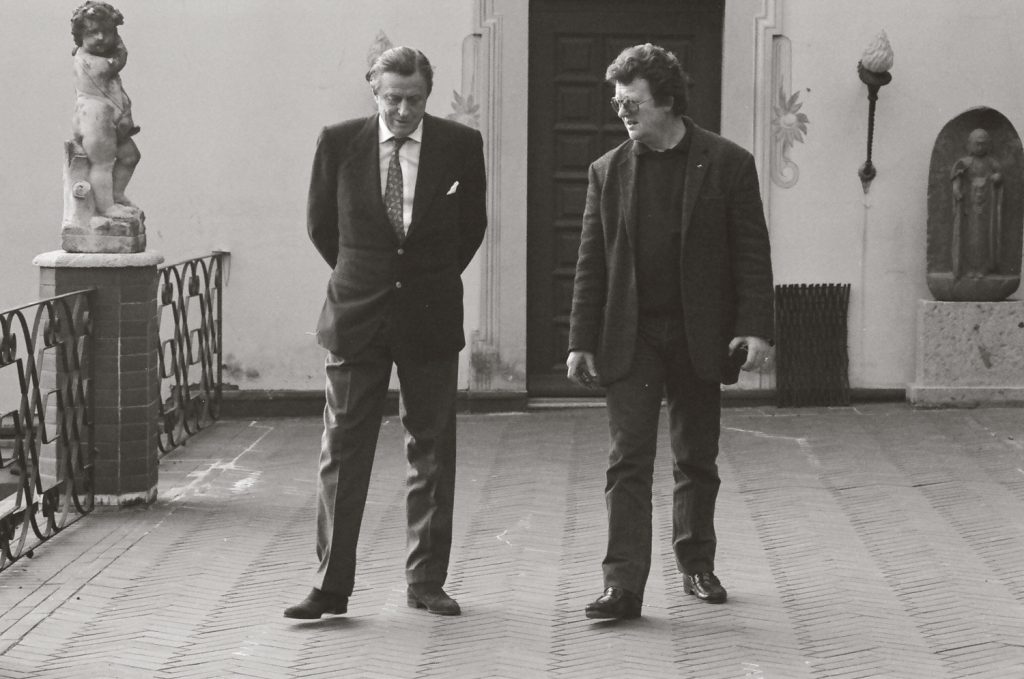 Hans Heinrich (‘Heini’) Thyssen-Bornemisza and David R L Litchfield at Villa Favorita, Lugano, Switzerland, 1989 (photo copyright Nicola Graydon) Weshalb ich weiss, dass Dr Jan Schleusener ein Lügner ist? Weil ich es bin, über den er lügt. Und ebenso über Hans Heinrich Thyssen. Aber „Heini“ weilt nicht mehr unter uns, und so erbe ich als sein Biograf die Verantwortung dafür, jedwede verleumderische Anschuldigung über unser persönliches und professionelles Verhältnis – sowie über meine Glaubwürdigkeit als Autor – zu hinterfragen.
Die erwähnten Lügen sind in Dr Schleusener’s Buch „Die Enteignung Fritz Thyssens“ enthalten, welches vom Ferdinand Schöningh Verlag im März 2018 veröffentlicht und von der Fritz Thyssen Stiftung gefördert wurde. In diesem Buch behauptet Jan Schleusener, es habe ein „Zerwürfnis“ zwischen „Heini“ und mir gegeben, nachdem er den Auftrag an mich für das Schreiben seiner Biografie „wieder zurückgezogen“ habe. Schleusener verweist sogar auf bestimmte Seiten der deutschen Ausgabe meines Buches „Die Thyssen-Dynastie“, wo, so gibt er fälschlicherweise an, ich diese Situation bestätigt hätte. Weiterhin besteht Schleusener darauf, mein Buch enthalte „in weiten Strecken“ eine „polemische Abrechnung“ mit „Heini“, und dass es „überdeutlich nicht sine ira et studio geschrieben“ sei. Sodann beteuert er, dass ich zwar „viele einschlägige Quellen studiert“ hätte, diese aber „einseitig“ auswerten würde, um meine „skandalisierenden Absichten“ zu stützen.
Die Wahrheit ist, dass die Absage später zurück gezogen wurde, ohne jemals Friktionen hervor gerufen zu haben. Ich habe mich mit „Heini“ Thyssen überaus gut verstanden (und genauso ging es auch Caroline Schmitz, meiner deutschen Mitarbeiterin) und hatte keinerlei Grund, irgend eine Rache an ihm zu üben; ganz im Gegenteil. Die genauen Umstände unserer Beziehung habe ich in meinem Buch geschildert, aber Dr Schleusener hat während er seine Studie erarbeitete weder versucht, mich zu kontaktieren, noch die Situation klar zu stellen. Es kann also kaum ein Zweifel daran bestehen, dass seine Anschuldigungen nicht nur falsch sind, sondern obendrein böswillig und darauf ausgelegt, mein Ansehen und meine Glaubwürdigkeit als Autor zu schädigen. Als solche sind sie als verleumderisch anzusehen.
Ich würde auch annehmen – da er ein (wenn auch bisher wenig etablierter Nachwuchs-) Wissenschaftler ist -, dass seine Studenten, die Stätten der Gelehrsamkeit, bei denen er in Stellung ist, und auch die Fritz Thyssen Stiftung, alle von ihm erwarten würden, dass er an gewissen Standards der Ehrlichkeit und Professionalität festhält. Dies tut er aber offensichtlich nicht. Das ist besonders bedenklich, wenn es um seine Forschungen zum Dritten Reich geht. So nehme ich an, Dr Schleusener erachtet das Lügen als eine zulässige Gepflogenheit, unbenommen des Themas oder erörterten Zeitraums. Dies wurde deutlich aus seiner abschlägigen Anwort auf meine E-Mails an ihn, in denen ich meiner Erwartung eines Widerrufs und einer Entschuldigung Ausdruck gab. Sein Verleger sah es als gänzlich unnötig an, mir überhaupt zu antworten. All dies sind keine guten Vorzeichen hinsichtlich der Genauigkeit dieser ganzen akademischen Serie von Büchern zum Thema Thyssen.
Schlussendlich möchte ich noch Dr Schleusener’s Anschuldigung behandeln, ich hätte gewisse Aspekte „skandalisiert“. In Wirklichkeit hatte ich gar keinen Bedarf, etwas zu skandalisieren, da die Geschichte selbst ohne jegliche Übertreibungen schon skandalös genug ist. Interessehalber: es war „Heini“ selbst, der den Titel-Slogan der englischen Ausgabe „Schande und Skandale in der Familie“ vorschlug. Und so weit es meine Freundschaft mit „Heini“ betrifft, so darf ich Dr Jan Schleusener an den letzten Paragraphen meines Buches erinnern: „In meiner Rolle als Heini Thyssen-Bornemiszas Beichtvater bin ich ein Teil dieser Familie geworden und werde es wohl immer bleiben. Und niemals werde ich ein Glas Rotwein an meine Lippen führen, ohne an ihn zu denken“. Nicht gerade die Gedanken eines Menschen, der auf Rache aus ist.
Tags: accuracy, Die Enteignung Fritz Thyssens, Die Thyssen-Dynastie, Ehrlichkeit, Ferdinand Schöningh Verlag, Fritz Thyssen Foundation, Fritz Thyssen Stiftung, Genauigkeit, Hans Heinrich Thyssen, honesty, Jan Schleusener, professionalism, Professionalität, The Expropriation of Fritz Thyssen, Third Reich
Posted in The Thyssen Art Macabre, Thyssen Corporate, Thyssen Family Comments Off on The Lies of Doctor Schleusener oder Die Lügen des Jan Schleusener
Monday, March 5th, 2018
| Dieses Buch zu rezensieren ist für uns ein echtes Ärgernis, da so viele Stränge und Einzelheiten darin unserem bahn-brechenden Werk über die Thyssens entlehnt sind, welches ein Jahrzehnt zuvor erschien, Derix uns nichtsdestotrotz keine einzige Nennung gewährt. Es ist erstaunlich, dass sie nicht genug berufsethisches Gefühl aufbringt, unseren Beitrag zur Thyssenschen Geschichtsschreibung an zu erkennen; vor allem wo sie doch auf einer Konferenz 2009 ausdrücklich erklärt haben soll, dass nicht-akademische Betrachtungsweisen, denen gegenüber die Fachwelt häufig Unbehagen empfände (und Berührungsängste mit der Angst vor Statusverlust im Kampf um Deutungshoheit), einen immer größeren Raum einnehmen.
Frau Derix selbst ist natürlich nicht vom ängstlichen Typ, auch wenn sie ziemlich scheinheilig wirkt. Sie scheint vorauseilenden Gehorsam an den Tag zu legen und voller Hingabe, die Erwartungen ihrer vermutlich parteiischen Zahlmeister in Gestalt der Fritz Thyssen Stiftung erfüllen zu wollen. Leider ist sie offensichtlich auch nicht die vorausschauendste Person, da sie z.B. schreibt, Heinrich Lübke, Direktor der August Thyssen Bank (er starb 1962) sei später Bundespräsident Deutschlands gewesen (jener Heinrich Lübke war in dieser Position bis 1969).
Aber die intellektuellen Unzulänglichkeiten der Simone Derix sind weitaus gravierender als es simple Sachfehler wären, die ohnehin mindestens einem ihrer zwei langjährigen Mitarbeiter, drei Projektleiter, vier akademischen Mentoren und sechs wissenschaftlichen Mitarbeiter hätten auffallen müssen. Sie versucht uns allen Ernstes zu erzählen, dass die Erforschung der Lebenswelten von reichen Personen ein vollkommen neuer Zweig der akademischen Forschung sei, und dessen illustrer Pionier sie selbst. Weiss sie denn nicht, dass Geschichtsschreibung klassischerweise ausschließlich von Reichen, über Reiche und für Reiche getätigt wurde? Hat sie bereits vergessen, dass selbst einfachstes Lesen und Schreiben bis vor hundert fünfzig Jahren Privilegien der wenigen Mitglieder der oberen Schichten waren?
Gleichzeitig erscheint sie, im Gegensatz zu uns, keine persönlichen Erfahrungen mit außergewöhnlich reichen Menschen erworben zu haben. Ihre Förderung, während eines früheren Vorhabens, durch die finanzstarke Gerda Henkel Stiftung war vermutlich gleichermaßen auf Armeslänge. Reiche Leute verkehren nur mit reichen Leuten, und es gibt keinerlei Anzeichen dafür, dass Derix sich irgendwie für ernst zu nehmende Kommentare über deren Lebensstil qualifiziert hätte, es sei denn, sie wurde für ihr vorliegendes Werk pro Wort bezahlt…
Was allerdings tatsächlich neu ist, ist dass der weg gefegte Feudalismus durch etablierte demokratische Gesellschaften ersetzt wurde, in denen Wissen allgemein zugänglich ist und die Gleichheit vor dem Gesetz Priorität hat. Ja, Derix hat Recht, wenn sie sagt, dass es schwierig ist, die Archive von Ultra-Reichen einzusehen. Diese wollen immer nur glorreiche Dinge über sich verbreiten und die Realitäten hinter ihrem überwältigenden Reichtum verbergen. Aber es ist grotesk so zu tun, als hätten die Thyssens jetzt auf einmal beschlossen, sich in Ehrlichkeit zu üben und offiziellen Historikern großzügig zu erlauben, ihre privatesten Dokumente zu sichten. Der einzige Grund, weshalb Simone Derix nunmehr einige kontroverse Fakten über die Thyssens publiziert, ist, dass wir diese bereits publiziert haben. Der Unterschied liegt darin, dass sie unsere Belege mit ausgesprochen positiven Termini neu umspannt, um dem allgemeinen Programm der Schadensbegrenzung dieser Serie gerecht zu werden.
Derix scheint zu glauben, auf diese Weise auf zwei Hochzeiten tanzen zu können; ein Balanceakt der dadurch drastisch erleichtert wird, dass sie bereits zu Anfang ihrer Studie jegliche Erwägungen bezüglich Ethik und Moral kategorisch ausschließt. Die Tatsache, dass die Thyssens ihre deutschen Firmen (inklusive derer, die Waffen produzierten und Zwangsarbeiter verwendeten) hinter internationalen Strohmännern tarnten (mit dem zusätzlichen Bonus der groß angelegten Umgehung deutscher Steuern) wird von Derix als irreführende Beschreibung dargestellt, welche “eine staatliche Perspektive impliziert” und angewandt wird, um “eine gewünschte Ordnung zu etablieren, nicht eine bereits gegebene Ordnung abzubilden”. Als ob “der Staat” eine Art hinterhältige Einheit sei, die bekämpft werden müsse, und nicht das gemeinschaftliche Unterstützungswesen für alle gleichgestellten, rechtstreuen Bürger, so wie wir Demokraten ihn verstehen.
Dies ist nur eine von vielen Äußerungen, die zu zeigen scheinen, wie sehr die möglicherweise als autoritär zu beschreibende Einstellung ihrer Sponsoren auf Derix abgefärbt hat. Die Tatsache, dass Akademiker, die bei öffentlich geförderten Universitäten angestellt sind, in solch einer Weise von den eigennützigen Institutionen Fritz Thyssen Stiftung, Stiftung zur Industriegeschichte Thyssen und ThyssenKrupp Konzern Archiv als Public Relations Vermittler missbraucht werden, ist äusserst fragwürdig; v.a. wenn man angeblich akademische Maßstäbe anlegt. Und vor allem wenn von diesen behauptet wird, sie seien unabhängig.
****************
In der Welt von Simone Derix werden die Thyssens immer noch (!) v.a. als „Opfer“, „(Steuer-)flüchtlinge“, als „enteignet“ und „entrechnet“ beschrieben; selbst wenn sie ein oder zwei Mal über 500 Seiten hinweg kurz zugeben muss, dass es ihnen in der “langfristigen Perspektive (…) gelungen zu sein (scheint), Vermögen stets zu sichern und für sich verfügbar halten zu können”.
Was ihre Beziehung zum Nationalsozialismus angeht, so nennt sie sie damit „verwoben“, „verquickt“, sagt, dass sie in ihm „präsent“ waren, in ihm „lebten“. Mit zwei oder drei Ausnahmen werden die Thyssens nie richtiger Weise als handelnde, profitierende, u.v.a. zum Bestand des Regimes beitragende Akteure beschrieben. Stattdessen wird die Schuld wiederum, genau wie in Band 2 („Zwangsarbeit bei Thyssen“), weitgehendst den Managern zugeschrieben. Dies ist für die Thyssens sehr praktisch, da die Familien dieser Männer nicht die Mittel haben, gleichwertige Gegendarstellungen zu publizieren, um ihre Lieben zu rehabilitieren.
Wenn Simone Derix jedoch davon spricht, dass „aus einer nationalstaatlichen Perspektive (…) diese Männer als Ganoven erscheinen (mussten)“, dann überschreitet sie bei Weitem die Grenzen der fairen Kommentierung. Die Ungeheuerlichkeit ihrer Behauptung verschlimmert sich dadurch, dass sie es unterlässt, Beweise beizufügen, so wie in unserem Buch geschehen, die zeigen, dass alliierte Ermittler klar aussprachen, dass sie die Thyssens selbst, nicht ihre Mitarbeiter, für die wahren Täter und Verdunkler hielten.
Und dennoch gibt Derix in ihrem Streben nach Thyssen Glanz vor, deutsche Größe, Ehre und Vaterlandsliebe zu beschwören. Immer wieder und auf bombastische Weise behauptet sie z.B., dass die Grablege / Gruft in Schloss Landsberg bei Mülheim-Kettwig „zukünftig die Präsenz der Familie und ihre Verbundenheit mit dem Ruhrgebiet garantieren (würde)“, und dass es im Falle der Thyssens einen „(unauflösbaren) (…) Zusammenhang von Familie, Unternehmen, Region und Konfession“ gibt. Dabei stuft sie die Thyssens nicht, wie es richtig wäre, im Rahmen der Industriellen-Familien Krupp, Quandt, Siemens und Bosch ein, sondern zieht es vor, ihren Namen übertreibend mit denen der Herrscherhäuser Bismarck, Hohenzollern, Thurn und Taxis und Wittelsbach zu umgeben.
In Wirklichkeit wählten viele der Thyssen-Erben eine Abkehr von Deutschland und ein transnationales Leben im Ausland. Ihr Mausoleum ist noch nicht einmal öffentlich frei zugänglich. Im Gegensatz zu dem was Derix andeutet, ist der starke, symbolische Name, der so eine Anhänglichkeit in Deutschland hervorruft, einzig der der Aktiengesellschaft Thyssen (jetzt ThyssenKrupp AG), als einem der Hauptarbeitgeber im Land. Dies hat überhaupt nichts mit Respekt für die Abkömmlinge des herausragenden August Thyssen zu tun, die aufgrund ihrer gewählten Abwesenheit in ihrer Mehrzahl in Deutschland absolut unbekannt sind.
****************
In diesem Zusammenhang ist es bezeichnend, dass Simone Derix die Thyssens als „altreich“ sowie „arbeitende Reiche“ kategorisiert. Obwohl Friedrich Thyssen Anfang des 19. Jahrhunderts bereits ein Bankier war, so waren es doch erst seine Söhne August (75% Anteil) und Josef (25% Anteil), die ab 1871 (und mit den Profiten aus zwei Weltkriegen) durch ihre unermüdliche Arbeit, und die ihrer Arbeiter und Angestellten, das enorme Thyssen-Vermögen schufen. Ihresgleichen ward in den nachfolgenden Thyssen-Generationen nie wieder gesehen.
So wurden die Thyssens ultravermögend und spalteten sich komplett von der etablierten adelig-bürgerlischen Oberschicht ab. Sie können wirklich nicht als „altreich“ bezeichnet werden, und ihre Erben auch nicht, auch wenn diese alles in ihrer Macht taten, um sich die äußere Aufmachung der Aristokratie anzueignen. (Hier stellt sich die dringende Frage, wieso Band 6 der Serie ausgerechnet „Fritz und Heinrich Thyssen – Zwei Bürgerleben in der Öffentlichkeit betitelt wurde). Dies beinhaltete die Einheiratung in den ungarischen, zunehmend falschen Adel, wonach, so muss es sogar Derix zugeben, mit dem Anbruch der 1920er Jahre jeder fünfte Ungar behauptete, der Aristokratie des Landes anzugehören.
Die Linie der Bornemiszas, in die Heinrich einheiratete z.B. waren eben nicht das alte „Herrschergeschlecht“ der Bornemiszas, auch wenn Derix das immer noch so wiederholt. Die Thyssen-Bornemiszas hatten Verbindung zum niederländischen Königshaus, nicht weil Heinrich’s Frau Margit bei Hofe selbsternannt „besondere Beachtung“ fand, sondern weil Heinrich in jenem Land wichtige Geschäftsinteressen vertrat. Dadurch wurde Heinrich Thyssen zum Bankier für das niederländische Königshaus und ein persönlicher Bekannter seines Namensvettern Heinrich, des Prinzgemahls der Königin Wilhelmina.
Außer für solche wirtschaftlichen Beziehungen wollten weder der deutsche, noch der englische oder irgend ein anderer europäischer Adel in Wirklichkeit diese Aufsteiger in ihren engeren Reihen willkommen heissen (Religion spielte natürlich auch eine Rolle, denn die Thyssens waren und sind katholisch). Das heisst, bevor nicht gesellschaftliche Konventionen mit Beginn der 1930er Jahre sich weit genug geändert hatten und ihre Töchter in die tatsächlich alten ungarischen Dynastien der Batthyanys und Zichys einheiraten konnten.
Aber bis dahin ließen sich die Brüder, basierend auf ihrem hervorragenden Reichtum, nicht davon abhalten, sich viele der erhabenen Sphären selbst zu erschließen. Laut Derix verbrachte Fritz Thyssen Anfang des 20. Jahrhunderts sogar Zeit damit, Pferde aus England zu importieren, die englische Fuchsjagd in Deutschland einzuführen und sich eine Hundemeute zur Hetzjagd auf Hirsche zuzulegen. Weiterhin ließ er anscheinend den Trakt für Dienstpersonal seines neu gebauten Hauses in Mülheim niedriger halten, um die „Differenz und Distanz zwischen Herrschaft und Personal“ zu signalisieren.
Dies sind tatsächlich erstaunliche, neue Offenbarungen, die zeigen, dass das traditionelle Bild, welches die Thyssen Organisation bisher herausgab, nämlich das des „Bad Cop“ Fritz Thyssen (deutscher Industrieller, „temporärer“ Faschist), „Good Cop“ Heinrich Thyssen-Bornemisza (Ungar, „Adeliger“) sogar noch irreführender ist, als wir bisher angenommen hatten.
****************
Wirklich bedauernswert sind die Versuche von Derix, Fritz Thyssen als gläubigen Peacenik und Mitglied einer gemäßigten Partei darzustellen. Und genauso sind es ihre lang anhaltenden Verrenkungen, Heinrich Thyssen-Bornemisza als perfekt assimilierten, ungarischen Gutsherren zu portraitieren. Sie berichtet allerdings, dass Heinrich’s Frau erwähnt hatte, dass er kein Wort der Sprache beherrschte; was allerdings Felix de Taillez in Band 6 nicht davon abhält, zu behaupten, er habe Ungarisch gesprochen. „Wenn Sie sie nicht schlagen können, dann müssen Sie sie verwirren“ war eines von Heini Thyssen’s Mottos. Es ist offensichtlich auch das Motto dieser Thyssen-finanzierten Akademiker geworden.
Währenddessen ist das Buch von Derix das erste von der Thyssen Organisation unterstützte Werk, das bestätigt, dass Heinrich Thyssen-Bornemisza eben doch seine deutsche (damals preussische) Staatsangehörigkeit beibehielt. Derix traut sich sogar soweit hervor, zu sagen, dass die ungarische Staatsangehörigkeit „von Heinrich möglicherweise aus funktionalen Gründen gewählt“ worden war. Doch diese Perlen der Aufrichtigkeit werden unter den Springbrunnen ihrer überschwänglichen Propaganda rasch erstickt, die darauf abzielt, die Thyssens der zweiten Generation besser dastehen zu lassen, als sie waren. Dies erstreckt sich auch darauf, die Rolle des August Thyssen Junior von der des schwarzen Schafs der Familie auf die des engagierten Unternehmers um zu schreiben.
Andererseits unterlässt es die Autorin immer noch, irgendwelche unternehmerischen Details zum Leben des weitaus wichtigeren Heinrich Thyssen in England um die Jahrhundertwende zu liefern (Stichworte: Banking und Diplomatie). Wie genau machte die Familie die enge Bekanntschaft von Menschen wie Henry Mowbray Howard (britischer Verbindungsoffizier beim französischen Marineministerium) oder Guy L’Estrange Ewen (Sonderbotschafter der Britischen Monarchen)? Eine große Chance zur echten Transparenz wurde hier vergeudet.
Derix unterlässt es weiterhin, das Augenmerk darauf zu richten, dass die Familienzweige August Thyssen und Josef Thyssen sich in sehr unterschiedliche Richtungen entwickelten. August’s Erben nützten Deutschland aus, verließen und verrieten es und waren ausgesprochen „neureich“, außer Heinrich’s Sohn Heini Thyssen-Bornemisza und dessen Sohn Georg Thyssen, die sich tatsächlich mit dem Management ihrer Firmen befassten.
Im Unterschied dazu verblieben Josef Thyssen’s Erben Hans Thyssen und Julius Thyssen in Deutschland (bzw. waren bereit dorthin aus der Schweiz zurück zu kehren, als in den 1930er Jahren Devisenbeschränkungen erlassen wurden), zahlten ihre Steuern, arbeiteten im Thyssen Konzern, bevor sie in den 1940er Jahren ihre Anteile verkauften, ihre Resourcen bündelten und berufliche Karrieren einschlugen. Nur Erben Josef Thyssen’s sind auf der Liste der 1001 reichsten Deutschen des Manager Magazins aufgeführt, aber aus unerklärten Gründen lässt Derix diese tatsächlich „arbeitenden reichen“ Thyssens in ihrer Studie weitgehenst unerwähnt.
****************
Glücklicherweise konzentriert Simone Derix nicht all ihre Kräfte auf schöpferische Erzählungen und Plagiarisierung, sondern bietet auch wenigstens einige politökonomische Fakten an. So legt sie offen, dass Heinrich Thyssen-Bornemisza bis 1933 ein Mitglied des Aufsichtsrats der Vereinigten Stahlwerke in Düsseldorf war, also bis nach Adolf Hitler’s Machtergreifung. Dies, in Kombination mit ihrer Aussage, dass sich Heinrich „bereits 1927/8 (von Scheveningen in den Niederlanden) dauerhaft nach Berlin orientiert zu haben (scheint)“ widerlegt eine der größten Thyssenschen Dienlichkeitslegenden, nämlich die, Heinrich Thyssen-Bornemisza habe ab 1932 seinen Hauptwohnsitz in der neutralen Schweiz gehabt (i.e. praktischerweise vor Hitler’s Machtergreifung); nachdem er „Deutschland noch rechtzeitig verlassen hatte“; obschon dies Derix nicht davon abhält, auch diese Täuschung danach gleichfalls noch zu wiederholen (- „Wenn Sie sie nicht schlagen können, dann müssen Sie sie verwirren“ -).
Tatsache ist, dass Heinrich Thyssen, obwohl er 1932 die Villa Favorita in Lugano (Schweiz) kaufte, weiterhin den Großteil seiner Zeit in verschiedenen Hotels verbrachte, v.a. aber in einer permanenten Hotelsuite in Berlin und ausserdem einen Wohnsitz in Holland beibehielt (wo Heini Thyssen fast allein, bis auf das Personal, aufwuchs). („Sein Tessiner Anwalt Roberto van Aken musste ihn 1936 daran erinnern, dass er immer noch nicht seine permanente Aufenthaltsbewilligung in der Schweiz beantragt hatte. Erst im November 1937 wurden Heinrich Thyssen und seine Frau mit je einem Ausländerausweis der Schweiz ausgestattet“ – Die Thyssen-Dynastie, Seite 149).
Derix justiert auch den alten Thyssen Mythos neu, wonach Fritz Thyssen und Heinrich Thyssen-Bornemisza geschäftlich kurz nach ihrer Erbschaft von ihrem Vater, der 1926 starb, geschäftlich getrennte Wege gegangen seien. Wir haben stets gesagt, dass die beiden Brüder bis tief in die zweite Hälfte des 20. Jahrhunderts eng miteinander verbunden blieben. Und simsalabim plötzlich gibt Derix nunmehr an: „Bisher wird davon ausgegangen, dass die Separierung des Vermögens von Heinrich Thyssen-Bornemisza und Fritz Thyssen 1936 abgeschlossen war“. Sie fügt hinzu: „Trotz aller Versuche, die Anteile von Fritz Thyssen und Heinrich Thyssen-Bornemisza voneinander zu separieren, blieben die Vermögen von Fritz und Heinrich (vertraglich geregelt) bis in die Zeit nach dem zweiten Weltkrieg miteinander verschränkt“.
Aber es ist ihr folgender Satz, der am ärgerlichsten ist: „Außenstehende konnten diesen Zusammenhang offenbar nur schwer erkennen“. In Wahrheit war die Situation deshalb so undurchsichtig, weil die Thyssens und ihre Organisation erhebliche Anstrengungen unternahmen und alles ihnen Mögliche taten, um die Dinge zu verschleiern, v.a. da dies bedeutete, dass sie die gemeinsame Unterstützung des Naziregimes durch die Thyssen Brüder tarnen konnten.
****************
Unter der großen Anzahl der Berater der Thyssens stellt die Autorin insbesondere den Holländer Hendrik J Kouwenhoven vor, und zwar als die Hauptverbindung zwischen den beiden Brüdern Fritz und Heinrich. „Er tat Chancen auf und erdachte Konstruktionen“, so schreibt sie. Kouwenhoven arbeitete seit 1914 bei der Handels en Transport Maatschappij Vulcaan der Thyssens und danach bei ihrer Bank voor Handel en Scheepvaart (BVHS) in Rotterdam seit ihrer offiziellen Gründung 1918 bis zu seiner Entlassung durch Heinrich Thyssen-Bornemisza im zweiten Weltkrieg.
Vermögensverwaltungsgesellschaft und Trust Department der BVHS war das Rotterdamsch Trustees Kantoor (RTK), welches Derix als „Lagerstätte für das Finanzkapital der (Thyssen) Unternehmen wie für die privaten Gelder (der Thyssens)“ beschreibt. Sie sagt nicht, in welchem Jahr diese Gesellschaft gegründet wurde. Laut Derix wurden „das Gebäude der Vermögensverwaltung, der Heinrich Thyssen-Bornemisza alle wichtigen Papiere anvertraut hatte (…), am 14. Mai 1940 bei einem Luftangriff auf Rotterdam (…) vollständig zerstört“. Für uns klingt das wie eine höchst fragwürdige Information.
Über die Akten der BVHS sagt Derix knapp: „Von der BVHS ist kein geschlossener Quellenbestand erhalten“. Wie praktisch, insbesondere da niemand außerhalb der Thyssen Organisation jemals in der Lage sein wird, diese Aussage wahrhaft unabhängig zu überprüfen; zumindest nicht bevor der Schutzmantel des Professor Manfred Rasch, Leiter des ThyssenKrupp Konzern Archivs, sich in den Ruhestand verabschiedet.
Derix spielt auf die „frühe Internationalisierung des (Thyssen) Konzerns“ ab 1900 an, und rechnet ihre Kenntnisse über Rohstoffankäufe und den „Aufbau eines eigenen Handels- und Transportnetzes“ Jörg Lesczenski zu, der zwei Jahre nach uns publizierte, und dessen Buch ebenfalls, so wie das von Derix, durch die Fritz Thyssen Stiftung unterstützt wurde. Aber sie unterlässt Querverweise auf die ersten Steueroasen (inklusive der der Niederlande), die sich zum Ende des 19. Jahrhunderts hin entwickelten und überlässt diesen Bereich bequem zukünftiger Forschung, die „weitaus intensiver“ ausfallen müsse „als dies bislang vorliegt“.
Derix nennt die Transportkontor Vulkan GmbH Duisburg-Hamborn von 1906 mit ihrer Filiale in Rotterdam (siehe oben) und die Deutsch-Überseeische Handelsgesellschaft der Thyssenschen Werke mbH in Buenos Aires von 1913 (übrigens: bis zum heutigen Tage ist die ThyssenKrupp AG im großen Stil im Rohmaterialhandel aktiv). Sie schreibt auch, dass die US-Amerikanischen Kredite für den Thyssen Konzern 1919 via der Vulcaan Coal Company begannen (verschweigt jedoch, dass diese Firma in London angesiedelt war).
****************
Nach Angaben von Simone Derix begann August Thyssen 1919 damit, seine Anteile an den Thyssen Unternehmen an seine Söhne Fritz und Heinrich zu übertragen, zunächst die von Thyssen & Co. und ab 1921 die der August Thyssen Hütte. Sie fügt hinzu, dass „bestehende Thyssen Einrichtungen im Ausland für Tausch und Umschichtung von Beteiligungen“ genutzt wurden.
Ab 1920 kaufte Fritz Thyssen in Argentinien Land. Die Thyssensche Union Banking Corporation (UBC), 1924 im Harriman Building am Broadway, New York, gegründet, wird währenddessen allein in der Sprache der „transnationalen Dimension des Thyssenschen Finanzgeflechts“ beschrieben und als „die American branch“ der Bank voor Handel en Scheepvaart.
Wir hatten bereits in unserem Buch beschrieben, wie Heinrich Thyssen-Bornemisza, über Hendrik Kouwenhoven, in der Schweiz 1926 die Kaszony Stiftung institutierte, um seine ererbten Firmenanteile zu deponieren; und 1931 die Stiftung Sammlung Schloss Rohoncz, als Depot für seine Kunstgegenstände, die er ab 1928 als leicht bewegliche Kapitalanlagen kaufte. Jetzt schreibt Derix, dass letztere ebenfalls bereits 1926 gegründet worden sei. Dies ist estaunlich, da es bedeutet, dass dieses Finanzinstrument ganze zwei Jahre bevor Heinrich Thyssen das erste Gemälde kaufte, gegründet wurde, das seinen Weg in die Sammlung fand, die er „Sammlung Schloss Rohoncz“ nannte (obwohl keines der Bilder jemals auch nur in die Nähe seines ungarischen, dann österreichischen Schlosses fand, in dem er ab 1919 nicht mehr lebte).
Die Terminierung der Bildung dieses Offshore-Instruments zeigt einmal mehr wie gekünstelt Heinrich Thyssen’s Neuerfindung als „Kunstkenner und Sammler“ tatsächlich war.
Derix gibt sogar freimütig zu, dass die Thyssenschen Familienstiftungen als „Gegenspieler (…) von Staat und Regierung auftraten“. Jedoch versäumt sie es, genauso wie Johannes Gramlich in Band 3 („Die Thyssens als Kunstsammler“) die Logistik des Transfers von ca. 500 Bildern durch Heinrich Thyssen-Bornemisza in die Schweiz in den 1930er Jahren zu beschreiben, inklusive der Tatsache, dass dies eine Methode der großangelegten Kapitalflucht aus Deutschland heraus darstellte. Die assoziierten Themen der Steuerflucht und Steuerumgehung bleiben vollständig außerhalb ihres akademischen Radars, und sie lässt damit z.B. unsere dokumentierten Belege aus.
****************
In einer weiteren, wagemutigen Um-Schreibung der offiziellen Thyssen Historie erklärt die Autorin, dass die Thyssen Brüder in ihren Finanzangelegenheiten oft parallel agierten. Und so kam es, dass die Pelzer Stiftung und Faminta AG von Kouwenhoven für Fritz Thyssen’s Seite in der Schweiz gegründet wurden. (Derix bleibt vage bestreffs genauer Daten. Wir haben veröffentlicht: 1929 für Faminta AG und die späten 1930er Jahre für die Pelzer Stiftung).
Derix weist darauf hin, dass diese beiden Finanzinstrumente auch geheime Transaktionen zwischen den zwei Thyssen Brüdern erlaubten. Vage bleibend fügt sie hinzu, sie hätten auch „das Auslandsvermögen der August Thyssen Hütte vor einer möglichen Beschlagnahmung durch deutsche Behörden (gesichert)“. Dabei verschweigt sie jegliche Referenz betreffs Zeitskala, und demnach wann genau solch eine Beschlagnahmung im Raum getanden haben soll (gibt sie hier etwa zu verstehen, dass diese bereits vor Fritz Thyssen’s Flucht aus Deutschland im September 1939, also im Zeiraum 1929-1939 zu erwarten gewesen sein könnte?).
Gleichzeitig etablierten Fritz und Amelie Thyssen einen festen Standort in den 1920er Jahren im Süden des deutschen Reiches, und zwar in Bayern (weit weg vom Thyssenschen Kerngebiet der Ruhr), welchen Derix als „bisher von der Forschung wenig beachtet“ darstellt. Natürlich war dieser monarchistischste aller deutschen Staaten nicht nur nah an der Schweiz, sondern er war zu jener Zeit auch die Wiege der Nazi Bewegung. Auch Adolf Hitler zog München Berlin vor.
Alle Finanzinstrumente der Familie wurden währenddessen weiter durch die Rotterdamsch Trustees Kantoor in den Niederlanden verwaltet. Diese „neu geschaffenen Banken, Gesellschaften, Holdings und Stiftungen wurden über Beteiligungen mit den produzierenden Thyssenschen Unternehmen verknüpft“, so Derix weiter.
Diese Unternehmen usw. waren aber ebenso mit der aufsteigenden Nazi Bewegung verknüpft, so z.B. durch einen Kredit von ca. 350,000 Reichsmark, den ihre Bank voor Handel en Scheepvaart ca. 1930 der NSDAP gewährte, zu einer Zeit, als sowohl Fritz Thyssen als auch Heinrich Thyssen-Bornemisza beherrschende Anteile an der BVHS hatten.
Laut Derix war es im Jahr 1930, dass Heinrich Thyssen anfing, seine Anteile an den Vereinigten Stahlwerken an Fritz zu verkaufen, während Fritz seine holländischen Anteile an Heinrich verkaufte. In der Nachfolge war Heinrich Thyssen dann allein in Kontrolle der Bank voor Handel en Scheepvaart, und zwar von 1936 an.
Insbesondere war es eine Thyssen Firma mit Namen Holland-American Investment Corporation (HAIC), die Fritz Thyssen’s Kapitalflucht aus Deutschland ermöglichte. Laut Derix erwarb die Pelzer Stiftung „im Herbst 1933 von Fritz Aktien der HAIC und damit seine darin zusammengefassten niederländischen Beteiligungen. Dieses Geschäft geschah mit Zustimmung der deutschen Behörden, die von der HAIC wussten. Aber 1940 sahen die Deutschen, dass eine erhebliche Diskrepanz bestand zwischen 1,5 Millionen Reichsmark der niederländischen Beteiligungen in HAIC wie angegeben, und dem tatsächlichen Wert von 100 bis 130 Millionen RM.“
Dies ist überwältigend, da der heutige Wert dieser Summe bei vielen hundert Millionen Euros liegt!
Wenn man bedenkt, dass Heinrich’s Frau angab, dass er ca. 200 Millionen Schweizer Franken seines Vermögens in neutrale Länder gebracht hatte, dann würde dies bedeuten, dass die Thyssen Brüder es möglicherweise geschafft hatten, zusammen einen Gegenwert in Bar aus Deutschland abzuziehen, der fast dem gesamten Geldwert der Thyssen Unternehmen entsprach! Dies aber ist keine Schlussfolgerung, die Simone Derix zieht.
Man beginnt, sich zu wundern, was eigentlich zur Beschlagnahmung übrig gewesen sein soll, nachdem Fritz Thyssen bei Kriegsbeginn 1939 Deutschland verließ. Derix räumt ein, dass seine Flucht nicht zuletzt deshalb stattfand, weil er seine eigennützigen Finanztransaktionen lieber von der sicheren Schweiz aus, mit Hilfe des Heinrich Blass bei der Schweizerischen Kreditanstalt in Zurich, vervollständigen wollte.
Obwohl wir einige Hinweise auf Summen herausarbeiten konnten, so hatten wir doch keine Ahnung, dass das Gesamtausmaß der Kapitalflucht durch die Gebrüder Thyssen so dramatisch war. Dass Simone Derix diesen Punkt im Namen der Thyssen Organisation anspricht ist beachtenswert; selbst wenn sie es unterlässt, die angemessenen Schlussfolgerungen zu ziehen – möglicherweise da diese ihrem „Blue-Sky“ Auftrag zuwiderlaufen würden.
Fürwahr und in den Worten des weitaus erfahreneren Harald Wixforth steht für diese „Großkapitalist(en) (…) tatsächlich (…) das Profitinteresse des Unternehmens immer über dem Volkswohl“.
Es versteht sich von selbst, dass wir die Bände von Harald Wixforth und Boris Gehlen über die Thyssen Bornemisza Gruppe 1919-1932 und 1932-1947 mit Interesse erwarten.
****************
In diesem korrigierten offiziellen Licht überrascht Derix’s Zugeständnis, dass Fritz und Amelie Thyssen’s „Enteignung (…) jedoch nicht unmittelbar mit einer Einschränkung der Lebensführung verbunden (war)“ nun wirklich überhaupt nicht mehr.
Die Autorin gibt auch zum ersten Mal offizielle Abreisedaten für Fritz Thyssen’s Tochter Anita, ihren Ehemann Gabor und ihren Sohn Federico Zichy nach Argentinien bekannt. So fuhren sie anscheinend am 17.02.1940 an Bord des Schiffs Conte Grande von Genua in Richtung Buenos Aires. Um sie mit der standesgemäßen finanziellen Rückendeckung auszustatten waren kurz zuvor Anteile der Faminta AG in den Übersee-Trust Vaduz transferiert worden, dessen einzige Begünstigte Anita Zichy-Thyssen war, die die ungarische Staatsbürgerschaft besaß.
Derix schreibt sodann, dass Fritz Thyssen im April 1940 „sein politisches Wissen über das Deutsche Reich und die deutsche Rüstungsindustrie als ein Gut (einbrachte), das er im Tausch gegen die Unterstützung seiner Anliegen anbieten konnte“. Was aber genau waren diese Anliegen? Der hochmütig wahnhafte Fritz glaubte offensichtlich, dass er Hitler genauso einfach loswerden könne, wie er ihm einstmals zur Macht verholfen hatte. Dafür war er bereit, deutsche Staatsgeheimnisse mit dem französischen Außenminister Alexis Leger und dem Rüstungsminister Raoul Dautry in Paris zu teilen. Aber für Derix ist dieses Verhalten keinesfalls etwas Strittiges wie z.B. aktiver Landesverrat oder ein Ausdruck der Macht, sondern nichts weiter als das legitime Recht eines Ultra-Reichen, die Wahlmöglichkeiten seines gehobenen Lebensstils auszudrücken.
Während alle vorangegangene Thyssen Biografen, mit Ausnahme von uns, behauptet haben, die Thyssens hätten unausprechliche „Qualen“ während ihrer Inkarzeration in Konzentrationslagern erlebt, bestätigt Derix nunmehr unsere Information, dass sie die meiste Zeit ihrer Inhaftierung in Deutschland im bequemen, privaten Sanatorium des Dr Sinn in Berlin-Neubabelsberg verbrachten. Derix schreibt, sie seien dort „auf Befehl des Führers“ und „auf Ehrenwort“ gewesen. Dabei gab Fritz und Heinrich’s persönlicher Freund Hermann Göring während seiner alliierten Befragungen nach dem Krieg an, er habe diese privilegierte Behandlung initiiert. Nach Neubabelsberg wurden sie in verschiedene Konzentrationslager gebracht, aber Derix ist nunmehr gezwungen einzugestehen, dass sie sich jeweils eines Sonderstatuses erfreuten, der „an allen Aufenthaltsorten belegbar“ sei. Was die Frage aufwirft, warum deutsche Historiker es in der Vergangenheit für nötig erachtet haben, diese Fakten falsch darzustellen.
Derix’s Liste der alliierten Befragungen des Fritz Thyssen nach dem Krieg ist besonders bemerkenswert. Sie illustriert, mit welchem Ernst er der, wenn auch Unternehmens-bedingten, Kriegsverbrechen beschuldigt wurde; genug um ihn mit Inhaftierung zu bestrafen:
Im Juli 1945 wurde er ins Schloss Kransberg nahe Bad Nauheim gebracht, und zwar zum sogenannten Dustbin Zentrum für Wissenschaftler und Industrielle der amerikanischen und britischen Besatzungsmächte. Im August kam er nach Kornwestheim, und im September zum 7th Army Interrogation Center in Augsburg.
Derix erwähnt auch vage, Fritz Thyssen sei irgendwann 1945 durch Robert Kempner, Chefankläger bei den Nürnberger Prozessen, befragt worden.
Thyssen erlitt einen Kollaps und musste sich in ärztliche Behandlung begeben. Er wurde ins US Gefangenenlager Seckenheim gebracht, danach nach Oberursel. Sein Gesundheitszustand verschlimmerte sich. Von April bis November 1946 war er in verschiedenen Krankenhäuser und Kuranstalten zwischen Königstein (wo er eine unerwartete Besserung erlebte) und Oberursel. Ab November 1946 war Fritz Thyssen als Zeuge bei den Nürnberger Nachfolgeprozessen (man nimmt an, in den Fällen von Alfried Krupp und Friedrich Flick) geladen, während er weiterhin ständig Krankenhausbehandlungen erhielt, diesmal in Fürth.
Am 15.01.1947 wurde Fritz Thyssen entlassen und vereinigte sich wieder mit seiner Frau Amelie in Bad Wiessee. Danach kam sein deutscher Entnazifizierungsprozess in Königstein, wo er und Amelie im Sanatorium des Dr Amelung wohnten. In diesem Gericht, wie es seinem unaufrichtigen Charakter entsprach, gab Fritz Thyssen an, keinen Heller zu besitzen.
Währenddessen, so Derix, trat Anita Zichy-Thyssen mit Edmund Stinnes in Kontakt, der in den USA lebte, und mit dessen Schwager Gero von Schulze-Gaevernitz, einem engen Mitarbeiter des US Geheimdienstchefs Allen Dulles. Im Frühjahr 1947 traf sie sich, um „eine Ausreisegenehmigung ihrer Eltern nach Amerika zu erwirken“, mit dem früheren US-Senator Burton K Wheeler in Argentinien, der 1948 nach Deutschland reiste „um Fritz Thyssen aus seinen Denazifizierungsschwierigkeiten zu helfen“. Dies ist sicherlich ein Aspekt einer Einflussnahme auf höchster Ebene, die wir mit weitaus größeren Einzelheiten in unserem Buch präsentiert haben, die aber Johannes Bähr in seinem Band 5 der Serie („Thyssen in der Adenauerzeit“) erstaunlicherweise vollkommen unterschlägt.
****************
Ein anderer Thyssen, der Probleme mit seiner Entnazifizierung gehabt haben sollte, dies aber nicht tat, war Heinrich’s Sohn Stephan Thyssen-Bornemisza.
Während sein Bruder Heini Thyssen im Deutschen Realgymnasium in Den Haag erzogen wurde, war Stephan auf das Internat Lyceum Alpinum in Zuoz, Schweiz, gegangen, wo die meisten Schüler aus der deutsch-sprachigen Schweiz, den Niederlanden und dem deutschen Reich stammten, bzw. Auslandsdeutsche waren. Demnach gab es in diesem Internat drei Schülerhäuser, mit den Namen „Teutonia“, „Orania“ und „Helvetia“. Nachdem er in Zurich und am Massachusetts Institute of Technology studiert hatte wurde er Assistent in einem Forschungslabor der Shell Petroleum Company in St. Louis. Dann schrieb er an der Universität Budapest seine Doktorarbeit und begann in der Lagerstättenforschung zu arbeiten.
Ab 1932, während er in Hannover lebte, arbeitete Stephan für die Seismos GmbH, eine Firma, die sich mit der Suche nach Bodenschätzen befasste. Sie wurde 1921 durch die Deutsch-Lux, Phoenix, Hoesch, Rheinstahl und die Gelsenkirchener Bergwerks AG gegründet. Derix schreibt: „Ab 1927 war die Gelsenkirchener Bergwerks AG, die wiederum zur 1926 gegründeten Vereinigte Stahlwerke AG gehörte, mit 50 Prozent der Anteile der Haupteigner des Unternehmens. Damit fiel Seismos unter Fritz Thyssens Teil des familialen Erbes. (…) In den 1920er Jahren waren die Messtrupps der Seismos für Ölfirmen wie Royal Dutch Shell oder Roxana Petroleum in Texas, Louisiana und Mexiko auf der Suche nach Öl. (…) Ihr Aktionsradius (weitete) sich auch auf den Nahen Osten, Südeuropa und England aus“.
1937 kaufte Heinrich Thyssen die Seismos für 1.5 Millionen Reichsmark und gliederte sie seinen Thyssenschen Gas- und Wasserwerken an. Während des Krieges, so Derix, war die Firma „an der Erschließung der Rohstoffe in den besetzten Gebieten beteiligt. (…) Beim Verlassen der Ostukraine im Zuge der Panzerschlacht von Kursk 1943 (musste sie) zahlreiches Gerät (…) zurücklassen“.
Hier liegt also einiges an Bedeutung vor für eine Firma, von der bisherige offizielle Thyssen Historien, wenn überhaupt, wenig Relevantes zu berichten hatten.
Und einiges an Bedeutung auch für den verschwiegenen Heinrich Thyssen-Bornemisza, dessen Sohn Heini Thyssen kurz nach Kriegsende seinen Schweizer Rechtsanwalt Roberto van Aken zu folgender Falschaussage gegenüber der US amerikanischen Visabehörde veranlasste: „Seit dem Aufstieg der Nazis an die Macht, insbesondere seit 1938, waren Dr Heinrich Thyssen-Bornemiszas niederländische Unternehmen angehalten, die Aufrüstungsbestrebungen der Nazis zu unterlaufen.“ (Die Thyssen-Dynastie, Seite 265)
Es ist fast in diesem gleichen, verschleiernden Geiste, dass Derix immer noch die Tatsache verbirgt, dass Seismos während des Kriegs sein Hauptquartier von Hannover in den Harz verlegte, wo das Nazi Programm der Massenvernichtungswaffen (V-Waffen) sein Zentrum finden sollte.
Derix deckt auf, dass Stephan ein Mitglied des NS-Fliegerkorps war und bestätigt seine Rolle als förderndes Mitglied der SS. Seine politische Haltung war anscheinend als „ohne jeden Zweifel“ beschrieben worden. Doch bringt es Derix nicht fertig, seine Involvierung in eine weitere Firma, nämlich die Maschinen- und Apparatebau AG (MABAG) Nordhausen auch nur zu erwähnen, geschweige denn dabei ins Detail zu gehen, die ebenfalls im Harz ansässig war.
Wir hatten bereits herausgefunden, dass Stephan Thyssen in den ersten Kriegsjahren Aufsichtsratsvorsitzender der MABAG geworden war. Diese Firma hatte, zusammen mit der IG Farben, „die Anlage eines ausgedehnten Höhlen- und Tunnelsystems im Kohnstein, einem Berg bei Nordhausen (begonnen), ausgestattet mit Tanks und Pumpen (…) Ab Februar 1942 empfahl Reichminister für Bewaffnung und Munition Albert Speer, den Bau von Raketen mit allen Mitteln zu unterstützen. Das war ein extrem ehrgeiziger Waffenherstellungsplan und bedeutete erheblich mehr Aufträge für die MABAG, die unter Aufsicht der Wehrmacht jetzt auch Turbopumpen für die V-Waffen produzierte“. (Die Thyssen Dynastie, S. 203).
Wir hatten angenommen, dass Stephan’s Position als Vorsitzender der MABAG mit einer größeren Investition seitens seines Vaters zusammengehangen haben muss. Simone Derix spricht das Thema überhaupt nicht an, aber der Rechtsanwalt und Historiker Frank Baranowski hat ein sehr wichtiges Dokument gefunden und erklärt auf seiner Webseite:
„1940 stieß der Deutsche Erdöl-Konzern nach einem Wechsel an der Spitze alle seine Werke, die nicht direkt in den Rahmen der Mineralöl- und Kohlegewinnung passten ab, darunter auch die MABAG. Von der Deutschen Bank vermittelt, ging das Aktienkapital von einer Million RM in verschiedene Hände über. Die Mehrheit erwarb Rechtsanwalt und Notar Paul Langkopf aus Hannover (590.000 RM), und zwar vermutlich im Auftrag eines Mandanten, der ungenannt bleiben wollte. Kleinere Anteile hielten die beiden Außenstellen der Deutsche Bank in Leipzig (158.000 RM) und Nordhausen (14.000 RM) sowie Stephan Baron von Thyssen-Bornemisza in Hannover (50.000 RM). Am 14. September 1940 wählte die MABAG ihren neuen Aufsichtsrat: (…) Direktor Schirner (…), Paul Langkopf, Stephan Baron von Thyssen-Bornemisza und der Leipziger Bankdirektor Gustav Köllman (…) (Die MABAG sah sich ……..als reiner Rüstungslieferant und produzierte…… u.a. Granaten, Granatwerker …………und Turbopumpen für die A4-Raketen).“
Wie durch Zufall ist Paul Langkopf nun ausgerechnet ein Mann, dessen Dienste verschiedene Mitglieder der Familie über die Jahre in Anspruch genommen hatten. Es kann davon ausgegangen werden, dass der „anonyme“ Aktionär Stephans Vater Heinrich Thyssen-Bornemisza war. Die Geheimhaltung der Transaktion entspricht komplett seinem Stil. Und während Baranowskis Ansichten über die Verwendung von Zwangsarbeitern bei der MABAG und unsere auseinander gehen, so ist dieses von ihm erschlossenen Dokument doch ein weiterer Hinweis dafür, dass Heinrich während des Krieges definitiv 100% pro-Nazi war; während er sich anscheinend aus der Welt verabschiedet hatte und weit weg in seinem sicheren, Schweizer Hafen weilte, so wirkend, als hätte er mit gar nichts etwas zu tun.
Die große Simone Derix zieht es während dessen vor, sich auf relativ Triviales zu konzentrieren, so wie die Tatsache dass Stephan’s Mutter Margit ebenfalls, mit ihrem zweiten Mann, dem „germanophilen“, „antisemitischen“ Janos Wettstein von Westersheimb (der nach der Kriegswende 1943 seinen Job bei der Ungarischen Botschaft in Bern plötzlich verlor) während des Kriegs in der Schweiz lebte. Anscheinend hat sie sich nach dem Krieg für Stephans Ausreise aus Deutschland eingesetzt, und zwar bei keinem Geringeren als Heinrich Rothmund, der während des Kriegs für weite Teile der anti-jüdischen Asylpolitik der Schweiz verantwortlich war.
****************
Schließlich bearbeitet Simone Derix noch zwei Themen in ihrem Buch – die wir auch behandelt haben, wenn auch zu einem verschiedenen Grad -; nämlich 1.) Die Golddeponierung der Thyssens in London vor dem Krieg und was damit während bzw. nach dem Krieg geschah und 2.) Die Entfernung der Thyssenschen und niederländisch königlichen Aktienzertifikate aus der Bank voor Handel en Scheepvaart in Rotterdam, deren Unterbringung in der August Thyssen Bank in Berlin während des Krieges und ihre Rückführung nach Rotterdam nach dem Krieg, in einer illegalen Aktion durch eine Niederländischen Militärmission unter der Tarnbezeichung „Operation Juliana“. Wir werden diese Themen angemessener bei unseren Besprechungen der Bände von Jan Schleusener, Harald Wixforth und Boris Gehlen analysieren.
In beiden Fällen spielten Mitglieder und Mitarbeiter der Thyssen Familie fragwürdige Rollen, indem sie ihre hochrangigen (diplomatischen und anderweitigen) Positionen ausnutzten, um es den Thyssens zu ermöglichen, in ihrer Gier nach grenzenlosem persönlichen Vorteil, eine Gastnation gegen die andere auszuspielen. Simone Derix führt ihre kritische Analyse hier nur so weit, dass sie sagt, diese Einmischungen hätten es kleineren Staaten wie den Niederlanden oder der Schweiz erlaubt, Siegermächte des zweiten Weltkriegs unter Druck zu setzen, um ihre eigenen nationalen Interessen am Vermögen der Thyssens zu wahren.
Während unser Buch ein mögliches „Handbuch der Revolution“ genannt worden ist, beschreibt Derix ihres als Model, bei dem „Die Thyssens (…) den Weg (…) für zentrale Suchrichtungen einer (…) Geschichte der Infrastruktur des Reichtums (weisen können)“. Sie lässt die Antriebskraft des „Neids“ à la Ralf Dahrendorf anklingen, während sie das Konzept der „Wut“ der Öffentlichkeit an der ständigen Inanspruchnahme rechtlicher Immunität durch die Super-Reichen außer Acht lässt, wie sie z.B. von Tom Wohlfahrt beschrieben worden ist.
Simone Derix’s Schreibstil ist sehr klar und während der Lesung im Historischen Kolleg in München verwandelte die sonore Stimme der speziell engagierten Sprecherin des Bayerischen Rundfunks, Passagen zu anscheinend tief in Rechtschaffenheit eingelegter Literatur. Aber diese Akademikerin, die von Professor Margit Szöllösi-Janze dem Publikum als „Spitzenforscherin“ angepriesen wurde, gibt sich selbst definitiv mehr Autorität darin, historische Urteile zu fällen, als es ihr gegenwärtig zusteht.
Während des nachfolgenden Podiumsgesprächs mit dem Historiker und Journalisten Dr Joachim Käppner von der Süddeutschen Zeitung, wies Derix die Konzepte von Macht und Schuld im Namen der Thyssens kategorisch zurück. Während sie dies tat, musste sie allerdings wiederholt durch Käppner vorangeleitet werden, um ihre äusserst stockenden Antworten zu fokussieren, die, nichtsdestotrotz, den Anschein gaben, vorher abgesprochen worden zu sein.
Wir hoffen, dass Simone Derix nicht die einzige Mitwirkende der Serie bleibt, die Antworten zu diesen Fragen formuliert – Aber dann vielleicht mit mehr Aufrichtigkeit, wenn nicht größerer Unabhängigkeit von der möglicherweise befangenen Fritz Thyssen Stiftung. |
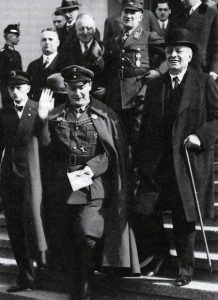 Fritz Thyssen und Hermann Göring in Essen, copyright Stiftung Ruhr Museum Essen, Fotoarchiv  Heinrich Thyssen-Bornemisza und Hermann Göring beim Deutschen Derby, 1936, copyright Archiv David R L Litchfield  Batthyany-Clan, ca. 1930er Jahre, dritter von links Ivan Batthyany, Ehemann von Margit Thyssen-Bornemisza, copyright Archiv David R L Litchfield  Hendrik J. Kouwenhoven, Bevollmächtigter für Heinrich Thyssen-Bornemisza, copyright Stadsarchief Rotterdam  Drei Thyssen Brüder vereint: von links Heinrich Thyssen-Bornemisza, August Thyssen Junior, Fritz Thyssen, Villa Favorita, Lugano, September 1938, copyright Archiv David R L Litchfield
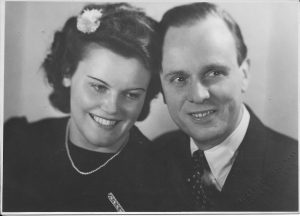 Stephan Thyssen-Bornemisza mit Ehefrau Ingeborg, Hannover, ca. 1940er Jahre (Foto Alice Prestel-Hofmann, Hannover), copyright Archiv David R L Litchfield 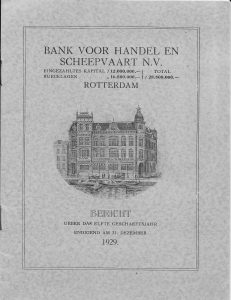 Thyssen Bank voor Handel en Scheepvaart Rotterdam, Jahresbericht 1930, copyright Archiv David R L Litchfield 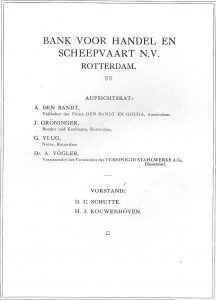 Thyssen Bank voor Handel en Scheepvaart Rotterdam, Aufsichtsrat und Verwaltungsrat 1929, copyright Archiv David R L Litchfield 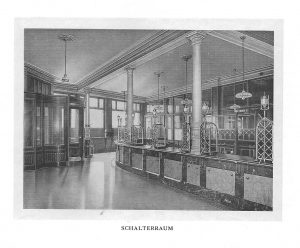 Thyssen Bank voor Handel en Scheepvaart Rotterdam, Schalterraum, copyright Archiv David R L Litchfield  Thyssen Bank voor Handel en Scheepvaart Rotterdam, 1929, Empfangsraum, copyright Archiv David R L Litchfield  Thyssen Bank voor Handel en Scheepvaart Rotterdam, 1929, Stahlkammern, copyright Archiv David R L Litchfield
|
|
Tags: "Operation Juliana", 7th Army Interrogation Center, A4-Raketen, Adolf Hitler, Akademiker, Aktien, Aktienzertifikate, Albert Speer, Alexis Leger, Alfried Krupp, Allen Dulles, alliierte Ermittler, altreich, Amelie Thyssen, Anita Zichy-Thyssen, arbeitende Reiche, Argentinien, Aristokratie, Aufenthaltsbewilligung, Augsburg, August Thyssen, August Thyssen Hütte, August Thyssen Junior, Ausländerausweis der Schweiz, Auslandsdeutsche, Auslandsvermögen, Ausreisegenehmigung, Bad Nauheim, Bad Wiessee, Bank voor Handel en Scheepvaart, banking, Batthyany, Bayern, Berlin, Besatzungsmächte, Beschlagnahmung, besetzte Gebiete, Beteiligungen, Bismarck, Boris Gehlen, Bornemisza, Bosch, Broadway, Buenos Aires, Burton K. Wheeler, Conte Grande, Deusche Bank, Deutsch-Lux, Deutsch-Überseeische Handelsgesellschaft der Thyssenschen Werke mbH, deutsche Rüstungsindustrie, Deutsche Schule Den Haag, Deutschland, Devisenbeschränkungen, Die Thyssen-Dynastie, Die Thyssens als Kunstsammler, Dienlichkeitslegenden, Diplomatie, Distanz zwischen Herrschaft und Personal, Dr Amelung, Dr Joachim Käppner, Duisburg-Hamborn, Düsseldorf, Dustbin Zentrum für Wissenschaftler und Industrielle, Edmund Stinnes, England, Entnazifizierung, Erschließung der Rohstoffe, Ethik, Faminta AG, Faschist, Federico Zichy, Felix de Taillez, Finanzkapital, Flüchtlinge, förderndes Mitglied der SS, Forschung, Frank Baranowski, Friedrich Flick, Friedrich Thyssen, Fritz Thyssen, Fritz Thyssen Stiftung, Fritz und Heinrich Thyssen. Zwei Bürgerleben in der Öffentlichkeit, Fuchsjagd, Gelsenkirchener Bergwerks AG, Genua, Georg Thyssen, Gerda Henkel Stiftung, Gero von Schulze-Gaevernitz, Geschichtsschreibung, Golddeponierung, Granaten, Granatwerfer, Guy L'Estrange Ewen, Handels en Transport Maatschappij Vulcaan, Hannover, Hans Thyssen, Harald Wixforth, Harriman Building, Harz, Hauptwohnsitz, Heini Thyssen, Heini Thyssen-Bornemisza, Heinrich Blass, Heinrich Lübke, Heinrich Thyssen, Heinrich Thyssen-Bornemisza, Helvetia, Hendrik J. Kouwenhoven, Henry Mowbray Howard, Hermann Göring, Hetzjagd, Hoesch, Hohenzollern, Holland American Investment Corporation, Hundemeute, IG Farben, Internationalisierung, Jan Schleusener, Janos Wettstein von Westersheimb, Johannes Bähr, Johannes Gramlich, Jörg Lesczenski, Josef Thyssen, Julius Thyssen, Kapitalanlagen, Kapitalflucht, Kaszony Stiftung, Kohnstein, Königin Wilhelmina, Königstein, Konzentrationslager, Kornwestheim, Kriegsverbrechen, Krupp, Lagerstättenforschung, Landesverrat, Lebensstil, London, Louisiana, Luftangriff, Lugano, Lyceum Alpinum, MABAG, Macht, Machtergreifung, Management, Manager Magazin, Marineministerium, Maschinen- und Apparatebau, Massachusetts Institute of Technology, Massenvernichtungswaffen, Mausoleum, Mexiko, Mineralöl- und Kohlegewinnung, Moral, Mülheim-Kettwig, München, Nationalsozialismus, Neid, Neubabelsberg, neureich, neutrale Länder, New York, Nordhausen, NSDAP, Nürnberg, Nürnberger Nachfolgeprozesse, Oberursel, Offshore-Instrumente, Opfer, Orania, Panzerschlacht von Kursk, Paris, Paul Langkopf, Pelzer Stiftung, Phoenix, Plagiarisierung, Professor Manfred Rasch, Professor Margit Szöllösi-Janze, propaganda, public relations, Quandt, Quellenbestand, Ralf Dahrendorf, Raoul Dautry, Reichtum, Rheinstahl, Robert Kempner, Roberto van Aken, Rohmaterialhandel, Rohstoffankäufe, Rotterdam, Rotterdamsch Trustees Kantoor, Roxana Petroleum, Royal Dutch Shell, Ruhrgebiet, Rüstungslieferant, Sammlung Schloss Rohoncz, Sanatorium, Scheveningen, Schloss Kransberg, Schloss Landsberg, Schuld, Schweiz, Schweizerische Kreditanstalt, Seismos GmbH, Shell Petroleum Company, Siemens, Simone Derix, St. Louis, Staatsangehörigkeit, Stephan Thyssen-Bornemisza, Steuerflucht, Steuern, Steueroasen, Steuerumgehung, Stiftung Sammung Schloss Rohoncz, Stiftung zur Industriegeschichte Thyssen, Süddeutsche Zeitung, Tarnbezeichung, Täter, Teutonia, Texas, Thurn und Taxis, Thyssen & Co, Thyssen Biografen, Thyssen in der Adenauerzeit, Thyssen Konzern, Thyssen Organisation, Thyssen-Bornemisza Gruppe, Thyssen-Mythos, ThyssenKrupp Konzern-Archiv, Tom Wohlfahrt, transnationales Leben, Transparenz, Transportkontor Vulkan GmbH, Trust Department, Turbopumpen, Übersee-Trust Vaduz, ultravermögend, ungarische Staatsbürgerschaft, Ungarn, Union Banking Corporation, Universität Budapest, US Gefangenenlager Seckenheim, US-Amerikanische Kredite, US-Senator, V-Waffen, Vaterlandsliebe, Vereinigte Stahlwerke, Vermögen, Vermögensverwaltungsgesellschaft, Villa Favorita, Volkswohl, Vulcaan Coal Company, Waffen, Wehrmacht, Wittelsbach, Wut, Zichy, Zuoz, Zurich, Zwangsarbeit bei Thyssen, Zwangsarbeiter
Posted in The Thyssen Art Macabre, Thyssen Art, Thyssen Corporate, Thyssen Family Comments Off on Buchrezension: Thyssen im 20. Jahrhundert – Band 4: ‘Die Thyssens. Familie und Vermögen’, von Simone Derix, erschienen im Schöningh Verlag, Paderborn, 2016 (scroll down for english version)
Monday, March 5th, 2018
| Reviewing this book is a huge aggravation to us, as so much of it has been derived from our groundbreaking work on the Thyssens, published a decade earlier, for which the author grants us not a single credit. It is surprising that Simone Derix does not have the respect for professional ethics to acknowledge our historiographic contribution; especially since she stated in a 2009 conference that non-academic works, whilst creating feelings of fear amongst academics of losing their prerogative to interpret history, are taking on increasing importance.
Ms Derix herself is not the fearful type of course, though somewhat hypocritical. She appears to be preemptively obedient and committed to pleasing her presumably partisan paymasters, in the form of the Fritz Thyssen Foundation. Alas, she is clearly not the smartest person either; writing, for instance, that Heinrich Lübke, Director of the August Thyssen Bank (he died in 1962), was the same Heinrich Lübke who was President of Germany (in that position until 1969).
But Ms Derix’s intellectual shortcomings are much more serious than simple factual errors, which should, in any case, have been picked up by at least one of her two associate writers, three project leaders, four academic mentors and six research assistants. She is in all seriousness trying to convince us that research into the lives of wealthy persons is a brand new branch of academia, and that she is its most illustrious, pioneering proponent. Does she not know that recorded history has traditionally been by the rich, of the rich and for the rich only? Has she forgotten that even basic reading and writing were privileges of the few until some hundred and fifty years ago?
At the same time, contrary to us, Derix does not appear to have had any first hand experience of exceptionally rich people at all, particularly Thyssens. Her sponsorship, earlier in her studies, by the well-endowed Gerda Henkel Foundation, was presumably an equally ‘arm’s length’ relationship. Rich people only mix with rich people, and unless Derix got paid by the word, there is no evidence that she ever in any way qualified for serious comment on their modus operandi.
What is new, of course, is that feudalism has been swept away and replaced by democratic societies, where knowledge is broadly accessible and equality before the law is paramount. Yes, her assertion that super-rich people’s archives are difficult to access is true. They only ever want you to know glorious things about them and keep the realities cloaked behind their outstanding wealth. To suggest that this series is being issued because the Thyssens have suddenly decided to engage in an exercise of honesty, generously letting official historians browse their most private documents, however, is ludicrous. The only reason why Simone Derix is revealing some controversial facts about the Thyssens is because we already revealed them. The difference is that she repackages our evidence in decidedly positive terms, so as to comply with the series’ overall damage limitation program.
Thus, Derix seems to believe she can run with the fox and hunt with the hounds; a balancing act made considerably easier by her pronouncement, early on, that any considerations of ethics or morality are to be categorically excluded from her study. The fact that the Thyssens camouflaged their German companies (including those manufacturing weapons and using forced labour) behind international strawmen, with the benefit of facilitating the large-scale evasion of German taxes, is re-branded by Derix as being a misleading description ‘made from a state perspective’ and which ‘tried to establish a desired order rather than depict an already existing order’. As if ‘the state’, as we democrats understand it, is some kind of devious entity that needs fending off, rather than the collective support mechanism of all equal, law-abiding citizens.
It is just one of the many statements that appears to show how much the arguably authoritarian mindset of her sponsors may have rubbed off on her. The fact that academics employed by publicly funded universities should be used thus as PR-agents for the self-serving entities that are the Fritz Thyssen Foundation, the Thyssen Industrial History Foundation and the ThyssenKrupp Konzern Archive is highly questionable by any standards, but particularly by supposedly academic ones. Especially when they claim to be independent.
****************
In Derix’s world, the Thyssens are still (!) mostly referred to as ‘victims’, ‘(tax) refugees’, ‘dispossessed’ and ‘disenfranchised’, even if she admits briefly, once or twice in 500 pages, that ‘in the long-term it seems that they were able always to secure their assets and keep them available for their own personal needs’.
As far as the Thyssens’ involvement with National Socialism is concerned, she calls them ‘entangled’ in it, ‘related’ to it, being ‘present’ in it and ‘living in it’. With two or three exceptions they are never properly described as the active, profiting contributors to the existence and aims of the regime. Rather, as in volume 2 (‘Forced Labour at Thyssen’), the blame is again largely transferred to their managers. This is very convenient for the Thyssens, as the families of these men do not have the resources to finance counter-histories to clear their loved ones’ names.
But for Simone Derix to say that ‘from the perspective of nation states these (Thyssen managers) had to appear to be hoodlums’ really oversteps the boundaries of fair comment. The outrageousnness of her allegation is compounded by the fact that she fails to quote evidence, as reproduced in our book, showing that allied investigators made clear reference to the Thyssens themselves being the real perpetrators and obfuscators.
Yet still, Derix purports to be invoking German greatness, honour and patriotism in her quest for Thyssen gloss. She alleges bombastically that the mausoleum at Landsberg Castle in Mülheim-Kettwig ‘guarantees (the family’s) presence and attachment to the Ruhr’ and that there is an ‘indissoluble connection between the Thyssen family, their enterprises, the region and their catholic faith’. But she fails to properly range them alongside the industrialist families of Krupp, Quandt, Siemens and Bosch, preferring to surround their name hyperbolically with those of the Bismarck, Hohenzollern, Thurn und Taxis and Wittelsbach ruling dynasties.
In reality, many Thyssen heirs chose to turn their backs on Germany and live transnational lives abroad. Their mausoleum is not even accessible to the general public. Contrary to what Derix implies, the iconic name that engenders such a strong feeling of allegiance in Germany is that of the public Thyssen (now ThyssenKrupp) company alone, as one of the main national employers. This has nothing whatsoever to do with any respect for the descendants of the formidable August Thyssen, most of whom are, for reason of their chosen absence, completely unknown in the country.
****************
In this context, it is indicative that Simone Derix categorises the Thyssens as ‘old money’, as well as ‘working rich people’. But while in the early 19th century Friedrich Thyssen was already a banker, it was only his sons August (75% share) and Josef (25% share), from 1871 onwards (and with the ensuing profits from the two world wars) who created through their relentless work, and that of their employees and workers, the enormous Thyssen fortune. Their equal was never seen again in subsequent Thyssen generations.
Thus the Thyssens became ‘ultra-rich’ and were completely set apart from the established aristocratic-bourgeois upper class. They could hardly be called ‘old money’ and neither could their heirs, despite trying everything in their power to adopt the trappings of the aristocracy (which beggars the question why volume 6 of the series is called ‘Fritz and Heinrich Thyssen – Two bourgeois lives in the public eye’). This included marrying into the Hungarian, increasingly faux aristocracy, whereby, even Derix has to admit, by the 1920s every fifth Hungarian citizen pretended to be an aristocrat.
The line of Bornemiszas, for instance, which Heinrich married into, were not the old ‘ruling dynastic line’ that Derix still pretends they were. The Thyssen-Bornemiszas came to be connected with the Dutch royals not because Heinrich’s wife Margit was such a (self-styled) ‘success’ at court, but because the Thyssens had important business interests in that country. Thus Heinrich became a banker to the Dutch royal household, as well as a personal friend of Queen Wilhelmina’s husband Prince Hendrik.
The truth is: apart from such money-orientated connections, neither the German nor the English or any other European nobility welcomed these parvenus into their immediate ranks (religion too played a role, of course, as the Thyssens were and are catholics). Until, that is, social conventions had moved on enough by the 1930s and their daughters were able to marry into the truly old Hungarian dynasties of Batthyany and Zichy.
But until that time, based on their outstanding wealth, this did not stop the brothers from adopting many of the domains of grandeur for themselves. Fritz Thyssen, according to Derix, even spent his time in the early 1900s importing horses from England, introducing English fox hunting to Germany and owning a pack of staghounds. He also had his servant quarters built lower down from his own in his new country seat, specifically to signal class distinction.
These are indeed remarkable new revelations showing that the traditional image put out by the Thyssen organisation of bad cop German, ‘temporarily’ fascist industrialist Fritz Thyssen, good cop Hungarian ‘nobleman’ Heinrich Thyssen-Bornemisza is even more misleading than we always thought.
****************
Truly lamentable are Derix’s attempts to portray Fritz Thyssen as a devout, christian peacenik and centrist party member. And so are her lengthy contortions in presenting Heinrich Thyssen-Bornemisza as the perfectly assimilated Hungarian country squire. She does, however, report that Heinrich’s wife had stated he did not speak a word of the language, which does not stop Felix de Taillez in volume 6 writing that he did speak Hungarian. ‘If you can’t beat them, confuse them’ was Heini Thyssen’s motto. Clearly, it has also become the motto of these Thyssen-financed academics.
Meanwhile, Derix’s book is the first work supported by the Thyssen organisation to confirm that Heinrich Thyssen-Bornemisza did retain his German (then Prussian) citizenship. She also does venture to state that his adoption of the Hungarian nationality ‘might’ have been ‘strategic’. But these gems of truthfulness are swamped under the fountains of her gushing propaganda designed to make the second generation Thyssens look better than they were. This includes her development of August Junior’s role from black sheep of the family to committed businessman.
On the other hand, the author still fails to explain any business-related details on the much more important Heinrich Thyssen’s life in England at the turn of the century (cues: banking and diplomacy). How exactly did the family come to be closely acquainted with the likes of Henry Mowbray Howard (British liaison officer at the French Naval Ministry) or Guy L’Estrange Ewen (special envoy to the British royals)? A huge chance of genuine transparency was wasted here.
Derix also fails to draw attention to the fact that the August Thyssen and Josef Thyssen branches of the family developed in very different ways. August’s heirs exploited, left and betrayed Germany and were decidedly ‘nouveau riche’, except for Heinrich’s son Heini Thyssen-Bornemisza and his son Georg Thyssen, who really did involve themselves in the management of their companies.
By contrast, Josef’s heirs Hans and Julius Thyssen stayed in Germany (respectively were prepared to return there in the 1930s from Switzerland when foreign exchange restrictions came into force), paid their taxes, worked in the Thyssen Konzern before selling out in the 1940s, pooling their resources and adopting careers in the professions. Only the Josef Thyssen side of the family is listed in the German Manager Magazine Rich List; but for unexplained reasons Derix leaves these truly ‘working rich’ Thyssens largely unmentioned in her book.
****************
Fortunately, Derix does not concentrate all her efforts in creative fiction and plagiarisation, but manages to provide at least some substantive politico-economic facts as well. So she reveals that Heinrich Thyssen-Bornemisza was a member of the supervisory board of the United Steelworks of Düsseldorf until 1933, i.e. until after Adolf Hitler’s assumption of power. This, combined with her statement that ‘Heinrich seems to have orientated himself towards Berlin on a permanent basis as early as 1927/8 (from Scheveningen in The Netherlands)’ pokes a hole in one of the major Thyssen convenience legends, that of Heinrich Thyssen-Bornemisza having had his main residence in neutral Switzerland from 1932 onwards (i.e. conveniently from before Hitler’ assumption of power; having ‘left Germany just in time’); though this does not stop Derix from subsequently repeating that fallacy just the same (- ‘If you can’t beat them, confuse them’-).
Fact is that, despite buying Villa Favorita in Lugano, Switzerland in 1932, Heinrich Thyssen continued to spend the largest amounts of his time living a hotel life in a permanent suite in Berlin and elsewhere and also kept a main residence in Holland (where Heini Thyssen grew up almost alone, except for the staff). His Ticino lawyer Roberto van Aken had to remind him in 1936 that he still had not applied for permanent residency in Switzerland. It was not until November 1937 that Heinrich Thyssen and his wife Gunhilde received their Swiss foreigner passes (see ‘The Thyssen Art Macabre’, page 116).
Derix also readjusts the old Thyssen myth that Fritz Thyssen and Heinrich Thyssen-Bornemisza went their separate ways in business as soon as they inherited from their father, who died in 1926. We always said that the two brothers remained strongly interlinked until well into the second half of the 20th century. And hey presto, here we have Simone Derix alleging now that ‘historians so far have always assumed that the separation had been concluded by 1936’. She adds ‘despite all attempts at separating the shares of Fritz Thyssen and Heinrich Thyssen-Bornemisza, the fortunes of Fritz and Heinrich remained interlocked (regulated contractually) well into the time after the second world war’.
But it is her next sentence that most infuriates: ‘Obviously it was very difficult for outsiders to recognise this connection’. The truth of the matter is that the situation was opaque because the Thyssens and their organisation went to extraordinary lengths and did everything in their power to obfuscate matters, particularly as it meant hiding Fritz Thyssen’s and Heinrich Thyssen-Bornemisza’s joint involvement in supporting the Nazi regime.
****************
Amongst the Thyssens’ many advisors, the author introduces Dutchman Hendrik J Kouwenhoven as the main connecting link between the brothers, who ‘opened up opportunities and thought up financial instruments’. He worked from 1914 at the family’s Handels en Transport Maatschappij Vulcaan and then at their Bank voor Handel en Scheepvaart (BVHS) in Rotterdam from its official inception in 1918 to his sacking by Heinrich Thyssen-Bornemisza during the second world war.
The asset management or trust company of BVHS was called Rotterdamsch Trustees Kantoor (RTK), which Derix describes as ‘repository for the finance capital of the Thyssen enterprises, as well as for the Thyssens’ private funds’. She does not say when it was created. ‘Its offices and all the important papers that Heinrich Thyssen-Bornemisza had lodged (at RTK) were all destroyed in a German aerial bombardment of Rotterdam on 14.05.1940’, according to Derix. To us this sounds like a highly suspicious piece of information.
Of the files of BVHS she curtly says that ‘a complete set of source materials is not available’. How convenient, especially since no-one outside the Thyssen organisation will ever be able to verify this claim truly independently; or at least until the protective mantle of Professor Manfred Rasch, head of the ThyssenKrupp Konzern Archive, retires.
Derix alludes to ‘the early internationalisation of the Thyssen Konzern from 1900’, ascribing her knowledge of its bases in raw material purchases and the implementation of a Thyssen-owned trading and transport network to Jörg Lesczenski, who published two years after us (and whose work, like that of Derix herself, was backed by the Fritz Thyssen Foundation). But she leaves cross-references aside concerning the first tax havens (including that of The Netherlands) which were set up in the outgoing 19th century, conveniently referring this area to ‘research that should be carried out in the future’.
Derix names the 1906 Transportkontor Vulkan GmbH Duisburg-Hamborn with its Rotterdam branch (see above) and the 1913 Deutsch-Überseeische Handelsgesellschaft der Thyssenschen Werke mbH of Buenos Aires (by the way: to this day ThyssenKrupp AG is a major trader in raw materials). She also states that American loans to the Thyssen Konzern started in 1919 via the ‘Vulcaan Coal Company’ (failing to mention that this company was based in London).
****************
According to Derix, August Thyssen began transferring his shares in the Thyssen companies to his sons Fritz and Heinrich in 1919, first those of Thyssen & Co. and from 1921 onwards those of the August Thyssen smelting works. She then adds that existing Thyssen institutions outside of Germany were used in order to carry out this transfer.
From 1920 onwards, Fritz Thyssen began to buy real estate in Argentina. Meanwhile, the Thyssens’ Union Banking Corporation (UBC), founded in 1924 in the Harriman Building on New York’s Broadway, is described solely in the language of the ‘transnational dimension of the Thyssens’ financial network’ and as being ‘the American branch of the Bank voor Handel en Scheepvaart’.
We had already detailed in our book how Heinrich Thyssen-Bornemisza, via Hendrik Kouwenhoven, set up in Switzerland the Kaszony Family Foundation in 1926 to lodge his inherited participations and the Rohoncz Collection Foundation in 1931 to place art works he bought as easily movable capital investments from 1928 onwards. Now Derix writes that the Rohoncz Foundation too was founded in 1926. This is astonishing, since it means that this entity was set up a whole two years prior to Heinrich Thyssen buying the first painting to find its way into what he called the ‘Rohoncz Castle Collection’ (despite the fact that none of the pictures ever went anywhere near his Hungarian, then Austrian castle, in which he had stopped living in 1919).
The timing of the creation of this offshore instrument just proves how contrived Heinrich’s reinvention as a ‘fine art connaisseur and collector’ really was.
Derix even freely admits that these Thyssen family foundations were ‘antagonists of states and governments’. However, just like Johannes Gramlich in volume 3 (‘The Thyssens as Art Collectors’), she too leaves the logistics of the transfer of some 500 paintings by Heinrich Thyssen-Bornemisza into Switzerland in the 1930s completely unmentioned, including the fact that this represented a method of massive capital flight out of Germany. The associated topics of tax evasion and tax avoidance stay completely off her academic radar; ignoring our documented proof.
****************
In another bold rewriting of official Thyssen history the author states that the Thyssen brothers frequently acted in parallel in their financial affairs. And so it was that the Pelzer Foundation and Faminta AG came to be created , by Kouwenhoven, in Switzerland, on behalf of Fritz Thyssen and his immediate family. (Derix is hazy about exact dates. We published: 1929 for Faminta AG and the late 1930s for the Pelzer Foundation).
Derix points out that these two instruments also allowed secret transactions between the Thyssen brothers. She adds enigmatically that ‘Faminta protected the foreign assets of the August Thyssen smelting works from a possible confiscation by the German authorities’, whilst withholding any reference to a time scale of when such a confiscation might have been on the cards (is she suggesting a possibility prior to Fritz Thyssen’s flight in September 1939, i.e. anytime during the period 1929-1939?).
At the same time, in the 1920s, Fritz and Amelie Thyssen established a firm base in the south of the German Reich, namely in Bavaria – far away from the Thyssen heartland of the Ruhr – which Derix brands as a fact which has ‘so far been almost completely ignored by historians’. Of course, not only was this most royalist of German states close to Switzerland, but it was also, at that time, the cradle of the Nazi movement. Adolf Hitler also much preferred Munich to Berlin.
All the family’s financial instruments, meanwhile, continued to be administrated by Rotterdamsch Trustees Kantoor in The Netherlands. ‘These new Thyssen banks, companies, holdings and foundations created since the 1920s were connected to the Thyssen industrial enterprises (in Germany) through participations’, Derix continues.
These enterprises etc. were also supportive of the rising Nazi movement of course, such as when their Bank voor Handel en Scheepvaart around 1930 demonstrably made a loan of some 350,000 RM to the Nazi party, at a time when both Fritz Thyssen and Heinrich Thyssen-Bornemisza had controlling interests in BVHS.
According to Derix, it was starting in 1930 that Heinrich Thyssen sold his shares in the United Steelworks to Fritz while Fritz sold his Dutch participations to Heinrich and as a result Heinrich Thyssen alone was in control of the Bank voor Handel en Scheepvaart from 1936 onwards.
Specifically, it was a Thyssen entity called Holland-American Investment Corporation (HAIC) which facilitated Fritz Thyssen’s capital flight from Germany. According to Derix, ‘(in the autumn of 1933, the Pelzer Foundation acquired) shares in HAIC from Fritz and therefore his Dutch participations which were pooled therein. This was done in agreement with the German authorities who knew of HAIC. But in 1940, the Germans found out that there was a considerable discrepancy between the 1,5 million Reichsmark of Dutch participations held in HAIC as had been stated and the actual, true value, which turned out to be 100 to 130 million RM.’
This is staggering, as the modern day equivalent is many hundreds of millions of Euros!
Considering that Heinrich’s wife stated that he had taken some 200 million Swiss Francs of his assets into neutral countries, this would mean that, together, the Thyssen brothers possibly succeeded in extracting from Germany the cash equivalent of close to the complete monetary value of the Thyssen enterprises! This is not, however, a conclusion drawn by Simone Derix.
One begins to wonder what there was actually left to confiscate from Fritz Thyssen once he fled Germany at the onset of war in 1939. Derix admits that his flight happened not least because he preferred to complete his self-interested financial transactions from the safety of Switzerland, with the help of Heinrich Blass at Credit Suisse in Zurich.
Although we had managed to unearth several leads, we did not know that the real overall extent of the Thyssen brothers’ capital flight was quite this drastic. For Simone Derix to point this out on behalf of the Thyssen organisation is significant; even if she fails to draw any appropriate conclusions, as they would most likely be at odds with her blue-sky remit.
Truly, and in the words of the far more experienced Harald Wixforth no less: for these ‘mega-capitalist(s) (…) the profit of their enterprises (i.e. their own) always assumed far greater priority than the public’s welfare’.
Needless to say that we await Harald Wixforth’s and Boris Gehlen’s volumes on the Thyssen Bornemisza Group 1919-1932, respectively 1932-1947 with great interest.
****************
In this readjusted official light, Derix’s admission that Fritz and Amelie Thyssen’s ‘expropriation’ in late 1939 ‘did not directly result in any curtailment of their way of life’ no longer comes as any surprise.
The author also finally reveals for the first time official departure details of Fritz Thyssen’s daughter Anita, her husband Gabor and their son Federico Zichy to Argentina. Apparently they travelled from Genua, sailing on 17.02.1940 on board the ship Conte Grande, bound for Buenos Aires. In order to provide her with befitting financial support, shares in Faminta AG had been transferred to the Übersee-Trust of Vaduz shortly beforehand, of which Anita Zichy-Thyssen, a Hungarian national, was the sole beneficiary.
Derix then states that by April 1940, Fritz Thyssen ‘used his political knowledge on the German Reich and the German armaments industry as an asset that he could use in exchange for support for his personal wishes’. But what exactly were those wishes? The hubristically delusional Fritz obviously thought he could get rid of Hitler as easily as he had helped him get into power. For this, he was prepared to share German state secrets with French Foreign Minister Alexis Leger and Armament Minister Raoul Dautry in Paris. But for Derix, rather than being anything as contentious as active treason or an expression of power, his behaviour is nothing more than an ultra-rich man’s legitimate right to express his elevated lifestyle choices.
While all previous Thyssen biographers, apart from us, have purported that Fritz and Amelie Thyssen suffered tremendous ‘excrutiations’ during their time in concentration camps, Derix confirms our information that they spent most of their German captivity in the comfortable, private sanatorium of Dr Sinn in Berlin-Neubabelsberg. She writes that they were kept there ‘on Hitler’s personal orders’ and ‘on trust’, though Fritz and Heinrich’s personal friend Hermann Göring, during his post-war allied interrogations, stated that their privileged treatment had been down to his initiative. After Neubabelsberg, they were taken to different concentration camps, but Derix is now forced to admit that they enjoyed ‘a special status’ which is retraceable ‘for each and every location’. Which makes one wonder, why German historians previously felt the need to misrepresent these facts.
Derix’s list of Fritz Thyssen’s allied, post-war interrogations is particularly noteworthy. It illustrates the seriousness in which he was considered to have been guilty of (albeit blue collar) war crimes, which should have been punishable by incarceration:
In July 1945 he was taken to Schloss Kransberg near Bad Nauheim, namely to the so-called ‘US/UK Dustbin Centre for scientists and industrialists’. In August, he went on to Kornwestheim before being taken, in September, to the 7th Army Interrogation Center in Augsburg.
Derix also vagely asserts that Fritz Thyssen was interrogated at some point ‘in 1945’ by Robert Kempner, chief prosecutor of the Nuremberg trials.
Thyssen suffered a collapse and had to go into medical care. He was taken to the US prisoners’ camp of Seckenheim, then to Oberursel. His health deteriorated. From April to November 1946 he went through various hospitals and convalescent homes between Königstein (where he made a surprise recovery) and Oberursel. From November 1946 onwards, he was at the Nuremberg follow-up trials as a witness (one presumes in the cases of Alfried Krupp and Friedrich Flick amongst others), while receiving continuous hospital treatment in Fürth.
On 15.01.1947 Fritz Thyssen was released to join his wife Amelie in Bad Wiessee. This was followed by his German denazification proceedings in Königstein, where he and Amelie lived at the sanatorium of Dr Amelung. In that court, as befitting his insincere character, Fritz Thyssen described himself as penniless.
Meanwhile, according to Derix, Anita Zichy-Thyssen made contact with Edmund Stinnes, who lived in the US and his brother-in-law Gero von Schulze-Gaevernitz, a close collaborator of US-secret service chief Allen Dulles. In the spring of 1947, ‘hoping to facilitate exit permits for her parents to go to America’, she met former US-senator Burton K Wheeler in Argentina, who travelled to Germany in 1948 ‘in order to help Fritz Thyssen out of his denazification problems’. It is certainly an aspect of high-level influence which we documented even more intensively, but which, astonishingly, Johannes Bähr in volume 5 (‘Thyssen in the Adenauer Period’) of the series has totally rejected.
****************
Another Thyssen who should have had problems with his denazification, but didn’t, was Heinrich’s son Stephan Thyssen-Bornemisza.
While his brother Heini Thyssen went to the German school in The Hague, Stephan had boarded at the Lyceum Alpinum in Zuoz, Switzerland, where most pupils were from German speaking Switzerland, The Netherlands and the German Reich, respectively were Germans living abroad. Consequently, the school ran three houses named ‘Teutonia’, ‘Orania’ and ‘Helvetia’. After studying chemistry in Zurich and at the Massachusetts Institute of Technology, he became an assistant at a research laboratory of the Shell Petroleum Company in St Louis. He then wrote his dissertation at Budapest University and began working in natural resources deposit research.
Since 1932, whilst living in Hanover, Stephan worked for Seismos GmbH, a prospecting company founded in 1921 by Deutsch-Lux, Phoenix, Hoesch, Rheinstahl and Gelsenkirchener Bergwerks AG. Derix writes: ‘From 1927 Gelsenkirchener, which belonged to the United Steelworks founded in 1926, was the main shareholder, holding 50% of the shares. This means Seismos came under Fritz Thyssen’s part of the family inheritance. (…) In the 1920s, prospecting groups of Seismos worked for oil companies such as Royal Dutch Shell or Roxana Petroleum in Texas, Louisiana and Mexico, looking for Oil. (…) Its radius then extended to the Near East, South-Eastern Europe and England’.
In 1937, Seismos was bought for 1.5 million RM by Heinrich Thyssen and incorporated into his Thyssensche Gas- and Waterworks. During the war, according to Derix, the company was ‘involved in the exploitation of raw materials in the (Nazi) occupied territories (…) During their withdrawal from the Eastern Ukraine during the 1943 tank battle of Kursk they had to leave behind much equipment’.
So, of no little importance for a company which so far, in Thyssen-backed histories, had been portrayed, if at all, as being of little consequence.
And not for the secretive Heinrich Thyssen-Bornemisza either, whose son Heini Thyssen shortly after the war would get his Swiss lawyer Roberto van Aken to lie to the US visa application department thus: ‘From the advent of the Nazis’ rise to power, and particularly from 1938 onwards, Dr Heinrich Thyssen-Bornemisza’s (…) corporations were directed with the definitive purpose of minimising the Nazi armament efforts’ (The Thyssen Art Macabre, page 207).
It is, if anything, in that same obfuscating spirit that Derix still conceals the fact that the Seismos company moved its headquarters from Hanover to the Harz mountains during the war, where the Nazis’ weapons of mass destruction program (V-rockets) would come to be based.
Derix reveals that Stephan Thyssen-Bornemisza was a member of the Nazi Aircorps and confirms he was a contributing member of the SS. Nazi officials apparently declared Stephan Thyssen’s political stance to be ‘beyond all doubt’. But Derix cannot bring herself to even mention, let alone detail his additional involvement with another company, namely Maschinen- und Apparatebau AG (MABAG) of Nordhausen, also in the Harz.
We had already established that Stephan Thyssen had become chairman of the supervisory board of MABAG in the early years of the war. This company, in conjunction with IG Farben, ‘had built a vast network of caves and tunnels in the Kohnstein mountain near Nordhausen equipped with tanks and pumps (…). From Februar 1942, Armaments and Munitions Minister Albert Speer recommended all possible support for the development of rockets. This represented massively ambitious armaments manufacturing plans and a great deal more work for MABAG, who, under the control of the Wehrmacht, were now also producing turbo fuel pumps for V-rockets’ (The Thyssen Art Macabre, page 160).
We had speculated that Stephan’s position of chairman of MABAG must have been due to a major investment made by his father Heinrich. While Simone Derix entirely fails to address any aspects of this topic, the lawyer and historian Frank Baranowski has unearthed a highly important document and explains on his website:
‘In 1940, the Deutsche Petroleum Konzern, following a change in their management, divested itself of all its works which did not fit into their framework of petroleum and coal extraction, including MABAG. Deutsche Bank negotiated the transfer of the share capital of 1 million Reichsmark into various hands. The majority was acquired by the solicitor and notary Paul Langkopf of Hanover (590,000 RM), which was most likely done on the orders of a client who wished to remain anonymous. Smaller share parcels were held by the Deutsche Bank in Leipzig (158,000 RM) and in Nordhausen (14,000 RM) as well as by Stephan Thyssen-Bornemisza in Hanover (50,000 RM). On 14.09.1940 MABAG elected its new supervisory board: Director Schirner, Paul Langkopf, Stephan Thyssen-Bornemisza and the Leipzig bank director Gustav Köllmann. (MABAG came to see itself as a company entirely geared to the production of armaments, …..including grenades, grenade launchers …….and turbo pumps for the A4-rockets)’.
It just so happens that Paul Langkopf was a professional whose services had been engaged by various members of the Thyssen family over the years. It can be presumed with near certainty that the ‘anonymous’ shareholder was Heinrich Thyssen-Bornemisza. The secrecy of the transaction fits his style completely. And while Baranowski’s and our views on the use of forced labour by MABAG differ, his evidence is another indication towards the fact that Heinrich was definitely 100% pro-Nazi during the war, even while he was apparently retiring from the world, far away in his Swiss safehaven, pretending to have nothing to do with anything.
The great Simone Derix, meanwhile, prefers to concentrate on relatively trivial revelations such as the fact that Stephan’s mother Margit also lived in Switzerland with her second husband, the ‘germanophile’, ‘antisemitic’ Janos Wettstein von Westersheimb, who lost his job at the Hungarian embassy in Berne when the war turned in 1943. Apparently, she lobbied ‘for Stephan to be allowed out of Germany (after the war) via Heinrich Rothmund, who during the war had been responsible in large parts for the anti-Jewish asylum policies of Switzerland’.
****************
Finally Simone Derix covers two other important topics in her book – as did we, albeit to a different degree -; namely: 1.) The Thyssens’ pre-war London gold deposits and their fate during, respectively after the war and 2.) the removal of the Thyssens’ and Dutch royals’ share certificates from the Bank voor Handel en Scheepvaart in Rotterdam to the August Thyssen Bank in Berlin during the war, and their return to Rotterdam after the war, through an illegal act by a Dutch Military Mission, code named ‘Operation Juliana’. We will analyse the coverage of those topics more adequately in our reviews of Jan Schleusener’s, Harald Wixforth’s and Boris Gehlen’s forthcoming volumes.
In both matters, members and associates of the Thyssen family played questionable roles, using their high-level (diplomatic and other) positions, to help the Thyssens play off one host nation against another, in their pursuit of limitless personal advantage. Simone Derix only takes her critical analysis as far as to say that these interferences allowed smaller states such as The Netherlands or Switzerland to pressurise victorious powers of the second world war in order to safeguard their own national interests in the Thyssens’ fortune.
While our book has been called a possible ‘handbook for revolution’, Derix describes hers as ‘a model showing the way concerning the central, investigative strands for a history of the infrastructures of wealth’. She evokes the driving forces of ‘jealousy’ à la Ralf Dahrendorf, by the general public towards the super-rich, while ignoring the concept of ‘anger’ at their selfish sense of perennial legal immunity, as described by many such as Tom Wohlfahrt.
Simone Derix’s writing style is very clear and during her book presentation at the Historisches Kolleg in Munich, the suave voice of the specially engaged Bavarian Radio reader made the passages sound like high literature, marinated in integrity. However, this academic, who was introduced to the audience by Professor Margit Szöllösi-Janze as ‘elite researcher’, definitely arrogates to herself a greater authority in broadcasting historical judgements than she is currently entitled to.
At the subsequent podium conversation with the historian and journalist Dr Joachim Käppner of the Süddeutsche Zeitung, Derix rejected the concepts of power and of guilt unequivocally on behalf of the Thyssen family. In doing so, however, she had to be coaxed by Käppner repeatedly to focus her extremely hesitant flow of answers, which gave every impression, nevertheless, of having been pre-agreed.
Let’s hope Simone Derix does not remain the only contributor of the series to formulate answers to these important questions – But with more honesty, hopefully, if not greater independence from the questionable role of the Fritz Thyssen Foundation. |
Fritz Thyssen and Hermann Göring in Essen, copyright Stiftung Ruhr Museum Essen, Fotoarchiv Heinrich Thyssen-Bornemisza and Hermann Göring at the German Derby, 1936, copyright Archive David R L Litchfield Batthyany-Clan, ca. 1930s, third from left Ivan Batthyany, husband of Margit Thyssen-Bornemisza, copyright Archive David R L Litchfield Hendrik J. Kouwenhoven, general representative of Heinrich Thyssen-Bornemisza, copyright Stadsarchief Rotterdam Three Thyssen brothers in harmony: from left Heinrich Thyssen-Bornemisza, August Thyssen Junior, Fritz Thyssen, Villa Favorita, Lugano, September 1938, copyright Archive David R L Litchfield
Stephan Thyssen-Bornemisza with his wife Ingeborg, Hanover, ca. 1940s (Foto Alice Prestel-Hofmann, Hanover), copyright Archive David R L Litchfield Thyssen Bank voor Handel en Scheepvaart Rotterdam, Year End Report 1929, copyright Archive David R L Litchfield Thyssen Bank voor Handel en Scheepvaart Rotterdam, Supervisory Board and Management Board 1929, copyright Archive David R L Litchfield Thyssen Bank voor Handel en Scheepvaart Rotterdam, Bank Counters, copyright Archive David R L Litchfield Thyssen Bank voor Handel en Scheepvaart Rotterdam, 1929, Reception Room, copyright Archive David R L Litchfield Thyssen Bank voor Handel en Scheepvaart Rotterdam, 1929, Steel Vaults, copyright Archive David R L Litchfield
|
|
Tags: "Operation Juliana", 7th Army Interrogation Centre, A4-rockets, Adolf Hitler, advisors, aerial bombardment, Albert Speer, Alexis Leger, Alfried Krupp, Allen Dulles, allied interrogations, allied investigators, Amelie Thyssen, American loans, anger, Anita Zichy-Thyssen, antagonists of states, anti-Jewish asylumc policies, antisemitic, Argentina, Armament Minister, art works, asset management, August Thyssen, August Thyssen Bank, August Thyssen smelting works, Bad Nauheim, Bad Wiessee, Bank voor Handel en Scheepvaart, banking, Batthyany, Bavaria, Bavarian Radio, beneficiary, Berlin, Berne, Bismarck, Boris Gehlen, Bornemiszas, Bosch, Broadway, Budapest University, Buenos Aires, capital flight, capital investments, catholics, centrist party, class distinction, concentration camps, confisation, Conte Grande, contributing member of the SS, country seat, Credit Suisse, denazification problems, denazification proceedings, deposit research, Deutsch-Lux, Deutsch-Überseeische Handelsgesellschaft der Thyssenschen Werke mbH, Deutsche Bank, Deutsche Petroleum Konzern, diplomacy, Dr Amelung, Dr Joachim Käppner, Duisburg-Hamborn, Düsseldorf, Dustbin Centre for scientists and industrialists, Dutch Military Mission, Dutch participations, early internationalisation, Edmund Stinnes, England, envy, established aristocratic-bourgeois upper class, ethics, exploitation of raw materials, expropriation, Faminta AG, fascist, faux aristocracy, Federico Zichy, Felix de Taillez, finance capital, fine art, Forced Labour, Forced Labour at Thyssen, foreign assets of the August Thyssen smelting works, foreign exchane restrictions, fox hunting, Frank Baranowski, French Foreign Minister, French Naval Ministry, Friedrich Flick, Friedrich Thyssen, Fritz and Heinrich Thyssen - Two bourgeois lives in the public eye, Fritz Thyssen, Fritz Thyssen Foundation, Gelsenkirchener Bergwerks AG, Genoa, Georg Thyssen, Gerda Henkel Foundation, German armaments industry, German historians, German Manager Magazine, German state secrets, Germans living abroad, Germany, Gero von Schulze-Gaevernitz, grenade launchers, grenades, Gustav Köllmann, Guy L'Estrange Ewen, Handels en Transport Maatschappij Vulcaan, Harald Wixforth, Harriman Building, Harz mountains, Heini Thyssen, Heinrich Blass, Heinrich Lübke, Heinrich Rothmund, Heinrich Thyssen-Bornemisza, Helvetia, Hendrik J. Kouwenhoven, Henry Mowbray Howard, Hermann Göring, Historisches Kolleg, Hoesch, Hohenzollern, holdings, Holland American Investment Corporation, Hungarian citizen, Hungarian embassy, Hungarian nationality, IG Farben, Jan Schleusener, Janos Wettstein von Westersheimb, Johannes Bähr, Johannes Gramlich, Jörg Lesczenski, Josef Thyssen, Julius Thyssen, Kaszony Family Foundation, Kohnstein, Königstein, Kornwestheim, Krupp, Landsberg Castle, Leipzig, lifestyle, London, Louisiana, Lugano, Lyceum Alpinum, MABAG, Management, managers, Maschinen- und Apparatebau AG, Massachussetts Institute of Technology, Mausoleum, Mexico, morality, Mülheim-Kettwig, Munich, nation states, national socialism, natural resources, Nazi Aircorps, Nazi occupied territories, Nazi regime, Near East, Neubabelsberg, New York, Nordhausen, nouveau riche, Nuremberg Trials, Oberursel, offshore-Instrument, Orania, oustanding wealth, Paris, participations, Paul Langkopf, Pelzer Foundation, permanent residency, perpetrators, petroleum and coal extraction, Phoenix, plagiarisation, post-war interrogations, pre-war London gold deposits, production of armaments, Professor Manfred Rasch, Professor Margit Szöllösi-Janze, propaganda, public welfare, Quandt, Queen Wilhelmina, Ralf Dahrendorf, Raoul Dautry, raw material purchases, real estate in Argentina, refugees, Reichsmark, Rheinstahl, Robert Kempner, Roberto van Aken, Rohoncz Castle Collection, Rohoncz Collection Foundation, Rotterdam, Rotterdamsch Trustees Kantoor, Roxana Petroleum, Royal Dutch Shell, royalist, Ruhr, Sanatorium, Scheveningen, Schloss Kransberg, Second World War, secrecy, Seismos GmbH, Shell Petroleum Company, Siemens, Simone Derix, St. Louis, Stephan Thyssen-Bornemisza, Süddeutsche Zeitung, Swiss foreigner passes, Switzerland, tank battle of Kursk, tax avoidance, tax evasion, tax haven, taxes, Teutonia, Texas, The Hague, the Netherlands, The Thyssen Art Macabre, The Thyssens as Art Collectors, Thurn und Taxis, Thyssen & Co, Thyssen biographers, Thyssen Bornemisza Group, Thyssen enterprises, Thyssen Family, Thyssen family foundations, Thyssen fortune, Thyssen in the Adenauer Period, Thyssen Industrial History Foundation, Thyssen institutions outside of Germany, Thyssen Konzern, Thyssen-owned trading and transport network, ThyssenKonzern, ThyssenKrupp AG, ThyssenKrupp Konzern Archive, Thyssens' financial network, Thyssensche Gas- und Wasserwerke, Ticino, Tom Wohlfahrt, transnational lives, transparency, Transportkontor Vulkan GmbH, treason, trust company, turbo fuel pumps, Übersee-Trust Vaduz, ultra-rich, Union Banking Corporation, United Steelworks, US prisoners' camp of Seckenheim, US visa application department, US-secret service chief, US-senator Burton K. Wheeler, V-rockets, victims, Villa Favorita, Vulcaan Coal Company, war, war crimes, weapons, weapons of mass destruction, Wittelsbach, Zichy, Zuoz, Zurich
Posted in The Thyssen Art Macabre, Thyssen Art, Thyssen Corporate, Thyssen Family Comments Off on Book Review: Thyssen in the 20th Century – Volume 4: ‘The Thyssens. Family and Fortune’, by Simone Derix, published by Schöningh Verlag, Germany, 2016
|

