Thyssen Corporate
Monday, June 21st, 2010
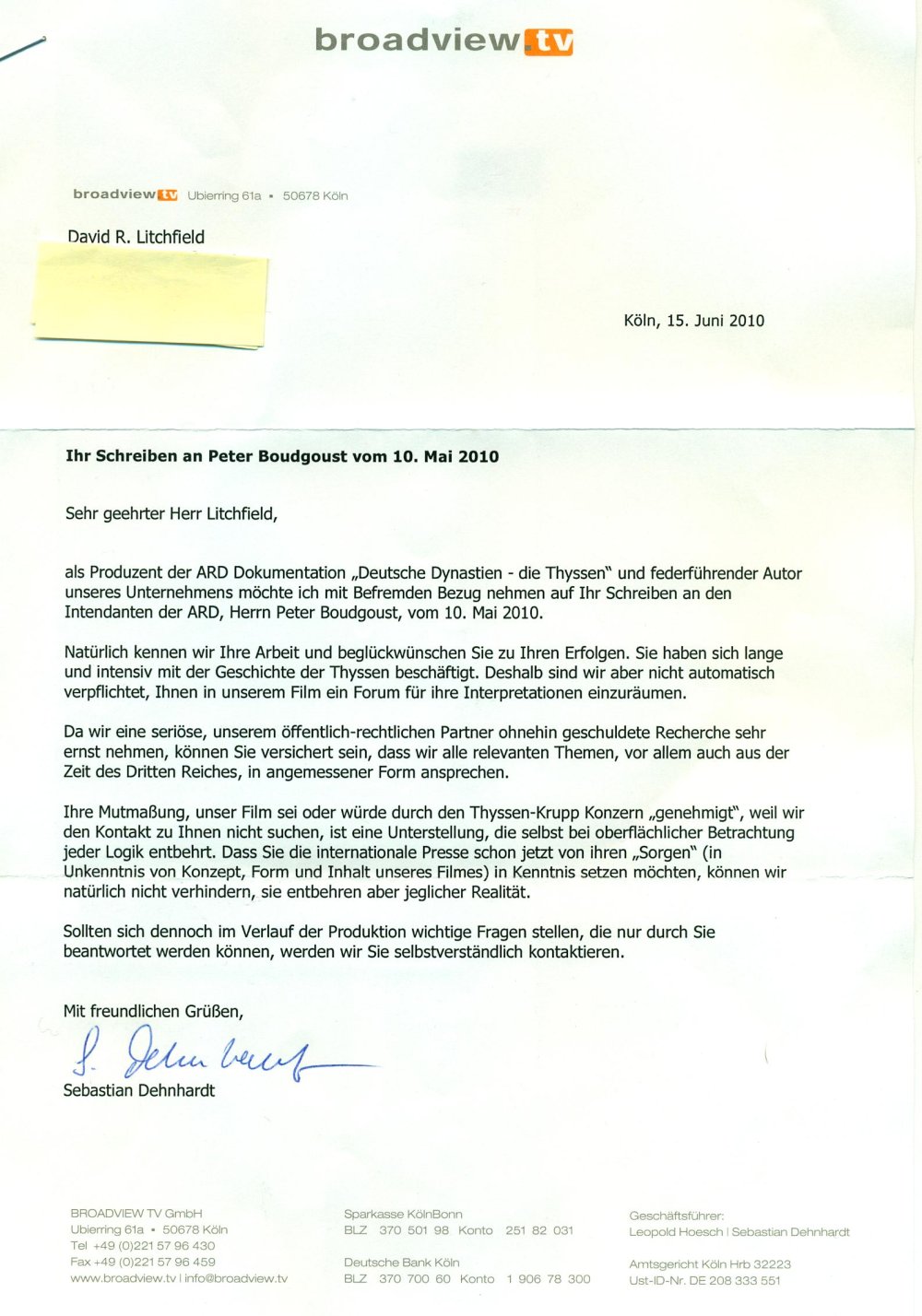
| Back in February we learned that Broadview TV in Cologne was producing a documentary on the Thyssens to be shown on German television (ARD channel) later this year as part of their ‘German Dynasties’ series. This was interesting news, as we knew that for several years such a venture has been planned in Germany but had so far failed to materialise.Following the publication of our book, a major rewriting of the family and corporate history was initiated, co-sponsored by the Thyssen corporation (via Fritz Thyssen Foundation) and the Thyssen family (represented by Georg Thyssen-Bornemisza). Now Broadview TV was announcing that their film (see this Scanned Document) would feature ‘August, Fritz and Heini Thyssen’, making no mention of either Heini’s father Heinrich Thyssen-Bornemisza, a key figure of the story whose role we have researched and reported extensively, or Fritz’s wife Amelie, who was a committed Nazi, yet regained ownership and control of the corporation after Fritz’s death in Argentina (not in Germany) in 1951, while never publicly recanting her political beliefs.
Instead, Broadview TV announced that their emphasis would be on ‘Fritz Thyssen’s TRAGIC embroilment with the Third Reich’ as well as ‘the patron of the arts Hans Heinrich Thyssen-Bornemisza’.
For a brief moment we paused to think what Heinrich and Heini Thyssen, who had spent most of their lives aggressively denying their Germanness, would think about being turned back into ‘Germans’ posthumously! And hadn’t Fritz and Amelie always insisted they were stateless? In my opinion as a German it is wrong for the German public to be asked to accept this family back into their national consciousness as one of their own, without being given the chance of seeing an unbiased picture of BOTH their achievements AND their failings.
We are not in any way denying the Thyssens’ achievements. They created a vast industrial empire, thousands of jobs and careers as well as wealth for the German nation and beyond. To be more precise, August and his brother Josef did those things, as well as their workers, foremen and managers. But Fritz (& Amelie) and Heinrich Thyssen were big cogs, very big cogs indeed in the process that brought Adolf Hitler to power. As such, the Thyssens’ ‘embroilment’ with the Nazis was NOT, I repeat NOT tragic for the Thyssens. The Thyssens were not victims. They were perpetrators. They supported the Nazis because they wished to eradicate Communism and Socialism and ensure their own profits and lifestyles.
The actual tragedy was the one that befell the people of Europe and of the wider world who died in their millions or survived to live on with their haunting memories. More often than not they were offered no support to come to terms with their experiences, while the Thyssens were allowed back into the position of role models. Now they’re reintroduced into the German media and, in our opinion, instead of owning up fully to their historic role, commission sanitised reports which airbrush inconvenient truths out of the public picture. This is evident in recent publications where embarrassing facts were circumvented or ignored.
We decided to contact Mr Dehnhardt to try and find out what kind of course he was planning to take with his documentary. Having written to him early in February we heard nothing. So we wrote to the Head of ARD, Mr Peter Boudgoust. He wrote back a very nice letter, saying he had passed our concerns on to the commissioning editors, in this case Christiane Hinz at WDR in Cologne. But we heard nothing from Mrs Hinz, even when emailing and phoning her.
Finally, after another letter to Mr Boudgoust, Mrs Hinz replied. She suggested our worries were ‘unfounded’, that the ‘POSSIBLE film about the Thyssens’ was still ‘ONLY AT A PROJECT STAGE’, that ‘all relevant historical points’ would be researched and that ‘if any questions arose that only [we] could answer’ they would ‘of course’ contact us. No apology was made for her previous silence.
Now finally – after 4.5 months – Mr Dehnhardt too has chosen to communicate with us, though rather pointedly, he has addressed his reply (see enclosed) to David only, not to myself, his German kinswoman, although our letter came from both of us. Once again, like Mrs Hinz before him, Mr Dehnhardt points out that ‘all relevant themes, including those from the time of the Third Reich’ will be dealt with, but adds ‘you have no right to expect for the interpretations derived from your research to be given an automatic platform in our programme’. He also bemoans our sceptical approach, stating that it is ‘devoid of any reality’, particularly in view of the fact we ‘know nothing about the concept, form and content of [his] film’. Meanwhile, however, he still fails to communicate any of the concept, form and content in the professional manner that we would expect.
The word ‘interpretation’, of course, is a very interesting choice in this context, as it carries all the connotations of ‘spin’. The fact is that if you leave Heinrich Thyssen-Bornemisza and Amelie Thyssen out of the picture, you refuse to deal with real historical issues, namely those of managing German companies throughout the war from a Swiss safehaven, including the use of slave labour, international Nazi banking, the Rechnitz Massacre, the Thyssens’ post-war protection from Allied retribution, etc, etc, etc. These are straightforward facts; not ‘interpretations’.
Mr Dehnhardt has been criticised in the past for producing a documentary in which the views were said to have been over-emotional and unbalanced. Kultura Online Magazin found that his film on the battle of Stalingrad did not give a voice to the Russian side and only described the results but not the reasons for the historic developments in question. When confronted with this criticism, Mr Dehnhardt replied: ‘I think the individual [German] soldier also has the right to be a victim, especially in the context of Stalingrad. My film shows that he was only a small cog in a big machine’.
Here Mr Dehnhadt is right. But this statement begs the question as to how he will deal with the ‘big cogs’ when it comes to his documentary on the Thyssens. Will he still have the likes of his father (or my father and uncles for that matter) in mind or will he now bow to the power and influence of the cosmopolitan ‘big cogs’? Will he tell the German public the tale of Fritz Thyssen suffering in a concentration camp, although we established he was under comfortable, protective custody while his brother Heinrich continued to supply the Nazis with coal, submarines and aerial torpedoes from the safety of Switzerland? And will he tell people what an art expert Heini Thyssen was when we showed that Heini Thyssen himself told us his father had bought the collection simply in order to transfer money out of Germany and Thyssen art has been used and abused as a convenient veneer behind which to hide a guilty past ever since?
We shall have to wait and see. But after our experiences of looking into all things Thyssen for over fourteen years, we remain sceptical, particularly since Mr Dehnhardt makes several films on different subjects every year. In this short space of time he could not possibly have enough insight into a vast topic such as Thyssen to offer anything but a simplified view. A view that is in danger of misrepresenting the past in a way that will once again allow the Thyssen big cogs to indulge their privileges while shunning their historic responsibilities.
We really hope to be proved wrong, because for the last seventy plus years the German public has been misinformed regarding Thyssen. We believe that while they may not like the image of the Thyssens that we have revealed, it is up to them, not to what might prove to be a Thyssen-influenced media company, to decide.
The programme was finally aired on 8 November 2010.
COMMENTS:
eldeadpixel writes: Thanks for this good article. I wonder if that documentary will be shown here in Spain… Keep us up to date! |
 Sebastian Dehnhardt, film producer and managing director of Broadview TV, Cologne 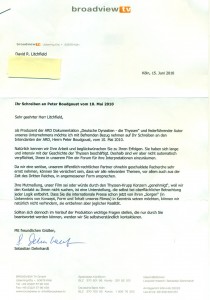 Four and a half months for a reply - And they call us 'illogical'... |
Tags: Adolf Hitler, Amelie Thyssen, ARD, Argentina, Broadview TV, Christiane Hinz, Communism, Fritz Thyssen, Fritz Thyssen Foundation, Georg Thyssen-Bornemisza, Heinrich Thyssen-Bornemisza, Kultura Online Magazine, Nazi Banking, Peter Boudgoust, Rechnitz Massacre, Sebastian Dehnhardt, slave labour, Socialism, Stalingrad, Switzerland, WDR
Posted in The Thyssen Art Macabre, Thyssen Art, Thyssen Corporate, Thyssen Family Comments Off on Is B r o a d v i e w TV’s Sebastian Dehnhardt helping the Thyssens to white-wash their history? (by Caroline Schmitz)
Monday, May 3rd, 2010
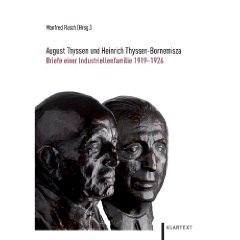
| Quite why ThyssenKrupp have waited so long to authorise their archivist and historian, Manfred Rasch, to bring out a book of letters between August Thyssen and his son Heinrich, seems somewhat of a mystery. The two men have, after all, been dead for 84 and 63 years respectively. But the professor appears to confirm my belief that this is part of the corporate and family response to my book, by including a rather bizarre statement amongst the credits, which runs thus (page 10):
‘People who are less interested in historically substantiated studies with traceable references and who would rather form their opinions based on sex-and-crime journalism might be entertained by Litchfield, David: The Thyssen Art Macabre, London 2006 (German edition: Die Thyssen-Dynastie, Die Wahrheit hinter dem Mythos, Oberhausen 2008).’
I feel such a statement says more about Rasch than it does about me, and I appreciate the publicity it has afforded my book, including the increase in visits to this website, particularly from the Ruhr district. However, a recent critical review awarded Rasch’s book on Amazon by a reader in Munich might have been unlikely to have imbued him with a similar spirit of generosity:
‘Unfortunately, the title of this book is somewhat misleading, as of the 214 letters only 4 are by Heinrich Thyssen’s hand. It also does not limit the scope of its contents to the years 1919-1926 but includes furthermore a considerable amount of historical material on the history of the Thyssen family and its industries which has been written by Professor Manfred Rasch who is listed as editor of the book. As Professor Rasch is also the head of the archives at ThyssenKrupp, it makes it difficult to accept the impartiality of his views. The style of the book is academic and thus requires an overwhelming interest in the subject matter, as much is being taken up with supportive material in the form of bibliography, sources, commentaries etc.
One also gets the impression that this book, despite its size and the obvious complexity of the research, was in fact created in some haste, as on far too many occasions it sidesteps various historical issues by announcing that scientific research is still ongoing. But what I find even more surprising is the way Prof. Rasch deals with other authors, some of whom have published considerable research about the subject, for instance the Briton David R L Litchfield (‘The Thyssen Art Macabre’, in German: ‘Die Thyssen-Dynastie’), whose description of the murder of 180 Hungarian slave labourers during a party organised at Rechnitz Castle by Margit Thyssen-Bornemisza caused a big stir a few years ago. Prof. Rasch suggests that his readers should view Litchfield’s book as mere entertainment: just an alarming error of judgement or a worrying example of professional jealousy?
This is particularly disturbing in the light of the anti-Semitism in the Thyssen family (see letters dated 9.9.1919, 21.7.1923 and 30.7.1923) which the book presents to the interested public. All in all, however, this is a fascinating read which contains much material of interest to both amateur and professional historians’.
One certainly gets the impression that the corporation may now be trying somewhat too hard to paper over the cracks in their historiography. You may no longer be able to see the cracks but you can certainly see where they have been, which only serves to draw attention to the papering.
I was also particularly interested in the impression that ThyssenKrupp is now giving of having archives that are open to the public. This was certainly not the case when we were researching our book. In fact quite the opposite. However, Rasch still seems determined to believe that, having been denied access to his archives, we chose to create our book without documentary evidence. This is of course totally and completely inaccurate and an opinion that appears to have been based on his wishful thinking.
Apart from the fact that our book is most certainly based on fully documented evidence, Rasch, who is obviously holding me responsible for the cracks in his professional credibility, would perhaps have been better advised not to talk of ‘entertainment’ in connection with a family that was responsible for the financing and use of slave labour, in particular (but not exclusively) in the context of the Rechnitz massacre (which Rasch chooses to ignore, apart from providing a link to an Austrian website).
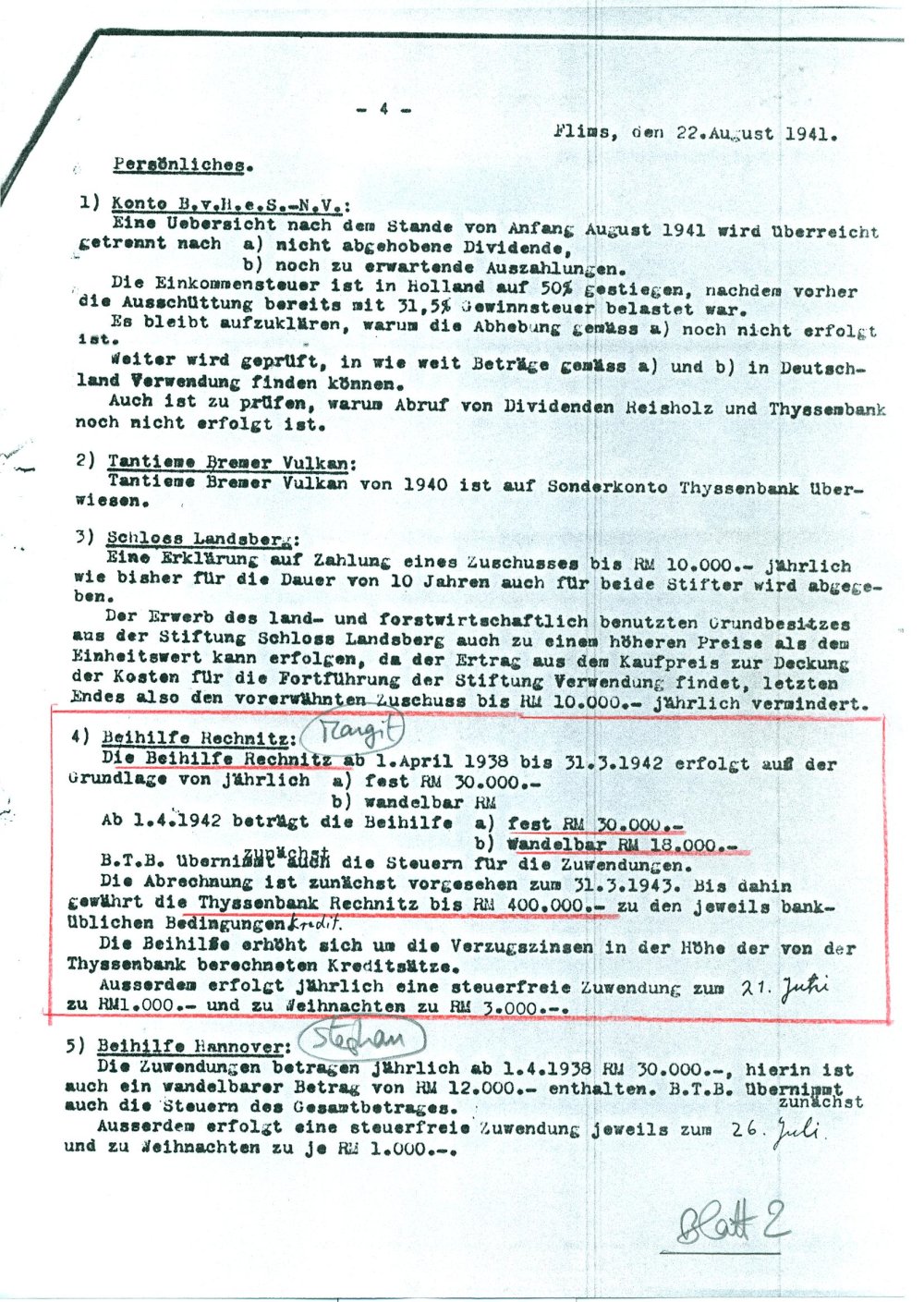
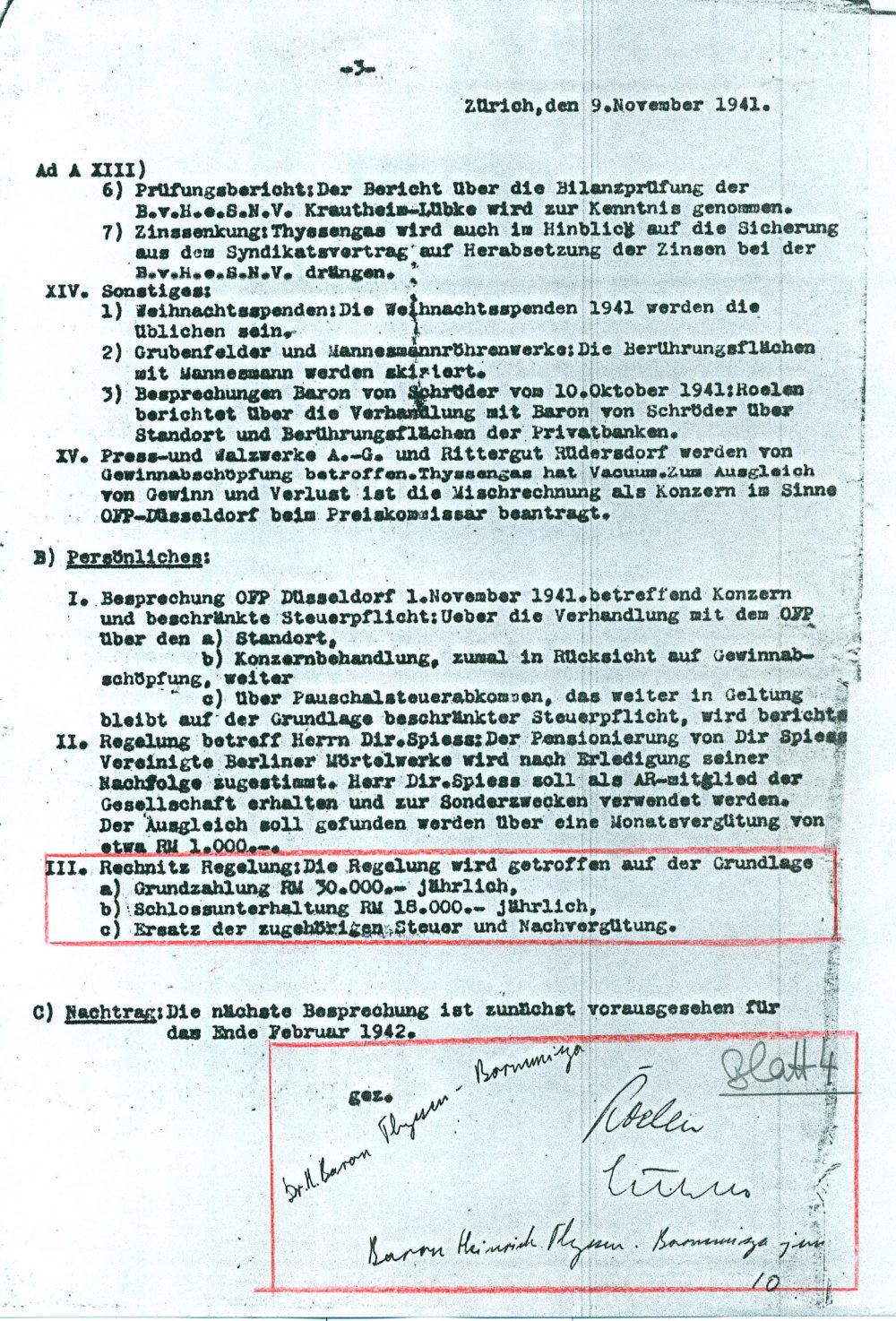
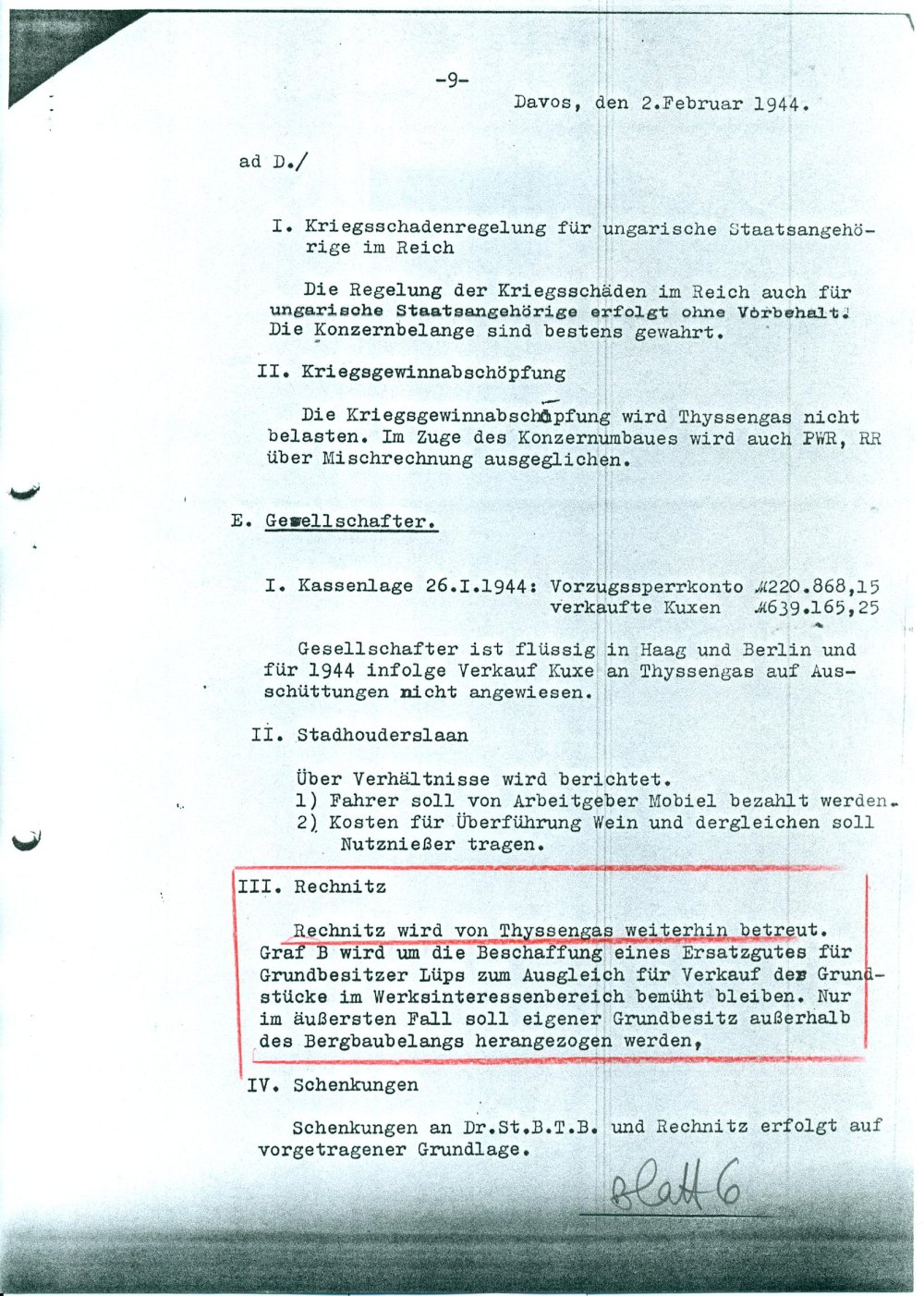
To assist Manfred Rasch with future editions of his book, I include in this post excerpts of documents confirming the Thyssens’ war-time financing of their SS-occupied castle in Rechnitz, documents which I can only assume he overlooked in his haste to publish his book. They concern meetings of Heinrich and his son Hans Heinrich Thyssen-Bornemisza (‘Heini’) with their managers Heinrich Lübke and Wilhelm Roelen on 22 August 1941 in Flims, on 9 November 1941 in Zurich and on 2 February 1944 in Davos and include details of the RM 400,000 loan from August Thyssen Bank Berlin to Rechnitz, yearly contributions of RM 30,000 for Margit Batthyany and RM 18,000 for the upkeep of the castle, as well as a notification that Thyssengas (then Thyssensche Gas- und Wasserwerke) was generally ‘looking after’ Rechnitz.
Scanned Document
Scanned Document-1
Scanned Document-2
(all excerpts of documents in this post are from the archives of David R L Litchfield and are to be reproduced with his permission only). |
 ThyssenKrupp's historian and archivist Prof. Manfred Rasch 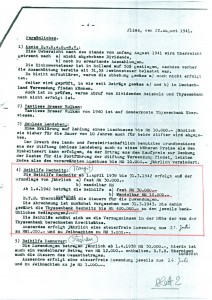 Documents substantiating Thyssen funding of Rechnitz castle during the second World War (Archives of David R L Litchfield, not to be reproduced without permission) 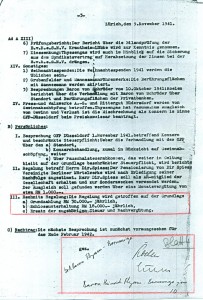 Documents substantiating Thyssen funding of Rechnitz castle during the second World War (Archives of David R L Litchfield, not to be reproduced without permission) 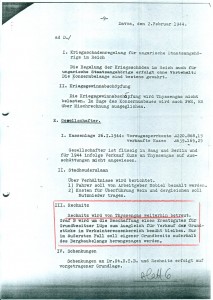 Documents substantiating Thyssen funding of Rechnitz castle during the second World War (Archives of David R L Litchfield, not to be reproduced without permission) |
|
Tags: Amazon, anti-Semitism, archives, August Thyssen, August Thyssen Bank, Berlin, bibliography, Davos, Flims, Heinrich Lübke, Heinrich Thyssen-Bornemisza, historiography, Manfred Rasch, Margit Batthyany, Rechnitz, Ruhr, slave labour, sources, Thyssengas, ThyssenKrupp, Thyssensche Gas- und Wasserwerke, Wilhelm Roelen, Zurich
Posted in The Thyssen Art Macabre, Thyssen Corporate, Thyssen Family Comments Off on What have ThyssenKrupp’s historians been doing all this time?
Thursday, March 4th, 2010
| Dear Manfred Rasch (‘Ueberspieler’, ThyssenKrupp Smoke and Mirrors Department),
Congratulations on your latest literary output, but I am confused. When we came to see you in November 1998, you told me that the letters between August Thyssen and his son Heinrich Thyssen-Bornemisza were Baron Heini Thyssen’s private property.
You also told us: ‘We are not a service organisation for the Thyssen family. We are the archive of a company or companies, and have nothing to do with the Thyssen-Bornemisza family.’ Were you lying or has something changed? So: Who owns the copyright to your book and/or to the letters? All very mysterious!
I am certainly looking forward to receiving a copy of the book, not so much because of what it will contain, but what it doesn’t. Fortunately, as we also have copies of all the letters, which were given to us by Heini Thyssen, we can fill in any gaps you might inadvertently have left. We hope nobody has been tempted to forge any additions, as you once accused us of doing.
I have to say that I find the fact that you, and presumably ‘the organisation’, are choosing to do such a book, while ThyssenKrupp is the subject of ‘independent’ academic research, deeply suspicious. Why do I get the feeling that it is all part of the re-writing of corporate and family history in response to the publication of our book ‘Die Thyssen-Dynastie. Die Wahrheit hinter dem Mythos’ (assoVerlag Oberhausen, 2008)? |
 |
Tags: assoVerlag, August Thyssen, Heini Thyssen, Heinrich Thyssen-Bornemisza, Manfred Rasch, Oberhausen, ThyssenKrupp
Posted in The Thyssen Art Macabre, Thyssen Corporate, Thyssen Family Comments Off on Private Enterprise?
Tuesday, January 19th, 2010
| Apart from the highly successful manufacture of U-Boats during both world wars, due, in part – particularly during WWII -, to their financially advantageous use of slave labour, the Thyssens have not always been fortunate in their shipbuilding endeavours; as you will see from our book ‘The Thyssen Art Macabre’, which exclusively reveals the full details of Heini Thyssen’s legendary ‘Swiss’ banana boat company.
But more recent embarrassments have included the Greeks’ reluctance to pay for several submarines built by ThyssenKrupp Marine Systems which they considered unfit for purpose. Somewhat more ironic is the news that the Israelis, of all people, have agreed to commission ThyssenKrupp to build them two frigates, possibly with the additional incentive of various financial aid measures supplied by the German government.
Even less successful has been the manufacture of commercial ships which has been reflected by the news that the ThyssenKrupp owned shipyard Blohm + Voss is in future intending to abandon all commercial shipbuilding. Unfortunately, the story doesn’t end there.
Due in part to the inclement financial situation and ThyssenKrupp’s disastrous investment in Brazil, they have decided to sell off a number of divisions in a grand spring sale. First through the door, by all accounts, were the guys from Abu Dhabi MAR. Not content with assisting in bailing out the world’s largest and most spectacular property fiasco in neighbouring Dubai, Abu Dhabi has expressed an interest in buying into ALL ThyssenKrupp’s shipbuilding enterprises, both commercial AND military.
No one has seen fit to comment on how this might affect the Israelis’ frigates, but the concept of German-funded, Muslim-built, Jewish warships is certainly an interesting one. Perhaps the companies involved could ask the court in Augsburg if it could lend them Karl-Heinz Schreiber for a while to help seal the deals.
* * * * * * * * * * * * * * * * * * * * * * * * * * * * * * * * * * * * * * * * * * * * * *
Abgesehen vom überaus erfolgreichen U-Boot-Bau in beiden Weltkriegen, teils basierend – vor allem im 2. WK – auf ihrer finanziell vorteilhaften Anwendung von Zwangsarbeit, waren die Schiffsbauunternehmungen der Thyssens nicht immer erfolgreich; dies ist in unserem Buch ‘Die Thyssen-Dynastie. Die Wahrheit hinter dem Mythos’ nachzulesen, welches alle Details über Heini Thyssen’s ruhmreiche ‘Schweizerische Bananendampfer-Firmen‘ exklusiv darlegt.
Peinlichkeiten jüngeren Datums schliessen Griechenlands Verweigerung der Zahlung für eine Anzahl von U-Booten ein, die von ThyssenKrupp Marine Systems gebaut wurden, und bei denen der Auftraggeber technische Mängel anprangerte. Etwas ironischer ist die Neuigkeit, dass ausgerechnet die Israelis beschlossen haben, bei ThyssenKrupp den Bau zweier Fregatten in Auftrag zu geben, und zwar möglicherweise unter Zuhilfenahme verschiedener finanzieller Unterstützungsmassnahmen der deutschen Regierung.
Noch weniger erfolgreich war seit einiger Zeit die Produktion von Handelsschiffen, was daran ablesbar ist, dass die zu ThyssenKrupp gehörende Blohm + Voss Werft in Zukunft jeglichen Handelsschiffsbau abstossen will. Leider ist die Geschichte damit noch nicht zu ende.
Unter anderem aufgrund der schlechten Finanzlage und ThyssenKrupp’s katastrophalen Fehlentscheidungen in Brasilien hat man beschlossen, eine Anzahl von Zweigen in einem grossangelegten Frühjahrsschlussverkauf zu veräussern. Als erste Anwärter präsentierten sich die Leute von Abu Dhabi MAR. Ungesättigt von seinen Rettungsaktionen nach dem erstaunlichen Immobilienfiasko des Nachbarstaats Dubai hat Abu Dhabi nunmehr sein Interesse daran angekündigt, sich in ALLE Schiffsbauunternehmungen von ThyssenKrupp einzukaufen, sowohl im zivilen wie auch im militärischen Bereich.
Bisher hat noch niemand kommentiert, wie sich dies auf die Israelischen Fregatten auswirken könnte, aber das Konzept von jüdischen Kriegsschiffen, welche von Deutschland finanziert und von Muslimen gebaut werden ist sicherlich hochinteressant. Vielleicht können die beteiligten Firmen ja beim Gericht in Augsburg anfragen, ob sie sich Karl-Heinz Schreiber eine Zeit lang ausleihen können, bis die Geschäfte erfolgreich abgeschlossen sind. |
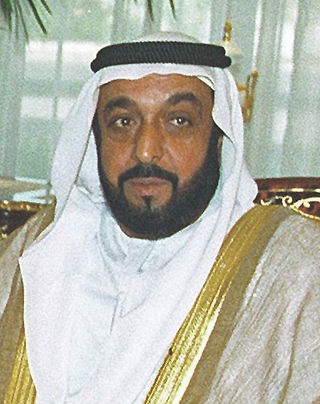
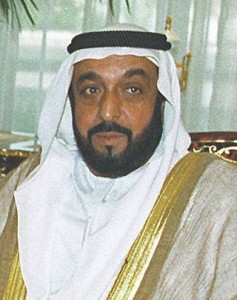 HH Sheikh Khalifa bin Zayed bin Al Nahyan, current President of the United Arab Emirates (UEA) and emir of Abu Dhabi  Civilian or military? That's the 100 Billion Dollar question  Schreiber The Fat Man, Singing |
Tags: Abu Dhabi MAR, Augsburg, Blohm + Voss, Brasilien, Brazil, Die Thyssen-Dynastie, Die Wahrheit hinter dem Mythos, Fregatten, frigates, Heini Thyssen, Karl-Heinz Schreiber, Schiffsbau, shipbuilding, slave labour, The Thyssen Art Macabre, ThyssenKrupp, ThyssenKrupp Marine Systems, U-boats, U-Boot, Zwangsarbeit
Posted in The Thyssen Art Macabre, Thyssen Corporate Comments Off on ThyssenKrupp’s Spring Sale Complications
Sunday, November 29th, 2009
| In today’s article on the forthcoming trial of John Demjanjuk, alleged participator in Jewish mass murders, Wolfgang Benz, head of the Centre for Anti-Semitism Research at the Technical University of Berlin, is quoted as being enthusiastic about the trial as he believes that ‘dealing with [Germany’s Nazi] past is extremely important’, even if the aforementioned Demjanjuk is only ‘a small cog’. Unfortunately Wolfgang Benz is less enthusiastic when it comes to dealing with the ‘big cogs’. When I wrote a feature in Frankfurter Allgemeine Zeitung concerning Heini Thyssen’s sister’s involvement in the slaughter of 180 Hungarian Jews at a party at their Austrian castle in Rechnitz in 1945, Wolfgang Benz immediately lept to her defence by denying the event ever took place. Even various German journalists, embarrassed by his denial, admitted that it wasn’t the first time that he had made such a questionable comment. |
 'Nazi Denialist' Wolfgang Benz |
Tags: Frankfurter Allgemeine Zeitung, Heini Thyssen, John Demjanjuk, Nazi Atrocity, Rechnitz, Sunday Telegraph, Technical University Berlin, Wolfgang Benz
Posted in The Thyssen Art Macabre, Thyssen Corporate, Thyssen Family Comments Off on Sunday Telegraph Quotes Nazi Atrocity ‘Denialist’ Wolfgang Benz
Sunday, October 25th, 2009
Book Review by Dr Erika Abcynski, Dormagen, Germany (translated by Caroline Schmitz):
‘David R L Litchfield has written a book about the Thyssen family from the founding of the Thyssen Concern to its collapse. Litchfield has assembled much interesting information about the Thyssens and thus about German capitalism per se.
As early as the founding of the first Thyssen works in 1870 August Thyssen combined greed, cleverness and sharp practice against his first business partner and brother-in-law as well as the elimination of competitors and the procurement of capital through marriage. Indeed, he concealed from his brother-in-law that he wanted to found his own rolling work in direct competition to him. The company Bechem & Keetman in Duisburg had to produce machinery exclusively for him. In the area surrounding Duisburg nobody but August Thyssen was able to buy machinery for a rolling work.
For the workers of the Thyssen works there was the rule of carrot and stick. “August’s expectations of his workers were very simple and straightforward. He expected them to abide by the ‘Reglement’, work very hard with the minimum of waste in time or materials, and produce as much as their engineer managers could get out of them…..The Meisters were expected to act as sub-contracting entrepreneurs rather than production or workshop supervisors of their respective departments”.
“The workers… remained entrapped by the Thyssens’ policy of supplying, and owning, all the worker’s needs ‘on-site’. The story, baths, canteens and lodging houses were all a man had time to need.” (quoted from David Litchfield, ‘Die Thyssen-Dynastie’). People were fired for minute transgressions. In 1928 the Thyssen-brothers Fritz and Heinrich locked out 225,000 workers for one month. Through the ownership of 67,000 workers’ lodgings, pressure could be exerted on the workforce and the government could be blackmailed through the threat of mass redundancies.
The Thyssen balance sheet for 1912 claimed the value of the Concern to be 562,153,182 Reichsmark. Before and during the First World War, there was strong collaboration between Thyssen and the Imperial government. One of August Thyssen’s friends was Hjalmar Schacht, later Hitler’s Economics Minister. Thyssens armaments production for German increased. By 1918, practically the whole enterprise produced for the war. The founding of firms in The Netherlands safeguarded Thyssen assets in case the war would be lost. Furthermore, tricks were used through the Thyssen-owned Bank voor Handel en Scheepvaart NV and assets safeguarded. Using the Hungarian citizenship of the Thyssen-son Heinrich Thyssen-Bornemisza, topped by a residency in the Netherlands, the Thyssen fortune was protected from allied confiscation, also after 1945. Heinrich Thyssen had married the daughter of the Hungarian Baron Bornemisza and had had himself adopted by his father-in-law in order to gain the title of Baron.
In 1923 there were the first contacts to Hitler. Fritz Thyssen knew about the plans for the putsch. He donated 100,000 Goldmarks for the National Socialist Party. He liked the fact that Hitler wanted to sort out the workers’ movement once and for all. At the beginning of the 1940s, Fritz Thyssen conceded that he had donated 62 million Reichsmark to the Nazi party over a 12 year period. Göring was one of his friends. In 1933 Fritz Thyssen joined the Nazi party, his wife had done so even earlier.
Tax evasion was an important business tool for the Thyssens. From 1919 to 1939 there were constant investigations by the financial authorities. In 1939 the Tax Directorate in Düsseldorf was able to prove that Fritz Thyssen had committed tax evasion and illegal foreign currency transactions, which Hitler had declared to be a capital offense. A fearful Fritz left for Switzerland on 1. September 1939, then moved to France. All his assets were placed by Göring under the trusteeship of Prussia and managed by joint friends and business partners of the two men. In other words, it was not his enmity against Hitler or any concerns about the mistreatment of Jews that led to Fritz Thyssen’s persecution, but the fact he was lining his own pockets. From the 1930s the Thyssens once again made money from armaments production, but also began simultaneously, just like August Thyssen during WWI, to safeguard their fortune, for instance in the USA and in South America. August Thyssen Hütte had nine POW-camps and seventeen camps for forced labourers. Heinrich Thyssen lived in Switzerland, led the affairs of his firms from there and continued to do business with the Nazis, but not publicly. From 1941 onwards he made his son Heini attend the meetings in Switzerland with the managers of his enterprises, which were also sometimes attended by Baron von Schröder of the Nazi bank Stein in Cologne, who was the trustee for Fritz’s confiscated industrial shares.
The most disgraceful story which members of the Thyssen family were involved in, is the murder of 200 Jews at Rechnitz Castle, where the eldest daughter of Heinrich Thyssen, Margit Batthyany, nee Thyssen-Bornemisza, lived with her husband, Count Batthyany, and high-ranking Nazis and SS-officers. During the night of 24 March 1945 the Ortsgruppen-leader Podezin, a Gestapo-official, left a party hosted by Count and Countess Batthyany with guests to shoot the Jews. The victims were 200 half-starved Jews who had been declared unfit for work. Local people said that Podezin had been in the habit of shooting Jews who were locked up in the castle cellars and that the Countess had enjoyed watching these events. After the war neither Margit nor other members of the Thyssen family wanted to know anything about this massacre and they were never prosecuted for it.
Litchfield has also assembled much information about the behaviour of the Americans and the British towards the Thyssens. For fear of the communists the Thyssens were handed back all of their fortune, works, shares and gold, despite their role in the Third Reich.
After 1945, Heinrich Thyssen transferred his role within the Thyssen Bornemisza Group to his son Heini Thyssen. But he did not much care for the Concern. Rather, he spent most of his time with sharing out his fortune. Other than that he had many relationships with glamorous, high society women and with the excesses of alcoholism. As a form of investment he bought many hundreds of paintings which were first exhibited and stored at his father’s villa in Switzerland. August Thyssen had started the art collection by buying works of Rodin, also as an investment. When Heini realised, that the maintenance of his collection was expensive, he searched for another way of handling it. Here he used all of his business acumen and various goods contacts, thus managing to sell about half of his art works to the Spanish state for 350 million dollars, payable free of tax, outside Spain, having first loaned the collection to the Spanish for 5 million dollars a year. The Spanish state met all costs for the use of the Thyssen pictures as a permanent public display.
The facts assembled in this review represent only a tiny fraction of the innumerable data painstakingly collected by Litchfield, which illustrate the greed and corruption of the Thyssens. The book is over 500 pages long and a thrilling read, the part about Heini Thyssen is somewhat too extensive.’
http://www.secarts.org/journal/index.php?show=article&id=948&PHPSESSID=ec1b0e599e946f1f299627d9346a7f4a
Tags: Adolf Hitler, Alcoholism, Armaments Production, August Thyssen, Auguste Rodin, Bank voor Handel en Scheepvaart, Bankhaus J. H. Stein, Duisburg, First World War, Forced Labour, Fritz Thyssen, Heini Thyssen, Heinrich Thyssen-Bornemisza, Hermann Göring, Kurt von Schröder, Margit Batthyany, National Socialist Party, Rechnitz Castle, Second World War, Thyssen Dynasty, Thyssen-Bornemisza Collection
Posted in The Thyssen Art Macabre, Thyssen Art, Thyssen Corporate, Thyssen Family Comments Off on ‘The Thyssen Dynasty – A Masterclass In The Unacceptable Face Of Capitalism’
Wednesday, October 21st, 2009
| Four or five years ago, a member of the Thyssen family told me his brother Georg was selling off their manufacturing companies and concentrating on investment services. Apparently, he had already been getting a regular 10% return on family money when the best anyone else was getting was 5 or 6%.
Well, it appears Georg was probably getting as much as 15 or 16% and taking the margin as profit. It was obviously good business. So good that he managed to sell the deal to others. So far, so good. But then the source of his miraculous return ceased to be so miraculous, as Bernie Madoff’s dark little secret became very, very public.
Quite rapidly those who had used the services of the Thyssen-Bornemisza company ‘Thybo Advisory’ realised that the chances of getting their money back from Bernie were non-existent, especially when he was awarded a 150-year jail sentence, so they (US-Trustee Irving Picard and the Belgian Investor Representative Deminor) decided to take Thybo Advisory to court. Judging by the fact that Thybo’s secretive Monaco offices were recently the subject of a police raid, one has to assume there may have been a certain lack of transparency somewhere down the line.
This is obviously bad news for the Thyssens, and all those who invested in Thybo. It appears that the amount lost may have been a great deal more than originally thought. The Monegasque authorities are also particularly allergic to these kind of goings on and may soon be asking the family to relocate. Perhaps the Thyssens will join many others in learning that the reluctance to pay tax and the desire to make a profit without working inevitably ends in tears. |
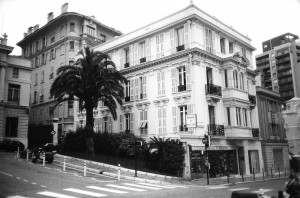 The Monaco headquarters of the Thyssen-Bornemisza Group and Thybo Advisory on Boulevard Princesse Charlotte |
Tags: Bernie Madoff, Georg Thyssen-Bornemisza, Monaco, Thybo Advisory, Thyssen Bornemisza Group, Thyssen Family, Thyssen-Bornemisza
Posted in The Thyssen Art Macabre, Thyssen Corporate, Thyssen Family Comments Off on Will The Thyssen Family Be Looking For A New HQ?
Tuesday, July 14th, 2009
| I recently came across an article about August Thyssen in the summer series on famous scions of the Lower Rhine region, published by the Rheinische Post newspaper, under the promising headline ‘A Globaliser From The Start’. But it contained the sentence ‘After the World War, August Thyssen lost his foreign participations’. As somebody who has studied the Thyssens for some fourteen years now, it was the kind of throw-away remark that sharply reminded me once again of the systematic manipulation of history that has accompanied this dynasty’s personal and corporate affairs for a very long time.
If you wish to get a very basic idea of what I’m talking about, go to German Wikipedia and check out the entries for Alfred Krupp, Hugo Stinnes, Friedrich Flick and August Thyssen; all four legendary German industrialists of similar status and place in history. Krupp warrants 5 illustrated pages, Stinnes 11, Flick 10, but Thyssen barely manages to make three quarters of a page! Why should this be so? The chief publicist and archivist of ThyssenKrupp, Professor Manfred Rasch, is more than capable of producing lengthy features on the founder of the Thyssen empire at opportune moments in local publications, such as Westdeutsche Allgemeine Zeitung, which are hugely sympathetic to the image of a company that still remains one of the major employers in the Ruhr area, as well as far beyond. So why does he not ensure that extensive and accurate information is available on a more general level?
The answer is: because there are many black holes in this dynasty’s history which would be too difficult to broach. Instead, gloss-overs and simplifications have been produced over the years by the official guardians of the Thyssen legacy and reproduced by unwitting journalists and historians. But even the most consistently spin-doctored histories are eventually bound to come unravelled. This is particularly true in times of bust such as today, when money becomes scarce and people re-examine their loyalties; as long, of course, as they can enjoy the freedom of democracy rather than being forced into the shackles of authoritarian rule so admired by the likes of Ecclestone, Mosley & Co.
One reason why the Thyssens have always purported to have ‘lost everything’ in the war (for the family members tend to ‘go the extra mile’, insisting all was lost, not just the foreign assets) is to excuse their involvement in arming the German Empires of Kaiser Wilhelm II and Adolf Hitler respectively. If it were shown that they actually profited from those regimes, the Thyssens would receive far less sympathy and respect than they do when portrayed as the sacrificial victims of the conflicts, who had to rebuild their fortunes each time from scratch by the sweat of their own brows. The latter being very much the picture painted on the new website of the Thyssen-Bornemisza Museum.
In actual fact, while other industrialists were punished for their support of the Reich, the Thyssens were not. They were even compensated for their losses. After World War I, this included their Lorraine ore mines and steel works, which the French insisted they give up. Heini Thyssen himself admitted to David and myself that far from his family losing, for instance, his grand-father’s Brazilian interests after 1918, he was able to liquidate some of them in the 1970s at vast profit. Despite such good fortune, ‘foreign assets’ have always been a particularly contentious issue in the Thyssen historiography, not least because this most quintessential of German dynasties, whose name still remains one of those inextricably linked with the fatherland’s deepest sense of national prosperity, honour and pride, has continuously reaped the benefits of German industry, while simultaneously refusing to admit allegiance to the country.
While the destruction of August Thyssen’s personal files after his death in 1926 ensured the public could never realise that this supposed German patriot had in fact moved his ultimate ownership structures abroad before 1914, a more overt public relations exercise was necessary after 1945 when the magnitude of the Nazis’ criminal activity came to light. That is why official communiques began to over-engineer Heinrich Thyssen’s cosmopolitan credentials, giving assurances that he ‘had distanced himself from Germany as a young man’, that he ‘became a Hungarian in 1906’, that he ‘gained a doctorate in philosophy in London’ and that he ‘settled in Switzerland in 1932’. On closer inspection even of the official sites, however, inconsistencies soon start to appear for all of these claims.
As far as Heinrich’s nationality is concerned, ThyssenKrupp AG has for some time now resorted to the line: ‘He kept his Hungarian citizenship until he died, but nevertheless acted ‘deutsch-nationally’ at times in the 1920s and 1930s. For this vague statement to be allowed to paraphrase the activities of such an important (if shielded) figure of 20th century history is quite simply astonishing. And of course it can in no way explain how German works owned by Heinrich Thyssen were still able to claim war damages from the allied government for Germany in 1946 on the basis of Heinrich being ‘a German abroad’. The fact is: Heinrich Thyssen lived in Lugano from 1938 (not 1932! – more of this later) until his death in 1947, controlling his German interests with the help of visiting managers and this makes him somebody who acted ‘deutsch-nationally’ (if this is what you want to call it), throughout Hitler’s time in power and beyond.
Turning to Heinrich’s academic title: the assertion of a doctorate in philosophy gained in London is pure fabrication. That is why it does not appear on the German websites, where it is clear and very acceptable to people that the doctorate was gained in Germany in the field of natural sciences. It is, on the other hand, very much emphasised in Spain, where the government’s expenditure of in excess of $600 million dollars on the Thyssen-Bornemisza art collection seems to make it imperative to stress the founder’s alleged cultural and specifically non-German credentials.
Here on www.museothyssen.org, we also find echoes of Francesca Habsburg‘s recent attempts to designate August Thyssen as the true founder of the Thyssen-Bornemisza Collection (even to the extent where a recent museum web-incarnation called him ‘August Thyssen-Bornemisza’!), thereby rebranding the whole dynasty as the art collectors she would like them to be (making her fourth in a row) rather than the industrialists and bankers that they really were. But the official website of the Thyssen-Bornemisza Museum also makes another announcement: ‘We know the collection was installed at Rohoncz Castle before Heinrich abandoned Hungary in 1919’. This is particularly worrying as the comprehensive catalogue of the museum squarely confirms the documentation in the Thyssen Archives showing that the first purchase made for the collection was in 1928 (unless that too has now been re-written!)
The smoke and mirrors at Museo Thyssen continue: ‘It is through the correspondence between August Thyssen and Auguste Rodin, namely in a letter from 1911, that we can see that August’s son Heinrich had by that time started his collection’. We have researched the same letters during the writing of our book but never came across anything that would confirm this. The official line basically intimates that with his transformation into a ‘Hungarian aristocrat’ in 1905 (the real dated being 1906-07), Heinrich Thyssen had also, somehow, acquired an art collection.
What seems clear to me is that people in charge of that museum are finally realising that they have a particularly grave problem on their hands. However, not knowing what to do about it, their inability to address serious issues breeds insecurity and confusion. That’s why another sentence has been added to the website: ‘We have few details about the first years of the collection’. While I guess it would be unfairly over-stressing the point if one reminded the Spanish tax payer once again, how much money he contributed and is still paying to the Thyssen Museum, the indelible facts concerning the early history of the collection are these: the Thyssen Collection was never at Rohoncz (Rechnitz). It was only named ‘Rohoncz Collection’ by Heinrich Thyssen with the specific aim of making it sound like an Austro-Hungarian heirloom. Unbelievably, the public as well as the media have bought this fiction decade after decade.
The staff of Frankfurter Allgemeine Zeitung got equally confused in October 2007, when they ran David’s piece on Heinrich Thyssen’s daughter, Margit Batthyany, and her involvement in the murder of 180 Hungarian Jews at Rechnitz Castle in March 1945, which had been published two weeks earlier in The Independent. None of the many continental journalists and historians who subsequently busied themselves in denigrating our work, such as Anja Seeliger of Perlentaucher fame for instance, actually figured out that the reason why the two features were markedly different was not only because of overt censorship in Germany, but also because staff at FAZ saw fit to fact-check the article – the fruit of 14 years of research – against the grossly inaccurate (ThyssenKrupp AG / Museo Thyssen / Thyssen Family) Gospel According to Wikipedia, the same Wikipedia that has rejected our corrective suggestions outright.
Back at Frankfurter Allgemeine: out came 1938 as Heinrich’s settlement date in Switzerland, in went 1932 (to ensure that Heinrich’s presence in Germany after Hitler’s ascension to power could be denied). Out went the proviso that the collection was never at Rohoncz, in went the age-old phrase that it was housed there. Out came our statement that the Thyssens acquired the Erlenhof stud farm from the liquidators of the persecuted Jew, Moritz James Oppenheimer, in 1933. In went the fabrication that Heinrich Thyssen’s business empire was completely separate from August or Fritz Thyssen’s empire. While we are grateful to FAZ for publishing the feature, this type of inaccurate ‘editing’ of copy in a newspaper of such quality should be of concern to everyone.
And even today, two years after the publication of our book, the Spanish museum continues to insist that ‘Heinrich Thyssen’s enterprises were completely separate from the German steel industry’, when even ThyssenKrupp’s website has been admitting for a while now that Heinrich owned the Press- and Rolling Works Reisholz and the Oberbilker Steelworks, both plants that produced canon for Adolf.
Spain is also still holding on to the idea that Heinrich was ensconced in Switzerland from 1932 onwards, where he ‘opened the doors of his gallery to the public in 1936’. Apart from family archival evidence, Heinrich’s own war-time curator, butler and companion, Sandor Berkes, assured us that the gallery building remained unfinished until 1940 and was only opened to the public in 1948. As can be seen from the picture above, far from being locked away in his Swiss villa, in 1936 Heinrich was, amongst other things, happily socialising at the German Derby with his personal friend Hermann Göring, whom he also assisted with personal and Reich banking facilities.
With a background of such systematic disinformation, it does not come as a surprise that the personal assertions by Thyssen family members are also becoming more and more ‘retrograde’. Francesca Thyssen is quoted as explaining to the Austrian ‘News’ Magazine in November 2008 (available in hard copy version only, not online!): ‘Of course my great-uncle (Fritz) was truly deeply enmeshed in Nazi-crimes, that’s no secret. That’s why my grandfather (Heinrich) took the name Bornemisza from his wife, because he left this whole family. Because he wanted to be different and wanted to leave this family’. Or, in other words: Heinrich Thyssen foresaw the coming of the Third Reich by 27 years!…
I can understand that the various guardians of the Thyssen legacy would feel the need to rewrite the unacceptable history of this family. But I do not appreciate the fact that journalists, historians and those who should know better continue to encourage the belief in facts which they know to be untrue or should admit to be so since the publication of our book. As far as the Spanish public in particular is concerned, which is at this very moment being told by Guillermo Solana, the director of the Thyssen-Bornemisza Museum, that new gallery space is urgently needed in Malaga and Sant Feliu de Guixols because the Madrid museum is ‘running out of space’, I feel the time has come to tell him that before any more tax funds are poured into Thyssen projects, the Thyssens might be more truthful about their past and that of the collection, while the Spanish government must admit how much they have and are paying the Thyssens for the display and storage of their paintings. |
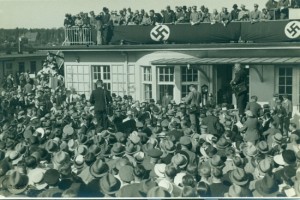 Celebrating the victory of stud farm Erlenhof's 'Nereide' at the 1936 German Derby. In the centre of the picture are (to the right) the winning horse's owner, Heinrich Thyssen (in grey top hat) and (to the left) his friend and associate Hermann Göring (in white suit) (photo: Tachyphot Berlin, copyright: David R L Litchfield) |
Tags: Anja Seeliger, August Thyssen, Francesca Habsburg, Guillermo Solana, Heinrich Thyssen, Manfred Rasch, Margit Batthyany, Oberbilker Steelworks, Press- and Rolling Works Reisholz, Rechnitz Castle, Rohoncz Collection, Thyssen-Bornemisza Museum, ThyssenKrupp
Posted in The Thyssen Art Macabre, Thyssen Art, Thyssen Corporate, Thyssen Family Comments Off on Thyssen Truth Must Come Out Before More Tax Money Goes In (by Caroline Schmitz)
Friday, May 8th, 2009
| During December 2008, I was invited by the Elfriede Jelinek Research Centre at the University of Vienna to take part in a discussion concerning her play ‘Rechnitz (Der Würgeengel)’ to take place in May 2009. Some four weeks prior to the event, I discovered one of the sponsors of the series of lectures and discussions under the title ‘Endless Innocence’ was to be Francesca Habsburg, nee Thyssen, in the form of her art foundation Thyssen-Bornemisza Art Contemporary (T-B A21). My introductory statement which I gave on the evening of 5 May in Vienna was largely in response to this situation. It read as follows:
‘I would like to say how gratified I am to have played such a major part in persuading Francesca Thyssen to accept, as part of her financial inheritance, some responsibility for her family’s behaviour. I believe this to be manifest in her sponsoring of this event.
However, I would have been even more gratified if she had made an apologetic admission, as opposed to a financial contribution, for being that the Thyssens were sponsors of Rechnitz Castle and the Countess (and I do have documentary evidence of that fact with me tonight), I consider there to be something obscenely ironic about the fact that we are all sitting here, 64 years later, discussing the Rechnitz Massacre, or a play by Elfriede Jelinek, which includes the massacre, while yet again being sponsored by The Thyssens in the form of Francesca’s art foundation.
I am also forced to question how, as long as any doubt remains concerning the extent of the Thyssens’ involvement in the Rechnitz Massacre, Vienna University can accept her money while claiming impartiality.
Unfortunately, this conflict of interest is not a unique situation in the academic world, particularly in the case of Wolfgang Benz, head of Anti-Semitism Research at the Technical University of Berlin, and Richard Evans, Chairman of the Faculty of History at Cambridge University, who have both attempted to discredit my writing in Frankfurter Allgemeine Zeitung and my book, ‘The Thyssen Art Macabre’, published in Germany under the title ‘Die Thyssen-Dynastie’, while accepting funding from the Fritz Thyssen Stiftung.
I am sad to say that I consider this type of arrangement brings into question the credibility of academic historians.
I now have another question. If Countess Margit Batthyany, nee Thyssen, sponsored the murder of 200 Hungarian Jews as after-dinner entertainment and possibly even played an active role in their murder, and then Elfriede Jelinek writes a play involving the atrocity, which can also be characterised as entertainment, albeit intellectual entertainment, but which I’m sure everyone here considers a work of art, where does that leave the killing of the Jews?
As I hope and believe is obvious from my article in Frankfurter Allgemeine Zeitung and my book ‘Die Thyssen-Dynastie’, I consider it a crime against humanity. And no amount of art sponsorship, intellectual smoke screens or academic denial is ever going to alter that.’
I was subsequently informed that Francesca had promised the university to make a public statement, but had failed to do so, despite numerous reminders, prior to her departure to her house in Jamaica.
http://www.jamaica-gleaner.com/gleaner/20090515/social/social3.html
(For the German version of my statement, please go to ‘Events’). |
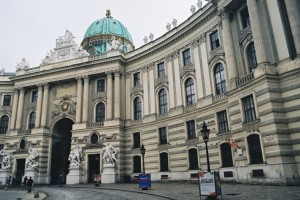 Vienna University, Elfriede Jelinek Research Centre 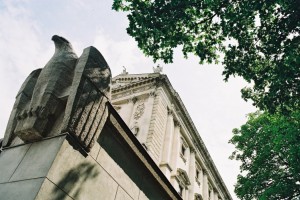 The Reich and the Habsburgs working together in public & private partnership 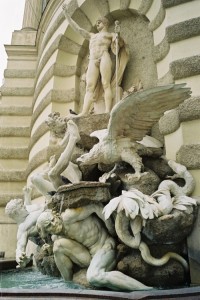 Professor Janke of the Elfriede Jelinek Research Centre still experiencing difficulties appreciating what constitutes freedom of speech |
Tags: Elfriede Jelinek, Elfriede Jelinek Research Centre, Francesca Habsburg, Francesca Thyssen, Fritz Thyssen Stiftung, Margit Batthyany, Rechnitz Castle, Rechnitz Massacre, Richard Evans, Thyssen-Bornemisza Art Contemporary, Wolfgang Benz
Posted in The Thyssen Art Macabre, Thyssen Corporate, Thyssen Family Comments Off on Vienna University’s Impartiality In Question
|