March 28th, 2010
| Interview with Sara Olivo for Epoca Magazine (Gaceta de Negocios) 12 March 2010.
EM: Do you think that Carmen Cervera and the Spanish State will come to an agreement for the Carmen Thyssen-Bornemisza Collection to remain in Spain?
DL: I hope not. The Spanish state does not need her pictures. And Carmen Cervera should not be asking the Spanish state for any payment. The Spanish state cannot afford it and the Madrid museum already loses money every year. So why pay more money to a wealthy Thyssen in order to lose even more money for the state? For the life of me I cannot think of a reason why Spain wants Carmen Thyssen’s third-rate pictures, when it already has too many first-rate pictures in other museums.
EM: What are the main difficulties faced by Tita to reach a satisfactory agreement?
DL: The main problems are her greed and Spain’s bad financial situation. She is trying to repeat the deal that her husband Heini made nearly 20 years ago. But she does not have his skill or knowledge. You did a terrible deal with Heini Thyssen. Even some of your own experts expressed scepticism about the wisdom of Spain buying his collection in 1993, for instance Eduard Castellet, President of the Fundacion Miro. So why would you want to do another, even more terrible deal?
EM: She says that she has offers from some museums in the USA and Europe. Can this be true?
DL: No, I don’t think that’s true. If she did, why would she not name them and say what they are offering her?
EM: She says she has as much money as people think…..Is it true?
DL: Her worth is never going to be what she says it is. I’m not sure she would even know herself. If she can claim that her pictures are worth €700 million, then of course she can claim to be a billionairess. But I believe that all of that is totally and completely exaggerated. Anyway, what does it matter how much money she has? She is taking money from Spain, not giving it.
EM: Is the Thyssen Collection overrated? Tita says it is worth €700 million.
DL: The Thyssen-Bornemisza Collection (i.e. Heini’s collection sold to Spain in 1993) is worthless, because it cannot be sold and requires constant taxpayers’ support to be housed and exhibited. As far as the Carmen Thyssen-Bornemisza Collection is concerned, as Carmen Cervera never says exactly what her collection comprises (240 pictures? 900 pictures? 3000 pictures?), it is impossible to value it. Therefore, what she is saying about its value is of no consequence. It is interesting, for instance, that the Spanish state seems to be insuring 655 of her pictures, when officially she is only exhibiting 240 at the Madrid museum:
http://vlex.com/vid/prestadas-coleccion-thyssen-bornemisza-15449009
EM: Can the negotiations affect the dispute between Tita and Borja and visa versa?
DL: Negotiations for what? She never says what she is negotiating. She constantly changes the number and nature of the pictures she wants Spain to rent from her. In Malaga, she is talking about a catalogue of 200 pictures, which only the conservative mayor has ever seen (not even the left-wing opposition in the town council has had the honour). The deal in Sant Feliu de Guixols is even more obscure, and yet she is talking about a ‘Thyssen museum network’ between the three locations. In the meantime, I calculate that Spain has already spent a total of around €100 milllion (!) to build facilities in Madrid, Malaga and Sant Feliu de Guixols to house parts of the Carmen Thyssen-Bornemisza Collection. If she is negotiating about pictures which are part of her son Borja Thyssen’s inheritance rights, then obviously he could challenge any deal.
EM: Do you think that being such a populist politician, Prime Minister Zapatero has a real interest in the collection with such a financial crisis as we currently have in Spain?
DL: I don’t understand why anyone, regardless of their political beliefs, would want to pay for pictures, some of which the Spanish state has already rejected before and others which were purchased from money previously paid to the Thyssens by the Spanish tax payer. It would be a bit like paying for the same thing twice!
EM: Tita said that the topic of her private collection is independent of the negotiations on the future of the Thyssen Museum. Do you think this is true?
DL: Carmen Cervera’s pictures housed in the Madrid museum since 2004 were not part of the original agreement with Heini, for which Spain paid $350 million in 1993 (according to my figures it was actually closer to $600 million if you include the real estate, architectural costs, insurance, lawyers fees, administration, etc,. etc.). Heini Thyssen did, however, manage to get a foot in the door for his wife by signing a separate agreement to loan an additional 70 pictures to the Madrid museum which remained in the ownership of him and Tita. This seems to be the basis of what she is trying to negotiate for Madrid now. This leads to an interesting point, which is that very few Spanish people (if any) have ever seen the original agreement. I have seen it, which is why I know that Spain made such a terrible deal.
I believe, that as a Spanish tax payer, you have the right to demand concrete information about all of this. At the moment, it is still all shrouded in a veil of smoke and mirrors. I can think of no reason why anyone would even consider acquiring her pictures, unless they are being paid some form of commission for doing so. On a personal level, I would also like to say that in my eyes, Carmen Cervera’s vulgarity and lack of taste actually damages Spain’s cultural image internationally. One more thing, which is very important: neither Tita nor Borja can do anything to affect the status of the original paintings bought by Spain from Heini Thyssen. Some reports make it sound like she could take Heini Thyssen’s pictures out of the Madrid museum as well. She cannot! |
 More, More, More, More, More, More, More, More, More, More, More, More, More, More, More, More, More, More, More, More, More, More, More, More, More, More, More, More, More, More, More, More, More, More, More, More, Mas, Mas, Mas, Mas, Mas, Mas, Mas, Mas, Mas, Mas, Mas, Mas, Mas, Mas, Mas, Mas, Mas, Mas, Mas, Mas, Mas, Mas, Mas, Mas, Mas, Mas, Mas, Mas, Mas, Mas, Mas, Mas, Mas, Mas, Mas, Mas, Mas, Mas, Mas, Mas, Mas, Mas, Mas, Mas, Mehr, Mehr, Mehr, Mehr, Mehr, Mehr, Mehr, Mehr, Mehr, Mehr, Mehr, Mehr, Mehr, Mehr, Mehr, Mehr, Mehr, Mehr, Mehr, Mehr, Mehr, Mehr, Mehr, Mehr, Mehr, Mehr, Mehr, Mehr, Mehr, Mehr, Mehr, Mehr, Mehr, Mehr, Mehr, Mehr... |
Tags: Borja Thyssen, Carmen Cervera, Carmen Thyssen-Bornemisza Collection, Eduard Castellet, Epoca Magazine, Fundacion Miro, Gaceta de Negocios, Heini Thyssen, Madrid, Malaga, Sant Feliu de Guixols, Sara Olivo, Spain, Thyssen Museum, Thyssen-Bornemisza Collection
March 4th, 2010
| Dear Manfred Rasch (‘Ueberspieler’, ThyssenKrupp Smoke and Mirrors Department),
Congratulations on your latest literary output, but I am confused. When we came to see you in November 1998, you told me that the letters between August Thyssen and his son Heinrich Thyssen-Bornemisza were Baron Heini Thyssen’s private property.
You also told us: ‘We are not a service organisation for the Thyssen family. We are the archive of a company or companies, and have nothing to do with the Thyssen-Bornemisza family.’ Were you lying or has something changed? So: Who owns the copyright to your book and/or to the letters? All very mysterious!
I am certainly looking forward to receiving a copy of the book, not so much because of what it will contain, but what it doesn’t. Fortunately, as we also have copies of all the letters, which were given to us by Heini Thyssen, we can fill in any gaps you might inadvertently have left. We hope nobody has been tempted to forge any additions, as you once accused us of doing.
I have to say that I find the fact that you, and presumably ‘the organisation’, are choosing to do such a book, while ThyssenKrupp is the subject of ‘independent’ academic research, deeply suspicious. Why do I get the feeling that it is all part of the re-writing of corporate and family history in response to the publication of our book ‘Die Thyssen-Dynastie. Die Wahrheit hinter dem Mythos’ (assoVerlag Oberhausen, 2008)? |
 |
Tags: assoVerlag, August Thyssen, Heini Thyssen, Heinrich Thyssen-Bornemisza, Manfred Rasch, Oberhausen, ThyssenKrupp
February 28th, 2010
The following is my exchange with Alexander Batthyany on the forum of ‘Das Magazin’ in Zurich during the month of February 2010. My latest entry was not accepted by the magazine’s forum (as of 24 June 2010, we notice that the Batthyany family have now made an entry concerning the Rechnitz Massacre on their website and that Das Magazin have also now included our criticism of the Batthyanys’ original lack of comment in their discussion forum):
End of February 2010: David Litchfield to Alexander Batthyany (unpublished by forum):
Bitte entschuldigen Sie die Verspätung meiner Antwort, aber ich musste erst noch ein Buch fertig schreiben, welches sich wiederum mit einer eminenten Familie beschäftigt, die ihre faschistische Vergangenheit verleugnet – diesmal eine englische Familie.
Was die deutschsprachige Bevölkerung angeht, so ist es meine Ueberzeugung, dass das einzige was ‘selbstverständlich’ ist, bzw. wobei keine Gefahr des ‘Missverstehens’ besteht, die Tatsache ist, dass viele Deutsche und Oesterreicher weiterhin glauben, dass es den Juden recht geschah und dass keinerlei Reue gezeigt wird, sondern im Gegenteil die Gelegenheit – falls gegeben – willkommen geheissen würde, das Gleiche morgen wieder zu verbrechen. Dies ist leider meine Sicht, die ich aus persönlicher Erfahrung gewinnen musste. Uebrigens wurde sie auch von Margit Batthyany’s Bruder Heini Thyssen mit mir geteilt.
Ich denke, es ist auch bemerkenswert, dass Sie die Thyssen Familie nicht erwähnen, deren Giftbecher Ihre Familie gern in Empfang nahm, wofür die Einwohner von Rechnitz bis heute bezahlen müssen.
Während ich akzeptiere, dass Sie persönlich das Massaker bedauern, die Opfer beklagen und mit ihren Familien trauern, so vermittelte mir Sacha Batthyany andererseits mündlich – im Gegensatz zu seinen gedruckten Aeusserungen – den Eindruck, dass Sie wohl die Ausnahme und nicht die Norm innerhalb des Batthyany Clans darstellen.
Sollte Ihnen daran gelegen sein, die Position Ihrer Familie in direkterer Weise aufzustellen, warum probieren Sie nicht, einen diesbezüglichen Beitrag auf www.batthyany.at freizuschalten, der Ihre Sympathie für die Opfer und Ihr Bedauern ob des Rechnitzer Massakers widerspiegelt, und eine Einladung an andere Mitglieder Ihrer Familie enthält, diese Haltung öffentlich zu unterstützen?
An Ihrer Stelle würde ich allerdings bei dieser Aktion lieber nicht die Luft anhalten. Wie Sie vielleicht wissen, enthält die Batthyany Webseite bisher keine einzige selbständige Information zum Thema Rechnitz.
Mid-February 2010: Alexander Batthyany to David Litchfield on ‘Das Magazin’ forum:
Manche Dinge sollten so selbstverständlich sein, dass sie zu erwähnen nicht mehr notwendig sein müsste. Aber da man das Selbstverständliche dann eben doch noch ausformulieren muss: Ich bedauere die 180 Opfer des Massakers ebenso wie ihre Angehörigen und Nachkommen.
Möglicherweise war mein Schreiben missverständlich formuliert, und wenn dem so sein sollte, will ich das gerne korrigieren: ich wollte primär zum Ausdruck bringen, dass Fragen der Schuld (der eigenen wie der innerhalb einer Familie) als existentielle Fragen individuell zu beantworten sind. Da ich ein Mitglied dieser Familie bin und einige der Beitragenden hier den Eindruck äusserten, dies sei eine Stellungnahme “für die Familie” wollte ich daher auf diesen einen Punkt gesondert hinweisen.
Ich beschäftige mich bereits lange genug mit diesem Thema – daher habe ich als gegeben vorausgesetzt, was ohnedies keine Frage mehr sein sollte: das Bedauern, bzw. die Sympathie mit den Ermordeten. Aus eben diesem Grund schrieb ich ja auch von Schuld und Verantwortung.
Mid-February 2010: David Litchfield to Alexander Batthyany on ‘Das Magazin’ forum:
Ich habe Ihren Beitrag immer wieder durchgelesen, kann aber leider nirgends einen Ausdruck Ihrer Sympathie für die 180 jüdischen Menschen entdecken, die in dieser Nacht getötet wurden; oder Ihres Bedauerns ob der grausamen Tat.
Ihre einzige Sorge scheint dem Ruf Ihrer Familie zu gelten.
Ich schliesse meine Beweisführung ab.
End Jan./Beg. Feb. 2010: Alexander Batthyany on ‘Das Magazin’ forum:
Das ist ein hervorragender Artikel, von dem ich viel gelernt habe. Was mir allerdings nicht eingeht, und was mir auch unter rein pragmatischen Gesichtspunkten kaum haltbar erscheint, ist die in manchen Kommentaren anklingende Meinung, dieser Artikel sei “für die Familie” geschrieben worden. Scheinbar gehen jene, die dies annehmen, davon aus, dass die Familie (oder auch nur irgendeine andere Familie) eine geschlossene Gruppe darstelle, die einen der ihren losschickt, um für sie zu sprechen oder zu schreiben.
Das liest sich als Idee vielleicht gut, ist aber kaum praktikabel: und das kann sich wohl jeder vor Augen führen, der den Versuch unternehmen wird, für seine eigene Familie zu sprechen oder einen Artikel zu veröffentlichen; und das Scheitern dieses Versuchs wird dann hoffentlich zeigen, wie unwahrscheinlich es ist, dass dies in einer doch recht grossen Familie wie der unserigen geschehen soll. Im Übrigen halte ich dies – neben der wie gesagt fehlenden Umsetzbarkeit eines solchen Unterfangens – auch für eine bedenkliche Modellierung der Familie als “Sippe”, die geschlossen für die Meinung und Reflexionen eines Einzelnen einstehe und umgekehrt. Bedenklich ist dies deswegen, weil das ein Bild ist, das üblicherweise nicht zuletzt eben jene zeichneten, über deren Verbrechen wir hier diskutieren und für deren Ideologie vermutlich keiner der hier Diskutierenden nur die geringste Sympathie empfindet. Darin dürften sich – über alle anderen Meinungsunterschiede hinweg – alle hier Diskutierenden in Konsens befinden.
Was ich eigentlich sagen will – und was meiner Lesart zufolge auch Sacha Batthyány nicht anders sieht und in einem in meinen Augen sehr gelungenen Text zum Ausdruck bringt: Am Ende steht jeder, der in seiner Verwandtschaft einen solchen “Fall” zu beklagen hat, alleine damit da: Hier konkret mit der Frage, was genau in dieser Nacht geschah und der nicht minder bohrenden Frage, was in den Jahren danach war, in denen die Beteiligten, inkl. Margit B., hoffentlich einmal ausgenüchtert genug gewesen sind, um über diese Nacht in Rechnitz nachzudenken. Auch alleine bleibt man mit der entscheidenden Frage, wie man selbst mit Schuld im eigenen Umfeld umgeht. Und man findet auch nicht allzu schnell eine Antwort darauf, und vermutlich wird auch diese Antwort immer nur Stückwerk bleiben. Schon daher – und auch, weil hoffentlich die historischen Recherchen über das Massaker von Rechnitz weitergehen werden – kann es keine “allgemeine Stellungnahme” geben – weder eine abschliessende, noch eine allgemeine. Bleiben wird allerdings das Problem der Schuld und des Umgangs mit Verantwortung. Auch das sollte die Vermutung, es handle sich bei dieser oder anderen Stellungnahmen um quasi in Auftrag gegebene Pressemitteilungen im Namen der Familie, oder für die Familie, relativieren. Die Familie besteht, wie jede andere Gruppe auch, aus Individuen; und Fragen der Schuld, Verantwortung und des Umgangs damit sind grundlegend und eigentlich individuelle Fragen. Das ist hier der Fall wie in allen anderen existentiellen Bereichen des Lebens ebenfalls.
Das scheint mir auch in dem Text von Sacha Batthyány zum Ausdruck zu kommen, zumindest so, wie ich ihn lese.
Our english translation of the article with our comments:
https://www.davidrllitchfield.com/2009/12/the-batthyany-conspiracy-all-innocent-on-the-eastern-front/
The original article by Sacha Batthyany, published on 11.12.2009:
http://dasmagazin.ch/index.php/ein-schreckliches-geheimnis/ |
 Willkommen beim Clan Batthyany |
Tags: Alexander Batthyany, Batthyany Clan, Batthyany Webseite, Einwohner von Rechnitz, Heini Thyssen, Margit Batthyany, Massaker von Rechnitz, Sacha Batthyany, Thyssen Familie
February 20th, 2010
 (photo: ABC newspaper, Spain)
February 20th, 2010
| It may be very sad but if there was ever an image that sums up what has become of Spain’s once great cultural heritage, it is this photograph (see above) of The Baroness of Bad Taste, Duchess of Greed, arriving in her gross ‘Panzermobile’ at ‘her’ museum.
As the excrement of corruption, greed, chat TV, celebrity-obsessed society and ‘dollar art’, as reflected in Hola, now covers whatever was once great about Spain and the true brilliance that undoubtedly still exists – and can even, occasionally, be seen through gaps in the scum – it becomes difficult not to believe that this is what the majority of Spanish people want or are prepared to accept.
They seem quite happy to have paid $600,000,000 for half of a second rate art ‘collection’ and spend yet further millions every year in subsidies, while this ugly recipient of their generosity demands yet more money.
So if, as it appears, their dreams really are now represented by Carmen Thyssen’s gross reality and overpriced art, then one can only accept the fact that she appears to be doing a very fine job.
Poor Spain!
http://www.abc.es/20100219/cultura-arte/carmen-thyssen-presenta-monet-201002191916.html |
 Lady ChaCha playing the Pink Joker (photo: Ines Baucells, ABC newspaper) |
Tags: Carmen Thyssen, Spain
February 15th, 2010
| Something is puzzling me.
Tomas Llorens Serra, ex-director of the Madrid Thyssen Museum, and now chief advisor of Carmen Thyssen on her planned Malaga Thyssen Museum, many years ago, told me personally that his academic background had been as a student of architecture at Portsmouth University in England, where he received his degree as an architect.
Of course, this would, in theory at least, qualify him to be part of the company (named by Miguel Ferrary in an article entitled ‘Disenar las entranas del Thyssen’ in ‘La Opinion De Malaga’ on 15 December 2009 as being ‘Nova Kiterea, based in Valencia’ – Mr Llorens’s hometown -, ‘created in August 2008 and of which Tomas Llorens is a ‘socio apoderado’) that is building the new cultural centre of Malaga, where Tita Thyssen, his ex-boss, is threatening to house her collection, or part of it. But it would not qualify him as an art historian or as a curator.
Perhaps this is the reason why on his CV at revistaarte.com he misses out all references to architecture and concentrates on the fields of law, aesthetics, philosophy and literature, which he seems to think did qualify him as an art historian.
(This comment was also posted by me today on this site at Diariosur newspaper, but taken down after 10 minutes. Not the first time, I might add, that a newspaper (Spanish or English for that matter) has censored my comments on the Thyssens! As the saying goes: ‘Just because you’re paranoid, doesn’t mean that they’re not trying to get you!…..) |
 TITA'S FRANCHISE DREAM  Is this man big enough for the job? |
Tags: Carmen Thyssen, La Opinion de Malaga, Madrid Thyssen Museum, Malaga Thyssen Museum, Miguel Ferrary, Nova Kiterea, Portsmouth University, revistaarte, Tita Thyssen, Tomas Llorens Serra, Valencia
February 3rd, 2010
| In 1976, I, David Litchfield, drew this logo with my own hand and as such it is protected under the laws relating to intellectual property.
I gave Ritz Newspaper, whose title was protected by laws of common usage, permission to use the logo as long as I was the publisher. The following is a warning.
“The path of the righteous man is beset on all sides by the iniquities of the selfish and the tyranny of evil men. Blessed is he, who in the name of charity and good will, shepherds the weak through the valley of darkness, for he is truly his brother’s keeper and the finder of lost children. And I will strike down upon thee with great vengeance and furious anger those who would attempt to use this logo without my permission in writing. And you will know my name is David Litchfield when I lay my vengeance upon thee”.
The entire contents (both words and pictures) of Ritz Newspaper, as published by me between 1976 and 1997, is also my property and copyright.
|
 |
Tags: Ritz Newspaper
January 19th, 2010
| Apart from the highly successful manufacture of U-Boats during both world wars, due, in part – particularly during WWII -, to their financially advantageous use of slave labour, the Thyssens have not always been fortunate in their shipbuilding endeavours; as you will see from our book ‘The Thyssen Art Macabre’, which exclusively reveals the full details of Heini Thyssen’s legendary ‘Swiss’ banana boat company.
But more recent embarrassments have included the Greeks’ reluctance to pay for several submarines built by ThyssenKrupp Marine Systems which they considered unfit for purpose. Somewhat more ironic is the news that the Israelis, of all people, have agreed to commission ThyssenKrupp to build them two frigates, possibly with the additional incentive of various financial aid measures supplied by the German government.
Even less successful has been the manufacture of commercial ships which has been reflected by the news that the ThyssenKrupp owned shipyard Blohm + Voss is in future intending to abandon all commercial shipbuilding. Unfortunately, the story doesn’t end there.
Due in part to the inclement financial situation and ThyssenKrupp’s disastrous investment in Brazil, they have decided to sell off a number of divisions in a grand spring sale. First through the door, by all accounts, were the guys from Abu Dhabi MAR. Not content with assisting in bailing out the world’s largest and most spectacular property fiasco in neighbouring Dubai, Abu Dhabi has expressed an interest in buying into ALL ThyssenKrupp’s shipbuilding enterprises, both commercial AND military.
No one has seen fit to comment on how this might affect the Israelis’ frigates, but the concept of German-funded, Muslim-built, Jewish warships is certainly an interesting one. Perhaps the companies involved could ask the court in Augsburg if it could lend them Karl-Heinz Schreiber for a while to help seal the deals.
* * * * * * * * * * * * * * * * * * * * * * * * * * * * * * * * * * * * * * * * * * * * * *
Abgesehen vom überaus erfolgreichen U-Boot-Bau in beiden Weltkriegen, teils basierend – vor allem im 2. WK – auf ihrer finanziell vorteilhaften Anwendung von Zwangsarbeit, waren die Schiffsbauunternehmungen der Thyssens nicht immer erfolgreich; dies ist in unserem Buch ‘Die Thyssen-Dynastie. Die Wahrheit hinter dem Mythos’ nachzulesen, welches alle Details über Heini Thyssen’s ruhmreiche ‘Schweizerische Bananendampfer-Firmen‘ exklusiv darlegt.
Peinlichkeiten jüngeren Datums schliessen Griechenlands Verweigerung der Zahlung für eine Anzahl von U-Booten ein, die von ThyssenKrupp Marine Systems gebaut wurden, und bei denen der Auftraggeber technische Mängel anprangerte. Etwas ironischer ist die Neuigkeit, dass ausgerechnet die Israelis beschlossen haben, bei ThyssenKrupp den Bau zweier Fregatten in Auftrag zu geben, und zwar möglicherweise unter Zuhilfenahme verschiedener finanzieller Unterstützungsmassnahmen der deutschen Regierung.
Noch weniger erfolgreich war seit einiger Zeit die Produktion von Handelsschiffen, was daran ablesbar ist, dass die zu ThyssenKrupp gehörende Blohm + Voss Werft in Zukunft jeglichen Handelsschiffsbau abstossen will. Leider ist die Geschichte damit noch nicht zu ende.
Unter anderem aufgrund der schlechten Finanzlage und ThyssenKrupp’s katastrophalen Fehlentscheidungen in Brasilien hat man beschlossen, eine Anzahl von Zweigen in einem grossangelegten Frühjahrsschlussverkauf zu veräussern. Als erste Anwärter präsentierten sich die Leute von Abu Dhabi MAR. Ungesättigt von seinen Rettungsaktionen nach dem erstaunlichen Immobilienfiasko des Nachbarstaats Dubai hat Abu Dhabi nunmehr sein Interesse daran angekündigt, sich in ALLE Schiffsbauunternehmungen von ThyssenKrupp einzukaufen, sowohl im zivilen wie auch im militärischen Bereich.
Bisher hat noch niemand kommentiert, wie sich dies auf die Israelischen Fregatten auswirken könnte, aber das Konzept von jüdischen Kriegsschiffen, welche von Deutschland finanziert und von Muslimen gebaut werden ist sicherlich hochinteressant. Vielleicht können die beteiligten Firmen ja beim Gericht in Augsburg anfragen, ob sie sich Karl-Heinz Schreiber eine Zeit lang ausleihen können, bis die Geschäfte erfolgreich abgeschlossen sind. |
 HH Sheikh Khalifa bin Zayed bin Al Nahyan, current President of the United Arab Emirates (UEA) and emir of Abu Dhabi  Civilian or military? That's the 100 Billion Dollar question  Schreiber The Fat Man, Singing |
Tags: Abu Dhabi MAR, Augsburg, Blohm + Voss, Brasilien, Brazil, Die Thyssen-Dynastie, Die Wahrheit hinter dem Mythos, Fregatten, frigates, Heini Thyssen, Karl-Heinz Schreiber, Schiffsbau, shipbuilding, slave labour, The Thyssen Art Macabre, ThyssenKrupp, ThyssenKrupp Marine Systems, U-boats, U-Boot, Zwangsarbeit
January 19th, 2010
| There is nothing new about plagiarism, and I must admit to being rather proud when I realised how much of my book on the Thyssens Elfriede Jelinek had used in her play ‘Rechnitz (The Exterminating Angel)’, crediting it in the published version of her play. But I also appreciated the irony in the fact that she had acknowledged her use of T. S. Eliot’s ‘The Hollow Men’, for Eliot was a master of literary borrowing.
However, when Jelinek subsequently accused me in Professor Walter Manoschek’s Book ‘Der Fall Rechnitz’ of basing ‘The Thyssen Art Macabre’ on ‘hearsay’, I thought a little light-hearted revenge might be in order, now that I have discovered the secret of her writing style:
First you need to write a play. Any play. Then you feed it through a computer translator into any other language. Then reverse the process back into the original language – and heyho! and voila! – you have instant Jelinek. Try it!
**************************************************************************************
Literarischer Diebstahl ist nichts neues und ich muss gestehen, dass ich ziemlich stolz war, als mir klar wurde, wieviel von meinem Buch über die Thyssens Elfriede Jelinek in ihrem Stück ‘Rechnitz (Der Würgeengel)’ verwendet hatte; sie erwähnt es in den Danksagungen der gedruckten Version. Ich war mir allerdings auch bewusst, wie ironisch die Bestätigung ihrer Verwendung von T. S. Eliot’s ‘The Hollow Men’ ist, denn Eliot war ein grosser Meister des Plagiats.
Als Jelinek mir jedoch im Nachhinein in Professor Walter Manoschek’s Buch ‘Der Fall Rechnitz’ vorwarf, mein Buch (deutsche Ausgabe: ‘Die Thyssen-Dynastie. Die Wahrheit hinter dem Mythos’) sei ein ‘meist auf Hörensagen beruhendes Buch’, dachte ich mir, es wäre nunmehr an der Zeit für ein bisschen scherzhafte Rache, zumal ich das Geheimnis ihres Schreibstils entdeckt hatte:
Zunächst müssen Sie ein Stück schreiben. Irgendein Stück. Dann schicken Sie es durch das Uebersetzungsprogramm auf Ihrem Computer in irgendeine andere Sprache. Danach schicken Sie es wieder zurück in die Originalsprache – und presto! und sodele! – schon haben Sie Instant-Jelinek. Probieren Sie’s mal! |
 Time can be so cruel  'Plagiarise, Plagiarise, Let no one else's work evade your eyes' (Tom Lehrer) |
Tags: Computer translation programme, Der Fall Rechnitz, Der Würgeengel, Die Thyssen-Dynastie, Die Wahrheit hinter dem Mythos, Elfriede Jelinek, Literarischer Diebstahl, Plagiarism, Plagiat, Rechnitz, T. S. Eliot, The Exterminating Angel, The Hollow Men, The Thyssen Art Macabre, Uebersetzungsprogramm, Walter Manoschek
January 10th, 2010
| At last! Spain begins to question the quality of the Thyssen-Bornemisza Collection, what the taxpayers might have got for their money and the wisdom of paying yet more money for ‘Tita’s Collection’. These were all things we have been publicly questioning for the last three years. So why has it taken so long? Without wishing to sound cynical, could it be a result of the credit crunch? While Spain was flooded with Euros, nobody wanted to see the King naked.
Today’s critic, Dr Juan Jose Junquera, is a Professor of Art History at Complutense University in Madrid, and as such could hardly claim to be a stranger to the collection. Perhaps the Thyssen-Bornemisza Collection Foundation Board, particularly Sir Norman Rosenthal, will now be obliged to make a comment, though with Rosenthal’s wife still working at the Prado, he could of course be accused of a conflict of interest.
The following is a translation of the Spanish original from today’s ABC newspaper.
No wonder Tita is busy preparing Villa Favorita in Lugano for re-occupancy. This feature looks to me like the Culture Ministry’s way of say ‘No’ to any further deals with Tita and if this one hits the buffers, Malaga looks ever less likely.
“After reading Carmen Cervera’s declarations in ABC on Sunday 3 January, I’ve had the following thoughts: I’m not doubting the generosity of her offer to loan the Thyssen Collection, but I’m asking myself of how much interest it actually is to the Spanish taxpayers. We still don’t know which paintings will stay in Spain once the current cession agreement concerning the collection of her late husband, Baron Thyssen-Bornemisza, ends, which was a question raised in its day by the then Director of the Prado, Professor Perez Sanchez, and to which there still hasn’t been a reply. In the meantime, the Prado lacks good quality Dutch paintings, such as Franz Hals, gaps which the Dutch Masters of the Thyssen Collection cannot fill. Is it really advisable to spend the few Euros that the Culture Minisry has available in order to rent a Gauguin escorted by paintings of somewhat dubious quality and authenticity on a background of nineteenth century artists whose works already gather dust in the storage rooms of both the Prado and provincial museums? Nobody doubts the commercial acumen of Baroness Thyssen; but what we mustn’t do is buy a lift for a bungalow without discussing the matter in public.”
http://www.abc.es/20100110/opinion-cartas/lectores-20100110.html
ABC Y SUS LECTORES, Domingo , 10-01-10
……..«La atenta lectura de las declaraciones de doña Carmen Cervera en ABC del domingo 3 de enero me sugiere unas reflexiones -dice JUAN JOSÉ JUNQUERA, catedrático de Historia del Arte de la Universidad Complutense-. No es que dude de la generosidad de su oferta de alquiler de la colección Thyssen, pero me pregunto hasta qué punto éste interesa a los contibuyentes españoles. Aún no sabemos cuáles son los cuadros que quedarán en España cuando acabe el convenio vigente de cesión de la colección de su difunto marido, el barón Thyssen-Bornemisza, pregunta que formuló en su día el que era director del Prado, profesor Pérez Sánchez y que aún no tiene respuesta. Mientras, el Prado carece de holandeses de calidad como Franz Hals, huecos que no cubren los maestros holandeses de la Colección Thyssen. ¿Realmente interesa gastar los poco euros de que dispone Cultura en alquilar un Gauguin escoltado por cuadros bien de dudosa calidad o autenticidad, bien de segundones decimonónicos cuyas obras decansan en los depósitos del Prado y de los museos de provincias? Nadie duda de las cualidades comerciales de la baronesa viuda Thyssen; lo que no debemos hacer es, sin discutirlo públicamente, comprar un ascensor para un chalet de planta baja……..». |
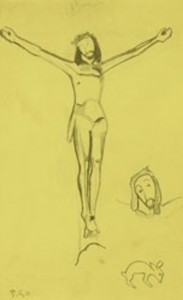 One of Tita's ten 'Gauguins (?)', which could become the subject of her forthcoming 'cleansing' operation (see ABC newspaper on 03.01.2010). 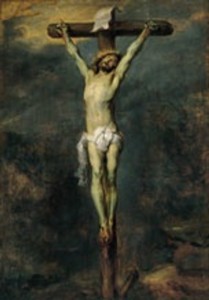 "'The Crucifixion', attributed to a painter from the circle of Sir Anthony van Dyck, which Heini purchased from Sotheby's at the 1995 sale of the Bentinck-Thyssen Collection for only £17,000 and immediately re-attributed to the Master himself" (from: 'The Thyssen Art Macabre' / 'La Historia Secreta de los Thyssen') |
Tags: ABC newspaper, Anthony van Dyck, Bentinck-Thyssen Collection, Carmen Cervera, Credit Crunch, Culture Ministry, Franz Hals, Gauguin, Juan Jose Junquera, Lugano, Malaga, Perez Sanchez, Prado, Sir Norman Rosenthal, Sotheby's, Spain, Taxpayer, Thyssen-Bornemisza Collection, Thyssen-Bornemisza Collection Foundation Board, Universidad Complutense, Villa Favorita
|