Thyssen Art
Tuesday, November 10th, 2009
| As the ravenous ThyssenArt Beast proceeded to eat its way through Malaga’s hot, sleepless nights, the Board of the Museo Carmen Thyssen-Bornemisza Foundation met for the very first time, presided over by ‘Our Precious Lady Carmen of The ChaChaCha’.
It seemed fitting for such a splendid occasion that it occurred in the town’s ‘Great Hall of Smoke and Mirrors’, which glittered proudly for ‘Carmen The Accumulator’s’ reunion with Vice-Presidente Francisco de la Torre (conservative mayor of Malaga), councillors Miguel Briones, Mariluz Reguero and Pedro Moreno Brenes, Tomas Llorens (former director of the Museo Thyssen Madrid), Guillermo Solana (current director of the Museo Thyssen Madrid) and one Teresa Sauret Guerrero. Only the identity of the other three members of the eleven-strong MCTBF board remained shrouded in deepest mystery.
Now, for some time, the unruly Izquierda Unida and their friends had been the lone ‘voice in the wilderness’, most un-‘preciously’ questioning the wisdom of spending tens of millions of Euros of taxpayers’ money on refurbishing crumbling provincial palaces to create more Thyssen Museums, bearing in mind that the Thyssens’ ‘precious’ immortality had already been subsidised in the country’s capital for twenty years to the tune of some 500 million Euros.
The main concern was the question of how many and exactly which of ‘The Baroness’s’ 1000 paintings – valued by The Great Art Expert herself at 800 million very ‘precious’ Euros – would eventually be housed in the new great institution. The only words crossing Her Magnificence’s own rose-scented lips was that they would all be ‘very nice’ and ‘very…..precious’, a view shared whole-heartily by the other defenders of The ThyssenArt Beast, all of them interested parties in their own ‘precious’ ways.
And so, as Mayor de la Torre opened the day’s proceedings, it looked like any remaining dissent could finally be quelled once and for all, when the solemn declaration was made that there would be not one but…..EIGHT (!) collections at the Carmen Thyssen-Bornemisza Museum in Malaga, and that these would comprise ‘romantic landscapes’, ‘naturalist landscapes’, ‘naval paintings’, ‘old masters’, ‘pictures from between the centuries from Tradition to The Renovation’, ‘portraits of Andalucia and Spain’, ‘costumbrism’, and, finally…..: ‘PRECIOUSCISM’!
Unwaware that this was just a word created during a game of scrabble between Guillermo Skywalker and Anikin Rosenthal, the common folk at once began to cheer uncontrollably. Men threw their hats in the air and women frantically fanned their flushed cheeks, while everyone whooped and hollered in manic delight: ‘It’s a miracle! My God, a miracle! What a great Baroness she is, Our Lady ChaChaCha. She is so beautiful and so good to us! We are so utterly greateful to her! Long may she live! Long may she live!‘.
Indescribable scenes of sheer, ‘precious’ ecstasy ensued, the crowd chanting ‘Pre-cious! Pre-cious! Pre-cious! Pre-cious!’ until their voices grew hoarse.
Finally, The ThyssenArt Beast’s old Jedi Master, Yoda Llorens, managed to regain control over the hysterial mob and delivered his coup de grace: the museum’s Mission Statement. Apparently it was ‘the intention of the museographic contents of the new art centre’….‘to mould a picture of Spanish society, and of that of Andalusia in particular, beginning with the romantic period and stretching through to the begining of the 20th century’.
Here the breath of the common folk was held for some time as they struggled to grasp the true meaning of the Jedi Master’s wise words. Stunned silence pervaded the air, until, out of the blue, one lone voice of dissent, Al Panpan, spoke out: ‘This picture of Andalusia which you are planning to ‘mould’, is a manipulative and unreal picture which was constructed from afar and represents the starting point of all the problems that came crushing down on us in the 20th century. I propose that Carmen Cervera inaugurate her new little museum wearing flamenco flounces and that the mayor joins her dressed up as The Joker’.
Security pounced at once, bundled up the obviously insane lone critic and quickly ushered him off to an uncertain future, but dark clouds began to gather, as great thunder rolled and lightening flashed, threatening to shatter the multitude of ‘precious’ mirrors. Suddenly, the form of ‘Borja, The Great Mighty Heir’ filled the doorway, lit by a single shaft of ghostly light. Terror descended. The people shivered with fear. Pausing, ‘The Great Mighty Heir’, with his inimitable stutter (a sure sign of true aristocratic breeding) began to read out passages from Hola Magazine, that most ‘precious’ of avant-garde gazettes: ‘G-g-gggg Gggigive me my Dddddog, my Dodododgy Ggggg-Goya. This is my uneq- eq- eqqqqq, un-eq, my un-eqqqqquiqui-, my uneqqqqui-vocal right!’, he finally roared in his booming voice.
It was later said that at this exact, precious moment in time, The King, who was not present but many hundreds of miles away, felt a sharp pain in his side and began to fear the worst for his magnificent, ‘precious’ friend, Tita Thyssen, and lo he was grieved!!
Sensing The King’s grief in reverse telepathy, the people started shouting: ‘Go home, Great Mighty Heir! Sling it! Get a job! And don’t you dare touch OUR precious paintings! They are OUR precious paintings, do you understand??!!’
And with a last whimpering roll of thunder he was gone.
The Great Impressionables had spoken. And so it was that The Great Accumulator’s ‘precious’ paintings were saved for the Spanish nation forever. Or as long as the Four Amigos can keep reaching deep into the wallets of the precious people of Spain. |
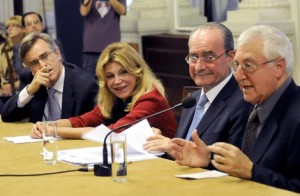 The Four Amigos: Guillermo 'Skywalker' Solana, 'Carmen The Accumulator', Francisco 'The Joker' de la Torre and Tomas 'Great Jedi Master Yoda' Llorens, addressing the people of Malaga on 21 October 2009 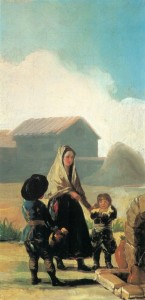 The Dodgy Goya. 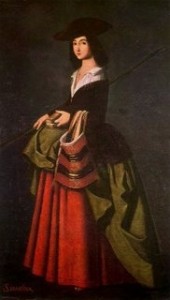 Another Dodgy Painting: Allegedly a 'Santa Marina' by Francisco de Zurbaran. Soon to be housed at the Carmen Thyssen-Bornemisza Museum in Malaga? 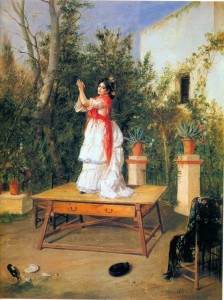 The Lady Dances (Manuel Cabral Aguado Bejarano, 1889) 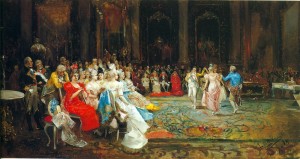 Dances At The Palace (Eugenio Lucas Villamil, 1894)
|
Tags: Carmen Cervera, Francisco de la Torre, Guillermo Solana, Hola Magazine, Izquierda Unida, Malaga, Mariluz Reguero, Miguel Briones, Museo Carmen Thyssen-Bornemisza, Pedro Moreno Briones, Preciosismo, Teresa Sauret Guerrero, The ThyssenArt Beast, Tita Thyssen, Tomas Llorens
Posted in The Thyssen Art Macabre, Thyssen Art Comments Off on Preciosismo: A Fairy Tale Of Modern Spain (by The Great Collaborator)
Wednesday, October 28th, 2009
| Dear Author of Tavarua – The Traveler Blogspot,
I feel compelled to comment on your post dated 21 October entitled ‘A Legendary Art Collector’, where you repeat several of the Thyssen mantras, including that the Thyssen-Bornemisza Collection was once housed at the family castle in Hungary. How far away from the truth you are can be seen from the evidence as described in our book. For instance, the foreword to the first exhibition of this collection, which took place in Munich in 1930, is extremely explicit and I will quote the most relevant passages from it to illustrate my comment to you:
‘…It was known to the inner circle of experts that during the last few years, shielded from the public, the basis for a new collection was created in Germany…..Even the owner and creator of the collection so far renounced the pleasure of seeing all of his treasures assembled in one place. Rather, he left them first of all under the seal of confidentiality in all those various locations where they had been acquired. This is why the Directorate of the Bavarian State Art Collections were so grateful and excited when, upon their suggestion, the collector Dr Heinrich Thyssen-Bornemisza decided to assemble the works, dispersed in Paris, The Hague, London, Berlin and other cities, temporarily in Munich and to entrust them to the ‘Neue Pinakothek’ for an exhibition…
…Here they are gathered for the first time to be appreciated by the public. One will note with amazement what has been possible in a surprisingly short period of time…I only wish to point out that it was possible to use the big movements on the art market, which the recent turmoils have brought with them, with circumspection and energy……
…Here they are: an exquisite male portrait by Michael Pacher and a female portrait by Albrecht Altdorfer, which we wholeheartedly commend as one of the high points of German art, as the perfect representation of German womanhood of that time in insurpassable truth and freedom…
…This new creation stands entirely alone in our German present……We believe that the national treasure can experience no greater enhancement and grounding than through the acquisition of great, noble works of art…
…The increasing impoverishment of our ‘Volk’ [the German people] and the financial crisis of our stately powers, which are becoming more dangerous every day, make us fear that the maintenance of cultural institutions will fall behind more and more…
…Dr Rudolf Heinemann-Fleischmann also carried out the laborious task of gathering all the works to be exhibited from their various locations….’ (Dr Fr Dörnhöffer, Munich, June 1930).
The sad truth about the Thyssen connection with Rechnitz (which has been Austrian, rather than Hungarian since 1921, before which it was known as Rohoncz) is that to this day the Thyssen family uses the name of the place to hide both the real provenance of their paintings and their own national provenance, which was firmly German, not Hungarian, Swiss, or anything else. This would not be quite as bad if, in March 1945, an appalling crime had not taken place in Rechnitz, which has tarnished the town’s image for ever.
The fact that, to this day, the Thyssens refuse to own up to their involvement in the Rechnitz Massacre of over 180 Jewish slave labourers to my mind makes their continued use of the town’s good name as a cloak for the early years of their collection especially distasteful. |
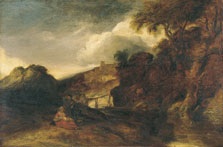 Jan Lievens, 'Rest on the Flight into Egypt' (ca. 1635): The first painting purchased for the Thyssen-Bornemisza Collection (Rohoncz Collection), in the year 1928. It never went anywhere near Rohoncz (Rechnitz) Castle and neither did any of the other 542 of Heinrich Thyssen's paintings. |
Tags: Albrecht Altdorfer, Dr Rudolf Heinemann-Fleischmann, Germany, Heinrich Thyssen-Bornemisza, Hungary, Jan Lievens, Michael Pacher, Neue Pinakothek, Rechnitz Castle, Rechnitz Massacre, Rest On The Flight To Egypt, Rohoncz Collection, Tavarua Blogspot, The ThyssenArt Beast, Thyssen-Bornemisza Collection
Posted in The Thyssen Art Macabre, Thyssen Art Comments Off on The ThyssenArt Beast (1928-2009): A Letter To Tavarua Blogspot (by Caroline Schmitz)
Sunday, October 25th, 2009
Book Review by Dr Erika Abcynski, Dormagen, Germany (translated by Caroline Schmitz):
‘David R L Litchfield has written a book about the Thyssen family from the founding of the Thyssen Concern to its collapse. Litchfield has assembled much interesting information about the Thyssens and thus about German capitalism per se.
As early as the founding of the first Thyssen works in 1870 August Thyssen combined greed, cleverness and sharp practice against his first business partner and brother-in-law as well as the elimination of competitors and the procurement of capital through marriage. Indeed, he concealed from his brother-in-law that he wanted to found his own rolling work in direct competition to him. The company Bechem & Keetman in Duisburg had to produce machinery exclusively for him. In the area surrounding Duisburg nobody but August Thyssen was able to buy machinery for a rolling work.
For the workers of the Thyssen works there was the rule of carrot and stick. “August’s expectations of his workers were very simple and straightforward. He expected them to abide by the ‘Reglement’, work very hard with the minimum of waste in time or materials, and produce as much as their engineer managers could get out of them…..The Meisters were expected to act as sub-contracting entrepreneurs rather than production or workshop supervisors of their respective departments”.
“The workers… remained entrapped by the Thyssens’ policy of supplying, and owning, all the worker’s needs ‘on-site’. The story, baths, canteens and lodging houses were all a man had time to need.” (quoted from David Litchfield, ‘Die Thyssen-Dynastie’). People were fired for minute transgressions. In 1928 the Thyssen-brothers Fritz and Heinrich locked out 225,000 workers for one month. Through the ownership of 67,000 workers’ lodgings, pressure could be exerted on the workforce and the government could be blackmailed through the threat of mass redundancies.
The Thyssen balance sheet for 1912 claimed the value of the Concern to be 562,153,182 Reichsmark. Before and during the First World War, there was strong collaboration between Thyssen and the Imperial government. One of August Thyssen’s friends was Hjalmar Schacht, later Hitler’s Economics Minister. Thyssens armaments production for German increased. By 1918, practically the whole enterprise produced for the war. The founding of firms in The Netherlands safeguarded Thyssen assets in case the war would be lost. Furthermore, tricks were used through the Thyssen-owned Bank voor Handel en Scheepvaart NV and assets safeguarded. Using the Hungarian citizenship of the Thyssen-son Heinrich Thyssen-Bornemisza, topped by a residency in the Netherlands, the Thyssen fortune was protected from allied confiscation, also after 1945. Heinrich Thyssen had married the daughter of the Hungarian Baron Bornemisza and had had himself adopted by his father-in-law in order to gain the title of Baron.
In 1923 there were the first contacts to Hitler. Fritz Thyssen knew about the plans for the putsch. He donated 100,000 Goldmarks for the National Socialist Party. He liked the fact that Hitler wanted to sort out the workers’ movement once and for all. At the beginning of the 1940s, Fritz Thyssen conceded that he had donated 62 million Reichsmark to the Nazi party over a 12 year period. Göring was one of his friends. In 1933 Fritz Thyssen joined the Nazi party, his wife had done so even earlier.
Tax evasion was an important business tool for the Thyssens. From 1919 to 1939 there were constant investigations by the financial authorities. In 1939 the Tax Directorate in Düsseldorf was able to prove that Fritz Thyssen had committed tax evasion and illegal foreign currency transactions, which Hitler had declared to be a capital offense. A fearful Fritz left for Switzerland on 1. September 1939, then moved to France. All his assets were placed by Göring under the trusteeship of Prussia and managed by joint friends and business partners of the two men. In other words, it was not his enmity against Hitler or any concerns about the mistreatment of Jews that led to Fritz Thyssen’s persecution, but the fact he was lining his own pockets. From the 1930s the Thyssens once again made money from armaments production, but also began simultaneously, just like August Thyssen during WWI, to safeguard their fortune, for instance in the USA and in South America. August Thyssen Hütte had nine POW-camps and seventeen camps for forced labourers. Heinrich Thyssen lived in Switzerland, led the affairs of his firms from there and continued to do business with the Nazis, but not publicly. From 1941 onwards he made his son Heini attend the meetings in Switzerland with the managers of his enterprises, which were also sometimes attended by Baron von Schröder of the Nazi bank Stein in Cologne, who was the trustee for Fritz’s confiscated industrial shares.
The most disgraceful story which members of the Thyssen family were involved in, is the murder of 200 Jews at Rechnitz Castle, where the eldest daughter of Heinrich Thyssen, Margit Batthyany, nee Thyssen-Bornemisza, lived with her husband, Count Batthyany, and high-ranking Nazis and SS-officers. During the night of 24 March 1945 the Ortsgruppen-leader Podezin, a Gestapo-official, left a party hosted by Count and Countess Batthyany with guests to shoot the Jews. The victims were 200 half-starved Jews who had been declared unfit for work. Local people said that Podezin had been in the habit of shooting Jews who were locked up in the castle cellars and that the Countess had enjoyed watching these events. After the war neither Margit nor other members of the Thyssen family wanted to know anything about this massacre and they were never prosecuted for it.
Litchfield has also assembled much information about the behaviour of the Americans and the British towards the Thyssens. For fear of the communists the Thyssens were handed back all of their fortune, works, shares and gold, despite their role in the Third Reich.
After 1945, Heinrich Thyssen transferred his role within the Thyssen Bornemisza Group to his son Heini Thyssen. But he did not much care for the Concern. Rather, he spent most of his time with sharing out his fortune. Other than that he had many relationships with glamorous, high society women and with the excesses of alcoholism. As a form of investment he bought many hundreds of paintings which were first exhibited and stored at his father’s villa in Switzerland. August Thyssen had started the art collection by buying works of Rodin, also as an investment. When Heini realised, that the maintenance of his collection was expensive, he searched for another way of handling it. Here he used all of his business acumen and various goods contacts, thus managing to sell about half of his art works to the Spanish state for 350 million dollars, payable free of tax, outside Spain, having first loaned the collection to the Spanish for 5 million dollars a year. The Spanish state met all costs for the use of the Thyssen pictures as a permanent public display.
The facts assembled in this review represent only a tiny fraction of the innumerable data painstakingly collected by Litchfield, which illustrate the greed and corruption of the Thyssens. The book is over 500 pages long and a thrilling read, the part about Heini Thyssen is somewhat too extensive.’
http://www.secarts.org/journal/index.php?show=article&id=948&PHPSESSID=ec1b0e599e946f1f299627d9346a7f4a
Tags: Adolf Hitler, Alcoholism, Armaments Production, August Thyssen, Auguste Rodin, Bank voor Handel en Scheepvaart, Bankhaus J. H. Stein, Duisburg, First World War, Forced Labour, Fritz Thyssen, Heini Thyssen, Heinrich Thyssen-Bornemisza, Hermann Göring, Kurt von Schröder, Margit Batthyany, National Socialist Party, Rechnitz Castle, Second World War, Thyssen Dynasty, Thyssen-Bornemisza Collection
Posted in The Thyssen Art Macabre, Thyssen Art, Thyssen Corporate, Thyssen Family Comments Off on ‘The Thyssen Dynasty – A Masterclass In The Unacceptable Face Of Capitalism’
Monday, October 5th, 2009
Tags: Bronzino, Thyssen-Bornemisza
Posted in The Thyssen Art Macabre, Thyssen Art Comments Off on Thyssen-Bornemisza Condom Poem
Wednesday, September 2nd, 2009
| “Readers of my book should be all too aware of my questioning of the authenticity of many of the Thyssen-Bornemisza Collection’s claimed master pieces, but only now, finally, has a major art historian supported my claim by insisting that the ‘Dürer’ ‘Jesus Among the Scribes’ in the Madrid Museo Thyssen is a fake”.
http://www.nnonline.de/artikel.aspart=1079333&kat=48&man=3
Translation by Caroline Schmitz of the article by Birgit Ruf in the Nürnberger Nachrichten of 02.09.2009.
”Dürer would have been ashamed of this work”
Nürnberg art historian raises doubts concerning the authenticity of a Dürer painting
Thomas Schauerte, the new head of the Nürnberg Albrecht-Dürer-House and an expert on the work of the famous artist has dared to proclaim an explosive theory. He is convinced that the painting ‘Christ Among the Scribes’, a main attraction in the Thyssen-Bornemisza Museum in Madrid, is not by Albrecht Dürer’s hand.
Thomas Schauerte had his first doubts concerning the authenticity of the painting – which was allegedly painted by Dürer in 1506 on poplar wood – in 2003 when he visited the big Dürer retrospective at the Albertina in Vienna. As a long-standing researcher on Dürer, who wrote his dissertation on the artist and participated in the publication of the full catalogue of his prints, Schauerte viewed the Albertina exhibition through the eyes of an expert. There, for the first time in many years, the famous painting was shown together with five existing drawings, showing details of the overall composition. It is a representation of the 12-year-old Christ in discussion with the scribes inside the Temple.
Crass decline in quality
“When one compares the Dürer drawings directly with the painting, one can see a crass decline in quality”, says Schauerte. Compared to the brilliant drawings the painting, he says, is “simply bad”. Clear words, which the art historian backs up by demonstrating various inconsistencies. “The head of Christ was originally planned in much too small a size”, he says and, using a reproduction of the painting, points towards a “shadowy area” where the head was subsequently “increased in size” through the addition of more hair.
And in Schauerte’s opinion another mistake, namely on the scribe positioned on the very left, would “never have been made” by the great master: the noble elder is possibly 70 or 80 years old, but he has the hands of a young man – no wrinkles, no age spots, no veins can be seen. “But Dürer above all people required in his teachings that a figure has to be harmonious and that the details must all fit together”, says Schauerte.
A mix of references
Apart from these details, he has some things to criticise concerning the overall composition as well. He says that the heads have simply been cut off at the upper edge of the painting, that the people in the work do not get into any kind of relationship with each other through visual contact and that no coherent image space is being created. Based on all these observations, Schauerte concludes: The painting is a product in the style of Dürer from the early 17th century, a pastiche, a mix of references. At the time there was a veritable Dürer-boom, so that everything that came from the master sold mit reißerischem Absatz. Therefore, those were also good times for Dürer-copyists and falsifiers.
If you listen to the 42-year old, you wonder very quickly why nobody else before him noticed the inconsistencies. As Thomas Eser, head of the Dürer-Research-Centre at the Germanisches Nationalmuseum, confirms, no other scientist has ever raised doubts as to the authenticity of the Madrid painting, which surfaced for the first time in 1642 in a private collection in Rome and was sold to the Thyssen Collection in 1934. “The painting is not documented anywhere before 1642. That is unusual for Dürer”, states Schauerte, who recently moved from Trier University to the Dürer House in Nürnberg. When the painting was sold around 1930, “the critical awareness was not yet so much in existence”. And that people in Madrid “are not very keen to open this box” is something one can comprehend.
Only in private collections
Eser explains: “Since the painting was known, there was a consensus amongst Dürer researchers that it is a Dürer. But as it only used to hang in private collections and not in world museums, it “hasn’t been critically examined often enough until now”. Eser welcomes the fact that his research-colleague Schauerte has now done so: “He adds to the knowledge by suggesting alternative viewpoints”. Schauerte’s “heretical theory”, which he has worked six years to back up, will now be published in time for the Book Fair in the series “Dürer-Research” by GNM-Verlag (German National Museum Publishers).
“The painting has no coherent spatial-narrative composition, but is, rather, a juxtaposition of Dürer-heads at close quarter”, Eser agrees with Schauerte’s observations. The latter asserts in his essay that almost all the heads of the scribes in this painting have models in other works by Dürer, but that most of them appear after the year 1506, which is the year inscribed on the tableau, next to the AD-monogram.
Like a medley
Eser draws a very graphic comparison: “If it were a pop song, one would say it is a medley. There are many Dürer themes placed in it, but only a few bars of each of them”. Eser thinks that Dürer himself would have made higher demands as to the “coherence of the description of space.” Schauerte expresses it even more drastically and insolently: “Dürer would have been ashamed of this work”.
Speaking of ashamed: That’s what the Thyssen Collection might prove to be if Schauerte is right. He has not yet spoken to the people in charge in Madrid about his “radical theory”. The Nürnberg researcher knows: “If I’m right, it would be a catastrophe for the collection”. The painting would then only be worth a fraction of its original worth. But Schauerte has also been in this business long enough to know: “It’s a very long process for new research results to become acknowledged”.
http://www.nz-online.de/artikel.asp?art=1080338&kat=49 |
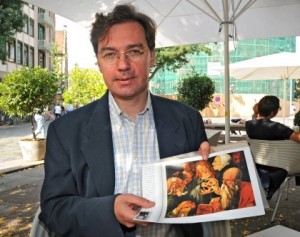 Art historian Thomas Schauerte, Director of the Albrecht Dürer Haus in Nürnberg (photo: Karlheinz Daut, Nürnberger Nachrichten) 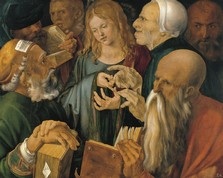 'Jesus Among the Scribes', attributed by the Thyssen-Bornemisza Museum in Madrid to Albrecht Dürer, but claimed by Thomas Schauerte to be the work of an early 17th century copyist. |
Tags: Albertina Wien, Albrecht Dürer, Albrecht Dürer Haus, Dürer-Forschungsstelle, Germanisches Nationalmuseum, Jesus Among the Doctors, Jesus unter den Schriftgelehrten, Museo Thyssen, Museum Thyssen-Bornemisza, Nürnberg, Nürnberger Nachrichten, Thomas Eser, Thomas Schauerte, Thyssen-Bornemisza Collection
Posted in The Thyssen Art Macabre, Thyssen Art Comments Off on Thyssen-Bornemisza Dürer A Fake
Tuesday, July 14th, 2009
| I recently came across an article about August Thyssen in the summer series on famous scions of the Lower Rhine region, published by the Rheinische Post newspaper, under the promising headline ‘A Globaliser From The Start’. But it contained the sentence ‘After the World War, August Thyssen lost his foreign participations’. As somebody who has studied the Thyssens for some fourteen years now, it was the kind of throw-away remark that sharply reminded me once again of the systematic manipulation of history that has accompanied this dynasty’s personal and corporate affairs for a very long time.
If you wish to get a very basic idea of what I’m talking about, go to German Wikipedia and check out the entries for Alfred Krupp, Hugo Stinnes, Friedrich Flick and August Thyssen; all four legendary German industrialists of similar status and place in history. Krupp warrants 5 illustrated pages, Stinnes 11, Flick 10, but Thyssen barely manages to make three quarters of a page! Why should this be so? The chief publicist and archivist of ThyssenKrupp, Professor Manfred Rasch, is more than capable of producing lengthy features on the founder of the Thyssen empire at opportune moments in local publications, such as Westdeutsche Allgemeine Zeitung, which are hugely sympathetic to the image of a company that still remains one of the major employers in the Ruhr area, as well as far beyond. So why does he not ensure that extensive and accurate information is available on a more general level?
The answer is: because there are many black holes in this dynasty’s history which would be too difficult to broach. Instead, gloss-overs and simplifications have been produced over the years by the official guardians of the Thyssen legacy and reproduced by unwitting journalists and historians. But even the most consistently spin-doctored histories are eventually bound to come unravelled. This is particularly true in times of bust such as today, when money becomes scarce and people re-examine their loyalties; as long, of course, as they can enjoy the freedom of democracy rather than being forced into the shackles of authoritarian rule so admired by the likes of Ecclestone, Mosley & Co.
One reason why the Thyssens have always purported to have ‘lost everything’ in the war (for the family members tend to ‘go the extra mile’, insisting all was lost, not just the foreign assets) is to excuse their involvement in arming the German Empires of Kaiser Wilhelm II and Adolf Hitler respectively. If it were shown that they actually profited from those regimes, the Thyssens would receive far less sympathy and respect than they do when portrayed as the sacrificial victims of the conflicts, who had to rebuild their fortunes each time from scratch by the sweat of their own brows. The latter being very much the picture painted on the new website of the Thyssen-Bornemisza Museum.
In actual fact, while other industrialists were punished for their support of the Reich, the Thyssens were not. They were even compensated for their losses. After World War I, this included their Lorraine ore mines and steel works, which the French insisted they give up. Heini Thyssen himself admitted to David and myself that far from his family losing, for instance, his grand-father’s Brazilian interests after 1918, he was able to liquidate some of them in the 1970s at vast profit. Despite such good fortune, ‘foreign assets’ have always been a particularly contentious issue in the Thyssen historiography, not least because this most quintessential of German dynasties, whose name still remains one of those inextricably linked with the fatherland’s deepest sense of national prosperity, honour and pride, has continuously reaped the benefits of German industry, while simultaneously refusing to admit allegiance to the country.
While the destruction of August Thyssen’s personal files after his death in 1926 ensured the public could never realise that this supposed German patriot had in fact moved his ultimate ownership structures abroad before 1914, a more overt public relations exercise was necessary after 1945 when the magnitude of the Nazis’ criminal activity came to light. That is why official communiques began to over-engineer Heinrich Thyssen’s cosmopolitan credentials, giving assurances that he ‘had distanced himself from Germany as a young man’, that he ‘became a Hungarian in 1906’, that he ‘gained a doctorate in philosophy in London’ and that he ‘settled in Switzerland in 1932’. On closer inspection even of the official sites, however, inconsistencies soon start to appear for all of these claims.
As far as Heinrich’s nationality is concerned, ThyssenKrupp AG has for some time now resorted to the line: ‘He kept his Hungarian citizenship until he died, but nevertheless acted ‘deutsch-nationally’ at times in the 1920s and 1930s. For this vague statement to be allowed to paraphrase the activities of such an important (if shielded) figure of 20th century history is quite simply astonishing. And of course it can in no way explain how German works owned by Heinrich Thyssen were still able to claim war damages from the allied government for Germany in 1946 on the basis of Heinrich being ‘a German abroad’. The fact is: Heinrich Thyssen lived in Lugano from 1938 (not 1932! – more of this later) until his death in 1947, controlling his German interests with the help of visiting managers and this makes him somebody who acted ‘deutsch-nationally’ (if this is what you want to call it), throughout Hitler’s time in power and beyond.
Turning to Heinrich’s academic title: the assertion of a doctorate in philosophy gained in London is pure fabrication. That is why it does not appear on the German websites, where it is clear and very acceptable to people that the doctorate was gained in Germany in the field of natural sciences. It is, on the other hand, very much emphasised in Spain, where the government’s expenditure of in excess of $600 million dollars on the Thyssen-Bornemisza art collection seems to make it imperative to stress the founder’s alleged cultural and specifically non-German credentials.
Here on www.museothyssen.org, we also find echoes of Francesca Habsburg‘s recent attempts to designate August Thyssen as the true founder of the Thyssen-Bornemisza Collection (even to the extent where a recent museum web-incarnation called him ‘August Thyssen-Bornemisza’!), thereby rebranding the whole dynasty as the art collectors she would like them to be (making her fourth in a row) rather than the industrialists and bankers that they really were. But the official website of the Thyssen-Bornemisza Museum also makes another announcement: ‘We know the collection was installed at Rohoncz Castle before Heinrich abandoned Hungary in 1919’. This is particularly worrying as the comprehensive catalogue of the museum squarely confirms the documentation in the Thyssen Archives showing that the first purchase made for the collection was in 1928 (unless that too has now been re-written!)
The smoke and mirrors at Museo Thyssen continue: ‘It is through the correspondence between August Thyssen and Auguste Rodin, namely in a letter from 1911, that we can see that August’s son Heinrich had by that time started his collection’. We have researched the same letters during the writing of our book but never came across anything that would confirm this. The official line basically intimates that with his transformation into a ‘Hungarian aristocrat’ in 1905 (the real dated being 1906-07), Heinrich Thyssen had also, somehow, acquired an art collection.
What seems clear to me is that people in charge of that museum are finally realising that they have a particularly grave problem on their hands. However, not knowing what to do about it, their inability to address serious issues breeds insecurity and confusion. That’s why another sentence has been added to the website: ‘We have few details about the first years of the collection’. While I guess it would be unfairly over-stressing the point if one reminded the Spanish tax payer once again, how much money he contributed and is still paying to the Thyssen Museum, the indelible facts concerning the early history of the collection are these: the Thyssen Collection was never at Rohoncz (Rechnitz). It was only named ‘Rohoncz Collection’ by Heinrich Thyssen with the specific aim of making it sound like an Austro-Hungarian heirloom. Unbelievably, the public as well as the media have bought this fiction decade after decade.
The staff of Frankfurter Allgemeine Zeitung got equally confused in October 2007, when they ran David’s piece on Heinrich Thyssen’s daughter, Margit Batthyany, and her involvement in the murder of 180 Hungarian Jews at Rechnitz Castle in March 1945, which had been published two weeks earlier in The Independent. None of the many continental journalists and historians who subsequently busied themselves in denigrating our work, such as Anja Seeliger of Perlentaucher fame for instance, actually figured out that the reason why the two features were markedly different was not only because of overt censorship in Germany, but also because staff at FAZ saw fit to fact-check the article – the fruit of 14 years of research – against the grossly inaccurate (ThyssenKrupp AG / Museo Thyssen / Thyssen Family) Gospel According to Wikipedia, the same Wikipedia that has rejected our corrective suggestions outright.
Back at Frankfurter Allgemeine: out came 1938 as Heinrich’s settlement date in Switzerland, in went 1932 (to ensure that Heinrich’s presence in Germany after Hitler’s ascension to power could be denied). Out went the proviso that the collection was never at Rohoncz, in went the age-old phrase that it was housed there. Out came our statement that the Thyssens acquired the Erlenhof stud farm from the liquidators of the persecuted Jew, Moritz James Oppenheimer, in 1933. In went the fabrication that Heinrich Thyssen’s business empire was completely separate from August or Fritz Thyssen’s empire. While we are grateful to FAZ for publishing the feature, this type of inaccurate ‘editing’ of copy in a newspaper of such quality should be of concern to everyone.
And even today, two years after the publication of our book, the Spanish museum continues to insist that ‘Heinrich Thyssen’s enterprises were completely separate from the German steel industry’, when even ThyssenKrupp’s website has been admitting for a while now that Heinrich owned the Press- and Rolling Works Reisholz and the Oberbilker Steelworks, both plants that produced canon for Adolf.
Spain is also still holding on to the idea that Heinrich was ensconced in Switzerland from 1932 onwards, where he ‘opened the doors of his gallery to the public in 1936’. Apart from family archival evidence, Heinrich’s own war-time curator, butler and companion, Sandor Berkes, assured us that the gallery building remained unfinished until 1940 and was only opened to the public in 1948. As can be seen from the picture above, far from being locked away in his Swiss villa, in 1936 Heinrich was, amongst other things, happily socialising at the German Derby with his personal friend Hermann Göring, whom he also assisted with personal and Reich banking facilities.
With a background of such systematic disinformation, it does not come as a surprise that the personal assertions by Thyssen family members are also becoming more and more ‘retrograde’. Francesca Thyssen is quoted as explaining to the Austrian ‘News’ Magazine in November 2008 (available in hard copy version only, not online!): ‘Of course my great-uncle (Fritz) was truly deeply enmeshed in Nazi-crimes, that’s no secret. That’s why my grandfather (Heinrich) took the name Bornemisza from his wife, because he left this whole family. Because he wanted to be different and wanted to leave this family’. Or, in other words: Heinrich Thyssen foresaw the coming of the Third Reich by 27 years!…
I can understand that the various guardians of the Thyssen legacy would feel the need to rewrite the unacceptable history of this family. But I do not appreciate the fact that journalists, historians and those who should know better continue to encourage the belief in facts which they know to be untrue or should admit to be so since the publication of our book. As far as the Spanish public in particular is concerned, which is at this very moment being told by Guillermo Solana, the director of the Thyssen-Bornemisza Museum, that new gallery space is urgently needed in Malaga and Sant Feliu de Guixols because the Madrid museum is ‘running out of space’, I feel the time has come to tell him that before any more tax funds are poured into Thyssen projects, the Thyssens might be more truthful about their past and that of the collection, while the Spanish government must admit how much they have and are paying the Thyssens for the display and storage of their paintings. |
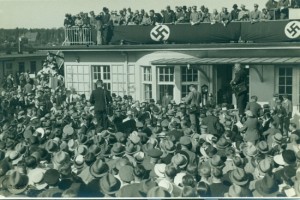 Celebrating the victory of stud farm Erlenhof's 'Nereide' at the 1936 German Derby. In the centre of the picture are (to the right) the winning horse's owner, Heinrich Thyssen (in grey top hat) and (to the left) his friend and associate Hermann Göring (in white suit) (photo: Tachyphot Berlin, copyright: David R L Litchfield) |
Tags: Anja Seeliger, August Thyssen, Francesca Habsburg, Guillermo Solana, Heinrich Thyssen, Manfred Rasch, Margit Batthyany, Oberbilker Steelworks, Press- and Rolling Works Reisholz, Rechnitz Castle, Rohoncz Collection, Thyssen-Bornemisza Museum, ThyssenKrupp
Posted in The Thyssen Art Macabre, Thyssen Art, Thyssen Corporate, Thyssen Family Comments Off on Thyssen Truth Must Come Out Before More Tax Money Goes In (by Caroline Schmitz)
Tuesday, June 23rd, 2009
| It is a well-known fact that within the money-obsessed art market, exposing fakes is rarely going to make you friends and certainly little in the way of a profit, which is the main reason why my questioning of many of the paintings in the Thyssen-Bornemisza Museum has been met with such deafening silence; particularly in Spain.
It was thus somewhat reassuring when Brian Sewell, the Evening Standard’s legendary art critic, recently took it upon himself to not only expose a painting from the Thyssen-Bornemisza Collection claimed to be by Edward Wadsworth as a fake, and question Tate Modern for including it in their ‘Futurism’ exhibition (until 20 September), but also to reveal the reason for such dishonesty.
http://www.thisislondon.co.uk/arts/artexhibition-20656913-details/Futurism/artexhibitionReview.do?reviewId=23709460
Unfortunately, he didn’t question Norman Rosenthal, veteran Exhibitions Secretary at London’s Royal Academy of Arts and now ‘freelance curator to international museums and galleries’, who has been a member of the Thyssen-Bornemisza Collection Foundation in Madrid for some 8 years. How could Rosenthal let ‘Wadsworth’s’ ‘Vorticist Abstraction 1915’ be included in the Tate Modern exhibition? Was it done because its inclusion might ‘give (the painting) respectability’, as Brian Sewell suggests?
It seems clear that Rosenthal is a man who may be sailing dangerously close to acting as both poacher and game-keeper. Indeed, he raised more than a few eyebrows with an article in The Art Newspaper of December 2008, where he advocated the introduction of a statute of limitations on the restitution of Nazi-looted art.
http://www.theartnewspaper.com/articles/The-time-has-come-for-a-statute-of-limitations/16627
My letter to the editor of The Art Newspaper has remained unpublished; until now:
‘8 December 2008
Dear Sir,
Sir Norman’s article concerning Nazi-looted art in your latest issue is fascinating more for what he doesn’t say than for what he does. Surely, the fact that he is a trustee of the Thyssen-Bornemisza Museum must present him with a conflict of interest; particularly now that the full extent of the Thyssen-Bornemiszas’ involvement with Göring and the Third Reich has been revealed, and a number of paintings in the Thyssen-Bornemisza Collection are believed to qualify as Nazi-looted art.
This is a fact that cannot have escaped Norman’s attention, particularly in the case of the Thyssen-Bornemisza Museum’s Pissarro painting ‘Rue St Honore, Afternoon, Effect of Rain’, which is the subject of a legal action for retrieval by the Cassirer family.
Under the circumstances, Sir Norman’s call for a statute of limitations could unfortunately be seen to be motivated more by his professional interests than his moral judgement’.
http://www.lootedartrecovery.com/looted-art/looted-objects/pending.htm
|
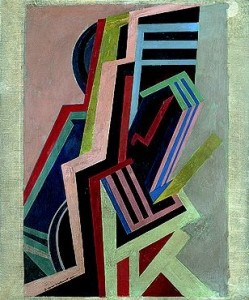 Another Fake Thyssen-Bornemisza (nee Wadsworth) ? |
Tags: Art Restitution, Brian Sewell, Camille Pissarro, Cassirer, Edward Wadsworth, Norman Rosenthal, Tate Modern, Thyssen-Bornemisza Collection Foundation, Thyssen-Bornemisza Museum
Posted in The Thyssen Art Macabre, Thyssen Art Comments Off on Brian Sewell Exposes Thyssen Fake But Not Norman Rosenthal
Tuesday, May 26th, 2009
| The fulfilment of the ambition of Heini Thyssen’s widow, Carmen Cervera, to see her own name in lights on a public museum – rumoured locations for which have so far included Madrid, Seville, Sant Feliu de Guixols and Malaga – continues to hang in the balance, as it has done, now, for some five years.
First political concerns about the plans for a Carmen Thyssen Bornemisza Museum in Malaga were raised in May 2008, when the professor of law at Malaga University and spokesperson for the United Left Party, Pedro Moreno Brenes, urged the local government to stop developing the new museum (for which € 25 million had already been budgeted) until a fully committed contract had been signed.
Then, on 31 March 2009, much was made of Carmen Thyssen and Malaga’s mayor, Francisco de la Torre, signing the papers to set up the foundation which is to manage the museum. Pictures were taken of ‘Tita’ laying the foundation stone.
While de la Torre had apparently been given three catalogues by the ‘Baroness’ from which 200 pictures would be chosen for the museum (on loan for 15 years), and it was claimed they were all “very attractive and interesting”, the opposition has so far failed in their attempts to gain access to an exact and definite list of the proposed works to be exhibited. Names of artists bandied about have included “Zurbaran, Zuloaga and Sorolla”.
On 19 April 2009, Moreno Brenes’s party presented a motion to the town council, critising the “notable legal insecurity” in the ongoing Thyssen negotiations, while adding that the budgeted costs for the Carmen Thyssen Bornemisza Museum of Malaga (to be opened at the end of 2010) had by now increased to € 38 million.
Today comes news that the main opposition party, the PSOE, which forms the national government of Spain, has joined the ranks of the critics of this project. Their spokesperson for the Malaga town government, Rafael Fuentes, has told Europa Press that Mayor de la Torre has “sacrificed the needs of ordinary citizens of Malaga in favour of pet projects of Barons and Earls” and that there is a marked “lack of transparency” in the Thyssen and other projects.
http://www.europapress.es/andalucia/noticia-psoe-critica-pp-ciudad-parada-no-haya-arrimado-hombro-lucha-contra-crisis-20090525152909.html
http://www.europapress.es/autonomias-00175/noticia-iu-insta-pp-conocer-obras-museo-thyssen-garantice-calidad-mismas-20090419112014.html
http://www.laopiniondemalaga.es/secciones/noticia.jsp?pRef=2008052100_2_181054__Malaga-pide-gastar-dinero-Thyssen-hasta-firmar-contrato |
|
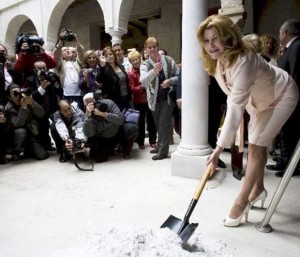 Tita Thyssen-Bornemisza cementing her future in Malaga (courtesy of Hola Magazine, 31 March 2009) |
Tags: Carmen Cervera, Carmen Thyssen Bornemisza Museum, Francisco de la Torre, Heini Thyssen, Hola Magazine, Malaga, Pedro Moreno Brenes, Rafael Fuentes, Sant Feliu de Guixols, Tita Thyssen
Posted in The Thyssen Art Macabre, Thyssen Art Comments Off on Tita Thyssen’s Proposed Malaga Gallery Questioned
|